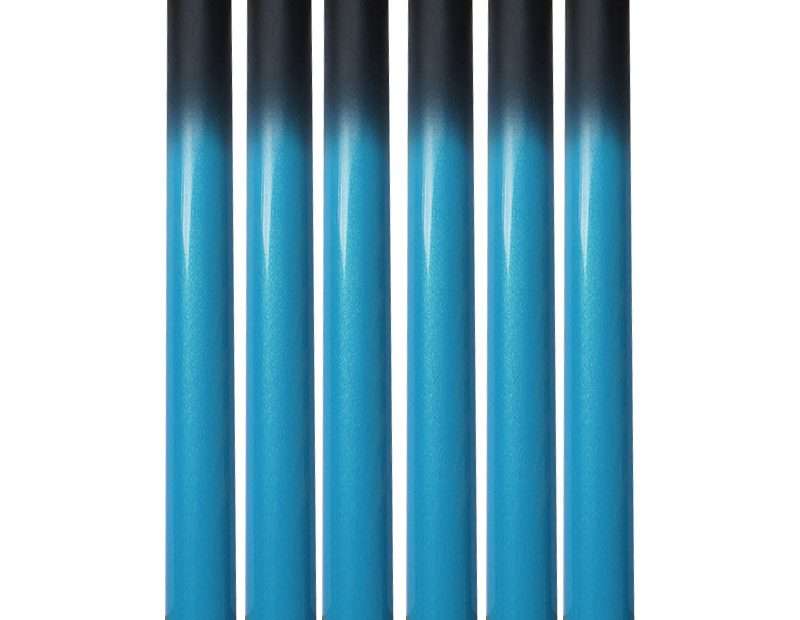
In composite tube manufacturing, the mandrel is the invisible foundation of every part produced. A roll-wrapping mandrel determines not just the internal diameter of the finished tube, but also its concentricity, surface finish, and — critically — whether the part can be extracted without damage. For manufacturers producing carbon fiber and fiberglass tubes at scale, roll wrapping mandrel design represents the single highest-leverage engineering decision: get it right, and production runs smoothly; get it wrong, and every tube becomes a struggle.
This design guide covers mandrel material selection, precision tolerances, surface engineering, extraction mechanics, and lifecycle economics for composite tube tooling.
Mandrel Material Selection: Steel vs Aluminum
The choice between steel and aluminum for roll-wrapping mandrels involves balancing precision, durability, weight, and cost. Chrome-plated steel mandrels — typically 1045 or 4140 alloy — offer the highest surface hardness (HRC 55–62 after chrome plating), excellent wear resistance, and the dimensional stability needed for tight-tolerance tubes. Steel mandrels dominate high-volume production where a single mandrel may produce 10,000+ tubes over its service life.
Aluminum mandrels (6061-T6 or 7075-T6) weigh roughly one-third of equivalent steel mandrels, reducing operator fatigue in manual rolling operations. They machine faster and cost 40–60% less than steel mandrels. However, aluminum’s softer surface (HRB 60–95) wears more quickly — typical service life is 2,000–5,000 tubes versus 10,000+ for chrome-plated steel. For prototyping, low-volume production, and large-diameter mandrels where weight matters more than wear resistance, aluminum is the economical choice.
Diameter Tolerance and Roundness Requirements
The mandrel’s outer diameter directly determines the tube’s inner diameter, making precision the primary design requirement. For standard industrial tubes, a diameter tolerance of ±0.05 mm (0.002″) is sufficient. For high-precision applications — telescoping poles, optical equipment tubes, aerospace structural members — tighten to ±0.025 mm (0.001″) or better. These tolerances must be verified at multiple points along the mandrel length, as diameter variation of even 0.1 mm over 1 meter can cause extraction binding.
Roundness (circularity) should be held to within 50% of the diameter tolerance. A mandrel that is oval by 0.05 mm will produce a tube with internal stress concentrations at the minor axis, potentially causing the tube to split during curing or go out-of-round under load. Centerless grinding followed by precision polishing is the standard finishing process for achieving consistent roundness across the mandrel length.
Surface Finish: The Extraction Enabler
Mandrel surface finish serves two competing requirements: it must be smooth enough for clean extraction, yet provide sufficient friction for the prepreg or wet fabric to grip during rolling. The industry standard is a surface roughness (Ra) of 0.2–0.4 μm — roughly equivalent to a #8 mirror finish on the smoother end, or a fine-ground finish on the rougher end.
Chrome plating enhances extraction: hard chrome’s naturally low coefficient of friction (0.15–0.20 against cured epoxy) significantly reduces extraction force compared to bare steel. For difficult extractions — long tubes with length-to-diameter ratios exceeding 50:1 — a PTFE-impregnated hard coat or mold release coating can reduce extraction force by an additional 30–50%. The mandrel surface should be inspected for scratches, pits, or plating delamination before each production run; any surface defect will imprint directly onto every tube produced.
A precision-ground chrome-plated mandrel held to ±0.025 mm diameter tolerance with 0.2 μm Ra surface finish is the foundation of high-yield composite tube production — the mandrel quality directly determines tube quality, and no amount of operator skill can compensate for a worn or out-of-tolerance mandrel.
Taper and Extraction Mechanics
Straight-wall mandrels are the simplest to manufacture but the most difficult to extract from long tubes. The extraction force grows exponentially with tube length as the cured composite grips the mandrel through both adhesive bonding and cured resin shrinkage (epoxy shrinks 1–3% volumetrically during cure, creating a compressive grip on the mandrel).
Tapered mandrels — typically with a 0.5–1.0 mm diameter reduction per meter of length — dramatically reduce extraction force by creating clearance as soon as axial movement begins. The trade-off is a non-uniform tube ID, which may or may not be acceptable depending on the application. For tubes requiring uniform ID, a collapsible or segmented mandrel design allows the mandrel core to be withdrawn first, letting the outer segments collapse inward for extraction. These designs cost 3–5× more than solid mandrels but are essential for long, small-diameter, or tightly toleranced tubes.
Mandrel Length and Deflection Limits
Mandrel length is limited by deflection under its own weight and rolling pressure. For a horizontally supported steel mandrel, deflection at the center follows beam bending equations: a 25 mm diameter steel mandrel, 2 meters long, supported at both ends, deflects approximately 0.3–0.5 mm under its own weight — potentially enough to cause wall-thickness variation in the finished tube.
For mandrels longer than 1.5 meters, consider increasing diameter, using intermediate supports during rolling, or switching to a vertical rolling configuration that eliminates gravity-induced sag. The practical limit for horizontal roll-wrapping with a solid mandrel is approximately 6 meters for diameters above 50 mm, and 3 meters for diameters below 25 mm. Beyond these limits, specialized support fixturing or segmented mandrel designs become necessary.
{gallery}
Cost Optimization and Lifecycle Management
A well-designed roll-wrapping mandrel from an ISO 9001 certified toolmaker represents a capital investment of $500–$5,000 depending on diameter, length, material, and precision grade. Viewed across a production lifecycle, this investment is modest: a $2,000 chrome-plated steel mandrel producing 10,000 tubes costs $0.20 per tube in tooling amortization — less than the cost of the resin used in a single tube.
Mandrel maintenance extends service life significantly. After every 500–1,000 cycles, inspect for diameter wear, surface roughness changes, and chrome plating integrity. Re-polishing can restore surface finish at minimal cost. Re-chroming (approximately $100–300 for a typical mandrel) effectively resets the mandrel to new condition. A well-maintained steel mandrel can remain in service for 5–10 years in moderate production volumes.
What is a roll wrapping mandrel?
A roll wrapping mandrel is a precision-ground cylindrical tool used as the forming surface for manufacturing composite tubes via the roll-wrapping process. Prepreg or resin-wetted fabric is wrapped around the mandrel, which sets the tube’s internal diameter. After curing, the mandrel is extracted, leaving the finished composite tube. Mandrel design — material, surface finish, tolerances, and taper — directly determines tube quality and production yield.
Which mandrel material is better: steel or aluminum?
Chrome-plated steel mandrels are better for high-volume production (10,000+ cycles), offering superior wear resistance, dimensional stability, and surface hardness. Aluminum mandrels are better for prototyping and low volumes (2,000–5,000 cycles), offering lower cost (40–60% less), lighter weight (one-third of steel), and faster machining lead times. For production volumes above 5,000 tubes annually, steel’s longer service life usually provides lower total cost per tube.
How tight should mandrel tolerances be?
Standard industrial tubes require mandrel diameter tolerance of ±0.05 mm (0.002″). High-precision applications (aerospace, optical, telescoping assemblies) require ±0.025 mm (0.001″) or tighter. Roundness should be within 50% of the diameter tolerance specification, achieved through centerless grinding and precision polishing.
How do you reduce mandrel extraction force?
Extraction force can be reduced through four approaches: (1) chrome plating the mandrel surface to lower the coefficient of friction, (2) applying PTFE-based mold release coatings, (3) designing a slight taper (0.5–1.0 mm/m) into the mandrel, and (4) for long or small-diameter mandrels, using a collapsible or segmented design. For tubes with length-to-diameter ratios above 50:1, a mechanical extraction fixture with controlled axial pull is recommended.
| Property | Steel Mandrel | Aluminum Mandrel | FRP Mandrel | Soluble Mandrel |
|---|---|---|---|---|
| Surface Finish (Ra) | 0.4-0.8 um | 0.2-0.6 um | 0.8-1.6 um | 0.4-1.0 um |
| CTE (10^-6/K) | 11-13 | 23-24 | 6-10 | Varies |
| Reusability | Thousands | Hundreds | Dozens | Single use |
| Cost (relative) | High | Medium | Low | Low (per unit) |
| Extraction Method | Hydraulic puller | Thermal/cooling | Destroy mandrel | Water/solvent wash |
| Taper Requirement | 0.5-1.0 mm/m | 1.0-2.0 mm/m | None (destroy) | None (dissolve) |