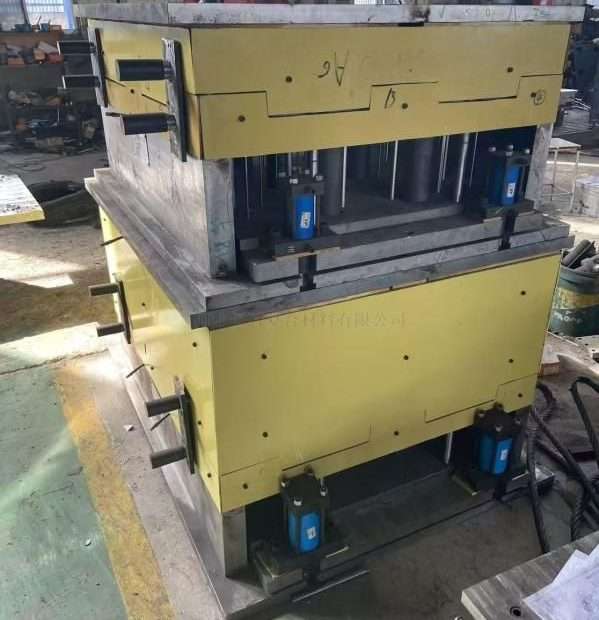
I asked six mold shop owners the same question: “What coating do you put on your SMC molds?” Two said chrome. Two said electroless nickel. One said nothing — just polish the P20 and run it. The sixth guy laughed and said “all of them, depending.” He’s the one who’s been in business the longest.
Twenty years of SMC mold maintenance records across a dozen shops show a pattern: no single coating wins everywhere. The right answer changes with production volume, resin type, and whether you’re molding A-surface parts or structural brackets nobody sees. Here’s what actually works, backed by mold shop data.
Tip 1: Chrome Plating Is Still the Workhorse — But Not for the Reason You Think
Hard chrome (industrial chromium, 0.025-0.05mm thick, 68-72 HRC) has been the default SMC mold coating since the 1980s. Most toolmakers spec it without asking why anymore.
The surface hardness is nice but it’s not why chrome works. Chrome’s real advantage for SMC molds is its surface energy: 36-38 mN/m, low enough that cured SMC resin releases cleanly without sticking but not so low that external mold release sprays bead up and run off. Internal mold release (IMR) additives in the SMC compound — typically zinc stearate — bloom to the surface during molding and maintain a release film on chrome. The combination of IMR plus chrome’s surface chemistry is what gives 30,000-50,000 cycles between re-polishing.
Where chrome fails: sharp corners under 2mm radius. Chrome builds thicker on edges during electroplating — the “dogbone effect.” A 0.05mm chrome spec on a flat surface becomes 0.08-0.10mm on a 1mm corner radius, creating a brittle ridge that chips within the first 2,000 cycles. The fix: back-grind corners after plating, or switch to a line-of-sight PVD process for detailed cavity features.
Cost for a medium SMC tool (800×600mm): $1,200-1,800 to chrome plate. Re-plating after 30,000-50,000 cycles: another $800-1,200, plus stripping the old chrome.
Tip 2: Electroless Nickel Works Better Than Chrome in One Specific Situation
Electroless nickel (EN, typically Ni-P with 9-11% phosphorus, 0.025-0.075mm thick) deposits uniformly — no edge buildup. For tools with deep ribs, thin walls, and internal posts, EN plates every surface at the same rate. A 0.05mm spec stays 0.05mm everywhere.
Post-plating heat treatment at 400°C for one hour brings EN hardness from 48-50 HRC (as-plated) to 62-66 HRC — close to chrome. EN also takes a finer polish: Ra 0.01-0.02 μm achievable versus 0.02-0.05 μm for chrome. If you’re molding A-surface automotive exterior panels where every micron of surface texture shows, EN gives you a cleaner starting finish.
EN’s weakness: it doesn’t hold up to abrasive fillers. SMC compounded with calcium carbonate or milled glass fibers abrade EN faster than chrome — 15,000-25,000 cycles versus chrome’s 30,000-50,000. For structural SMC with high filler loading (40-50% CaCO₃ by weight), chrome or PVD wins. For premium A-surface SMC with low filler content (under 20% by weight), EN is competitive and delivers better cosmetic results.
One shop’s policy: EN for visible exterior panels, chrome for under-hood structural parts. The cosmetic parts run lower filler anyway, so EN lasts. The structural parts need the abrasion resistance. Simple rule, saves rework.
Tip 3: PVD Coatings Are Worth It — If You’re Running Past 50,000 Cycles
Physical Vapor Deposition (PVD) puts down a ceramic-hard coating 2-5 microns thick — CrN (chromium nitride, 2,000-2,200 HV), TiN (titanium nitride, 2,200-2,500 HV), or AlCrN (aluminum chromium nitride, 3,000-3,200 HV). These coatings are 4-6× harder than chrome and the difference shows in wear life.
A tool shop in Taizhou that molds 200,000 SMC automotive bumper brackets per year switched from chrome to CrN PVD on their high-wear cavities in 2022. After 18 months: zero re-coating events. Chrome on the same geometry needed re-plating every 8-9 months. The CrN coating cost 2.5× more upfront but eliminated three re-coating events worth of downtime.
PVD limitations that matter:
- Line of sight only. Deep pockets and internal passages get thin or no coating. If your tool has complex internal geometry, PVD on the facing surfaces plus EN on the internal features.
- Coating thickness maxes out around 5-8 microns before internal stress causes spalling. You can’t build up thickness to compensate for substrate surface roughness — the substrate must be polished to Ra 0.02 μm or better before PVD.
- PVD process temperature (200-500°C depending on coating) can draw temper from pre-hardened tool steels. P20 pre-hardened to 28-32 HRC drops to 24-26 HRC after a 450°C PVD cycle — still usable but softer than you started with. H13 tool steel handles the temperature better.

Tip 4: Nitriding Is Underused — It’s Cheap and It Won’t Chip
Gas nitriding diffuses nitrogen into the steel surface to form a hard compound layer (Fe₂₋₃N, 800-1,200 HV) 0.01-0.02mm deep, with a diffusion zone extending 0.3-0.5mm below that. Unlike chrome or EN, there’s no coating to chip off — the surface IS the steel, just harder.
Nitriding works best on SMC molds for non-appearance parts because the surface turns dull gray (the “nitrided look”) and takes a slightly rougher finish than polished chrome. For electrical enclosure bases, structural brackets, and internal supports where nobody cares about surface gloss, nitrided P20 tools run 40,000-60,000 cycles between maintenance and cost $600-900 to nitride — roughly half the price of chrome.
The catch: nitriding adds 0.01-0.02mm of dimensional growth (the “white layer”). For tight-tolerance features — alignment pins, sliding interlocks, shut-offs — you need to either grind back after nitriding or mask those surfaces before treatment. Shops that skip this step learn the hard way when the mold won’t close.
Tip 5: Don’t Coat Wear Surfaces and Forget About Corrosion
Every SMC mold shop has a story about pulling a tool from storage and finding rust in the water lines or on uncoated clamp surfaces. SMC molding generates acidic condensation (pH 4.5-5.5 from styrene outgassing mixing with humidity in the air around the press). Unprotected steel exposed to that environment for weeks between production runs pits.
The habit that pays off: coat everything. Not just the cavity — the water line bores (EN plate them), the clamp surfaces (chrome or EN), the ejector pin bores (EN), the leader pins (nitride or PVD). A $2,500 coating job on a $40,000 tool is 6% of tool cost and prevents the rusted-ejector-pin-seizure that shuts down production for 3 days while the tool gets torn down and pins get machined new.
One practical habit from a high-volume shop: after every production run, spray all uncoated tool surfaces with a light water-displacing oil (WD-40 or similar). Takes 2 minutes. Costs nothing. Has saved them from rust remediation on tools stored for 3+ months between seasonal production runs.
Tip 6: Track Re-Coating Events, Not Just Cycles
The shops that get the most life out of their SMC molds don’t have secret coatings. They have a logbook. Every re-coat date, the cycle count, the reason for re-coat, and photos of the wear pattern.
Patterns that show up in the logs:
- Gate-area wear always accelerates first — 2-3× faster than cavity average — because the resin velocity and temperature are highest there. PVD on the gate area + chrome on the cavity is a cost-effective split.
- Tools running low-profile SMC (25-30% glass by weight, 1.5-2.0mm nominal thickness) wear coatings 20-30% less than tools running structural SMC (40-50% glass, 3-5mm thick). The higher glass loading is more abrasive.
- Ejector pin coatings fail before cavity coatings on 80% of tools. PVD-coated ejector pins (CrN, $3-5/pin premium over uncoated) last 3-4× longer.
SMC Mold Coating Comparison at a Glance
| Coating | Hardness | Thickness | Cycle Life | Cost (800x600mm tool) | Best For |
|---|---|---|---|---|---|
| Hard Chrome | 68-72 HRC | 0.025-0.05mm | 30,000-50,000 | $1,200-1,800 | General SMC, abrasive fillers |
| Electroless Nickel | 62-66 HRC (heat treated) | 0.025-0.075mm | 15,000-25,000 | $800-1,200 | A-surface parts, fine detail |
| PVD CrN | 2,000-2,200 HV | 0.002-0.005mm | 60,000-100,000 | $3,000-4,500 | High-volume, abrasive SMC |
| PVD TiN | 2,200-2,500 HV | 0.002-0.005mm | 50,000-80,000 | $2,800-4,200 | High-temp resins, IMC |
| Gas Nitriding | 800-1,200 HV | 0.01-0.02mm (compound) | 40,000-60,000 | $600-900 | Non-appearance structural parts |
How do I know when to re-coat instead of just re-polishing?
Measure the coating thickness. If chrome is below 0.015mm (from the original 0.05mm), re-plate. If EN is below 0.010mm, re-plate. You can check with a simple eddy-current coating thickness gauge ($300-500) — takes 30 seconds and tells you whether polishing alone will buy you another 5,000 cycles or whether you’re about to expose bare steel. Polishing removes 0.002-0.005mm of coating per maintenance cycle, so you get 3-5 polishes before re-coat is needed.
Can I coat an old SMC mold that’s already been in production?
Yes, with surface prep. Old molds need: strip residual release agent (alkaline cleaner, 60°C, 30 minutes), micro-blast to remove embedded resin residue from micro-roughness, check for existing chrome/EN (if present, strip before re-coating — you can’t plate over old chrome reliably), then polish to Ra 0.05 μm minimum before coating. Skipping the strip step is the #1 cause of coating delamination on re-coated tools.
What coating handles SMC with in-mold coating (IMC) best?
IMC adds another chemical load — the coating sees uncured IMC resin, which often contains isocyanates for polyurethane-based IMC systems. Isocyanates attack EN (the phosphorus reacts) but don’t affect chrome or CrN. If you run IMC, stick with chrome or PVD-CrN. EN tools running IMC show pitting within 2,000-3,000 cycles.