1. Introduction
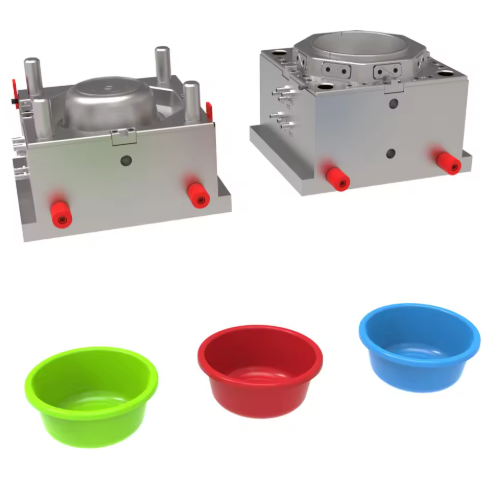
The wash basin mold is a critical component in the production of sanitary ware, requiring precise material selection and engineering to ensure hygiene compliance, surface quality, and manufacturing efficiency. Wash basin molds must accommodate complex geometries, maintain strict hygiene standards, and provide superior surface finishes while withstanding high-volume production cycles. This guide outlines material selection criteria, design considerations, and manufacturing processes specific to wash basin mold applications, focusing on EN 14688 compliance and durability requirements.
2. Material Selection for Wash Basin Molds
2.1 Pre-hardened Steel 718H
718H is the workhorse material for medium-to-high precision wash basin molds due to its excellent mechanical properties and cost-effectiveness. This nickel-enriched alloy (1.0-1.5% Ni) offers a hardness range of 33-38 HRC and superior polishability, making it suitable for producing wash basin molds with Class A surface finishes. The wash basin mold fabricated from 718H exhibits excellent dimensional stability (±0.02mm/m) and can withstand 500,000+ cycles, ideal for mass production of bathroom components. Its thermal conductivity (45 W/(m·K)) enables efficient cooling, reducing cycle times by 15-20% compared to conventional P20 steel in wash basin mold applications.
2.2 Corrosion-Resistant Stainless Steel S136
For wash basin molds requiring enhanced durability and corrosion resistance, S136 stainless steel provides exceptional performance through its high chromium content (13-14%). This martensitic stainless steel achieves 48-52 HRC after heat treatment and demonstrates superior corrosion resistance (500-hour salt spray resistance per ASTM B117), making it indispensable for wash basin mold components exposed to humid environments or chemical cleaning agents. The material’s mirror polishing capability (Ra ≤0.012μm) ensures scratch-resistant surfaces for visible wash basin components. While approximately 40% more costly than 718H, S136 extends wash basin mold service life to 800,000+ cycles in aggressive conditions, providing long-term economic benefits for premium bathroom products.
2.3 Mirror-Finish Steel NAK80
NAK80 pre-hardened steel has emerged as a preferred choice for wash basin molds requiring exceptional surface quality without secondary heat treatment. With a delivery hardness of 38-42 HRC and uniform microstructure, this material eliminates the need for post-machining heat treatment, reducing production lead times by 25%. Its superior polishability allows wash basin molds to achieve Ra ≤0.02μm surface finishes, critical for high-end wash basin applications where optical clarity and easy cleaning are paramount. The wash basin mold fabricated from NAK80 exhibits minimal dimensional distortion during machining, ensuring the precise fit required for seamless bathroom installations.
3. Design Considerations for Wash Basin Molds
3.1 Hygienic Design Requirements
Wash basin molds must incorporate features that ensure compliance with strict hygiene standards:
- Smooth, seamless surfaces with Ra ≤0.8μm to prevent bacterial growth
- Rounded corners (minimum radius 5mm) for easy cleaning
- Integral overflow channels with self-draining design
- Sloped basin bottom (minimum 2° gradient) for complete water drainage
Finite element analysis (FEA) is recommended to validate wash basin mold performance under thermal cycling conditions, ensuring dimensional stability across temperature variations from 10-80°C. The wash basin mold design should incorporate draft angles of 1.5-2° per side to facilitate easy demolding while maintaining water-tight seals.
3.2 Cooling System Optimization
Efficient thermal management in wash basin molds reduces cycle time and ensures dimensional consistency:
- Conformal cooling channels: 8-10mm diameter with 30-40mm spacing
- Beryllium copper inserts: Embedded in thick-walled sections to accelerate heat transfer
- Temperature uniformity: ±2°C across the cavity surface
- Flow rate: 2-3 m/s to achieve turbulent flow
For large wash basin molds (over 600mm in length), cooling time typically constitutes 55-65% of total cycle time (35-50 seconds), necessitating optimized channel layouts. Moldflow simulation should be employed to validate cooling efficiency and prevent warpage in thin-walled sections.
3.3 Water Drainage and Overflow Design
Effective water management is critical for wash basin mold functionality:
- Siphon-breaking features to prevent water retention
- Overflow capacity ≥1.5L/min per EN 14688 standards
- Anti-splash lip design (minimum 15mm height)
- Drain hole diameter ≥40mm with chamfered edges
The wash basin mold must incorporate precise alignment features for drain assembly, with positional tolerance of ±0.1mm to ensure proper sealing and prevent leakage.
4. Manufacturing Processes for Wash Basin Molds
4.1 Precision Machining Requirements
The production of wash basin molds demands advanced machining techniques:
- 5-axis CNC milling: For complex geometries with positional accuracy of ±0.005mm
- Wire EDM: For intricate overflow channels and drain features with ±0.002mm tolerance
- Surface grinding: Flatness within 0.005mm/m for critical mounting surfaces
- Ultrasonic polishing: To achieve Ra ≤0.02μm surface finish on visible areas
Wash basin mold components larger than 500mm require segmented machining with subsequent assembly, ensuring each segment maintains positional accuracy within 0.01mm. Critical surfaces must be finished to Ra ≤0.4μm to prevent bacterial adhesion and facilitate cleaning.
4.2 Surface Treatment Technologies
Wash basin mold surfaces require specialized treatment to ensure optimal performance and hygiene compliance:
- PVD coating: Titanium nitride (TiN) or chromium nitride (CrN) coatings (3-5μm thickness) for enhanced wear resistance
- Electrolytic polishing: For mirror finishes and reduced bacterial adhesion
- Nitriding: 0.1-0.3mm case depth for surface hardness of 800-1000 HV
- Antimicrobial coatings: Silver ion-infused treatments for healthcare applications
The surface treatment process must be validated through rigorous testing, including adhesion strength (≥50 N/cm) and chemical resistance to common bathroom cleaners per EN 14688 standards.
4.3 Assembly and Validation
Precise assembly is critical for wash basin mold performance:
- Guide pillar parallelism: ≤0.01mm over full stroke
- Clamping force distribution: Uniform within 5% across mold surface
- Hydraulic circuit integrity: 1.5× working pressure test for 30 minutes
- Trial molding: 50-piece production run with dimensional inspection per ISO 286 standards
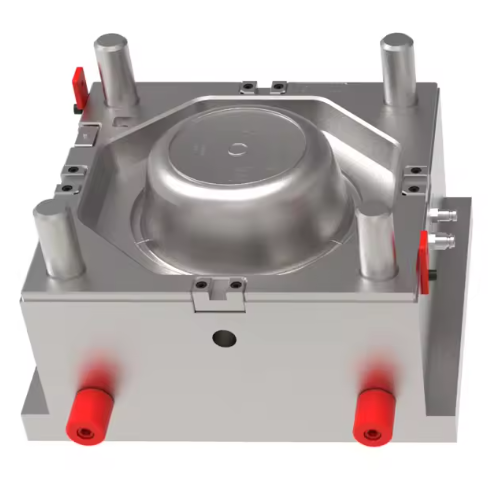
Large wash basin molds should incorporate adjustable tie-bar supports to compensate for thermal expansion. The assembly process must include laser alignment verification at each stage to ensure the final wash basin mold meets all dimensional requirements for bathroom installation.
5. Quality Control and Industry Standards
5.1 EN 14688 Compliance
Wash basin molds must comply with EN 14688 standards for sanitaryware, including:
- Material safety: Lead and cadmium leaching limits (0.8mg/dm² and 0.07mg/dm² respectively)
- Mechanical strength: 500g steel ball drop test from 1m height without damage
- Water tightness: No leakage at 1.5× working pressure
- Surface resistance: Scratch test with 5N load (Mohs hardness ≥5)
The wash basin mold design must incorporate features that facilitate compliance testing, including standardized measurement references and alignment targets for fixture installation.
5.2 Dimensional Inspection Protocol
Comprehensive inspection ensures wash basin mold accuracy:
- Coordinate measuring machine (CMM) inspection: 3D scanning with 0.001mm resolution
- Optical comparator: For profile verification of complex curves
- Surface finish analysis: Ra and Rz values verified using confocal microscopy
- Mold flow simulation validation: Fill time and pressure distribution analysis
Statistical process control (SPC) should be implemented for all critical wash basin mold parameters, with control limits set at ±3σ of process capability. Any out-of-specification condition requires root cause analysis and corrective action documentation.
6. Maintenance and Longevity Strategies
6.1 Preventive Maintenance Program
A structured preventive maintenance regimen extends wash basin mold service life:
- Daily: Clean cavity surfaces and check for debris after each production run
- Weekly: Inspect cooling channels for blockages and descale if necessary
- Monthly: Verify alignment and parallelism of guide pillars
- Quarterly: Measure wear on critical components and re-polish as needed
- Annually: Complete disassembly and replacement of worn components
Maintenance records should document all wash basin mold service activities, providing valuable data for optimizing maintenance intervals and predicting mold life expectancy.
6.2 Repair and Refurbishment Techniques
When wash basin mold components require repair, specialized techniques ensure minimal impact:
- Laser welding: For localized repair of damaged cavity surfaces
- Electroplating: Rebuilding worn surfaces to original dimensions
- Polishing rejuvenation: Restoring surface finish after extended use
- Coating reapplication: Renewing PVD or nitride layers
Post-repair validation requires 10-piece test molding and comparison to original CAD data to ensure the repaired wash basin mold meets all performance specifications.
7. Advanced Technologies in Wash Basin Mold Manufacturing
7.1 Additive Manufacturing
3D printing technologies are transforming wash basin mold production:
- Conformal cooling inserts: Optimized cooling channels following complex basin geometries
- Binder jetting: For producing intricate mold cores with internal features
- Hybrid manufacturing: Combining additive and subtractive processes for complex components
Additive manufacturing reduces wash basin mold lead times by 30-50% for complex geometries and enables cooling time reductions of 25-40% compared to conventional machining.
7.2 Digital Twin Technology
Industry 4.0 technologies are enhancing wash basin mold development:
- Virtual mold tryout: Using advanced CAE software to simulate the injection molding process
- Real-time monitoring: Sensor integration for temperature and pressure tracking
- Predictive maintenance: Machine learning algorithms to optimize service intervals
These digital technologies improve wash basin mold reliability, reducing unplanned downtime by 30-40% and improving overall equipment effectiveness (OEE) by 15-20%.
7.3 Antimicrobial Surface Technologies
Innovative surface treatments are addressing hygiene concerns in wash basin mold design:
- Silver ion-infused steels: Inhibiting bacterial growth on mold surfaces
- Photocatalytic coatings: Activated by light to decompose organic contaminants
- Superhydrophobic finishes: Reducing water adhesion and mineral deposit formation
These technologies support compliance with strict healthcare and hospitality hygiene standards, expanding the application range of wash basin mold products.
8. Conclusion
The design and manufacture of wash basin molds require a specialized approach that balances precision, hygiene compliance, and production efficiency. By selecting appropriate materials (718H for general applications, S136 for corrosion resistance, NAK80 for mirror finishes) and implementing robust quality control measures, producers can create wash basin molds capable of meeting the stringent requirements of modern sanitaryware manufacturing.
The wash basin mold industry continues to evolve through the integration of additive manufacturing, digital twin technology, and advanced surface treatments. These innovations enable the production of more complex, durable, and hygiene-compliant wash basin components while supporting the trend toward water conservation and sustainable manufacturing practices.
By following the guidelines presented in this essential guide, engineers and manufacturers can develop wash basin mold solutions that deliver consistent quality, maximize production efficiency, and support the ongoing evolution of bathroom technology. The future of wash basin mold technology will undoubtedly bring further advancements in materials, processes, and digitalization, ensuring the industry remains at the forefront of sanitaryware manufacturing innovation.
>>You may also like
Standards & References
The following industry standards are referenced in this article: