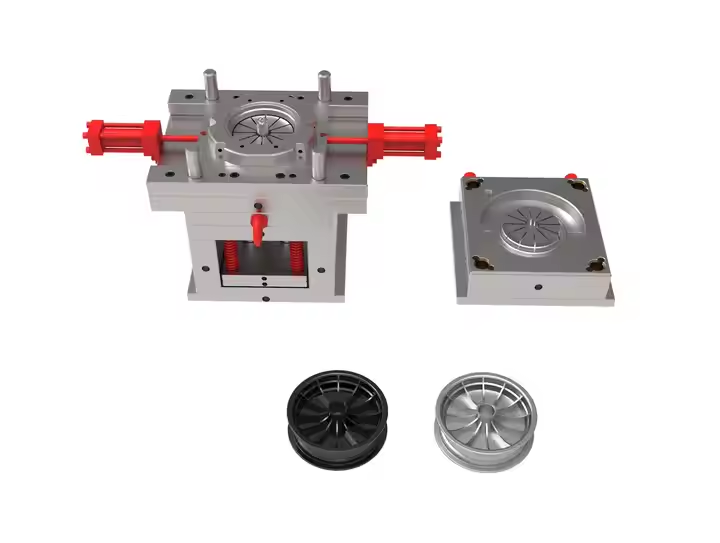
In the vast system of modern industrial manufacturing, trolley caster molds may be an obscure niche, but they play an indispensable role. From medical equipment transport carts to logistics and warehousing goods handling vehicles, from supermarket shopping carts to airport luggage trolleys, the application of wheels is ubiquitous. High-quality wheels cannot be produced without precision mold manufacturing.
Definition and Classification of trolley caster molds
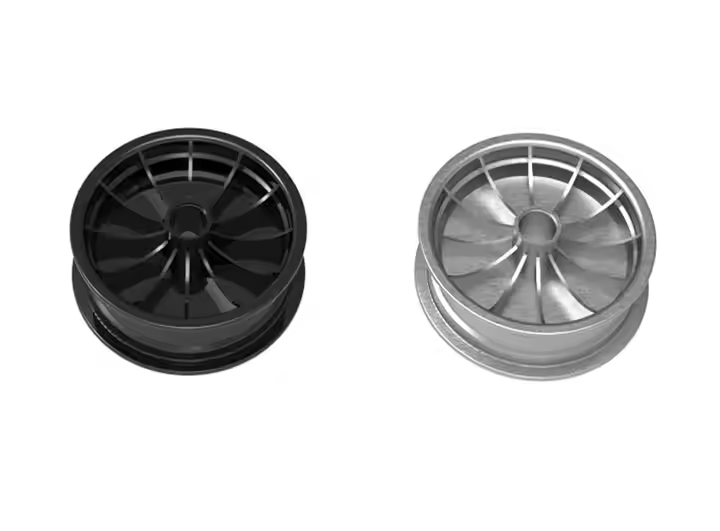
A trolley caster molds is a tool used to produce pushcart wheels. It forms metal or plastic materials into wheels with specific shapes and functions through particular molding processes. Depending on the material and application of the wheels, trolley caster molds can be divided into two main categories: metal wheel molds and plastic wheel molds.
Metal wheel molds are primarily used for manufacturing steel or aluminum wheels, which are known for their high strength and wear resistance. These wheels are suitable for heavy-duty applications and harsh environments. Plastic wheel molds, on the other hand, are used to produce wheels made from materials like polyurethane or nylon. These wheels are lightweight, flexible, and offer good shock absorption, making them ideal for light-duty and indoor use.
Manufacturing Process of trolley caster molds
The manufacturing process of trolley caster molds is complex and meticulous, involving several key steps:
(i) Design Phase
Mold design is the starting point of the entire manufacturing process. Designers need to determine the dimensions, shape, material, and load-bearing capacity of the wheels based on customer requirements and application scenarios. With the help of Computer-Aided Design (CAD) software, designers can accurately create three-dimensional models of the molds and conduct virtual assembly and simulation tests to ensure the rationality and feasibility of the mold design.
(ii) Machining Phase
Mold machining is the process of transforming design drawings into actual molds. This typically involves various mechanical machining processes such as milling, turning, and grinding. With the development of Numerical Control (NC) technology, the precision of modern mold machining has improved significantly, meeting the demands for high-precision and complex-shaped mold manufacturing. For example, high-precision CNC milling machines can process mold surfaces with micron-level accuracy, ensuring the dimensional accuracy and surface quality of the wheels.
(iii) Heat Treatment and Surface Treatment
For metal wheel molds, heat treatment is a crucial step to enhance the strength and wear resistance of the molds. Through processes like quenching and tempering, the internal structure of the mold material is altered, resulting in higher hardness and toughness. In addition, surface treatment processes such as electroplating and sandblasting can not only improve the wear resistance and corrosion resistance of the molds but also enhance their demolding performance, extending the service life of the molds.
(iv) Assembly and Debugging
After mold machining is completed, precise assembly and debugging are required. During assembly, it is essential to ensure that all components of the mold fit tightly together without any looseness or interference. The debugging phase involves actual injection molding or stamping to check the molding effect and dimensional accuracy of the mold, and to promptly identify and resolve any potential issues, such as shrinkage, flash, or dimensional deviations.

The Importance of trolley caster molds
trolley caster molds hold an extremely important position in industrial manufacturing, as they directly affect the quality, performance, and production efficiency of the wheels.
Quality Assurance:High-quality trolley caster molds ensure the dimensional accuracy, shape accuracy, and surface quality of the wheels. For example, in medical equipment trolleys, the precision of the wheels directly affects the stability and flexibility of the trolley, which is related to patient comfort and the work efficiency of medical staff. Precision molds can reduce wheel deformation and wear, thereby increasing the service life of the wheels.
Increased Production Efficiency:The performance of molds directly determines the production efficiency of the wheels. Efficient mold design can shorten the molding cycle, reduce scrap rates, and improve production efficiency. For example, by adopting advanced mold design and manufacturing technologies, the molding cycle of wheels can be shortened by more than 30%, while also reducing production costs.
Support for Product Innovation:The flexibility and customizability of molds provide support for wheel product innovation. As market demands continue to evolve, customers are placing higher requirements on the functionality and appearance of wheels. Through rapid modification and adjustment of molds, product upgrades and iterations can be quickly realized to meet the diverse market needs.
What is the role of heat treatment process for trolley caster molds?
The heat treatment process plays a crucial role in enhancing the performance and service life of trolley caster molds. Here are its main functions and applications:
1. Enhancing Hardness and Wear Resistance
Heat treatment processes such as quenching and tempering can significantly increase the hardness and wear resistance of molds. After quenching, the hardness of molds can reach a high level (e.g., 60-65 HRC), and tempering further optimizes their toughness and wear resistance. Additionally, surface strengthening processes like nitriding and carburizing can form a high-hardness wear-resistant layer on the mold surface, further extending the mold’s service life.
2. Improving Toughness and Fatigue Resistance
Through tempering treatment (quenching + high-temperature tempering), molds can achieve good toughness and fatigue resistance. This treatment effectively reduces the risk of cracking and deformation during use, especially for molds operating under high load and complex conditions.
3. Enhancing Machinability
Preparatory heat treatment processes such as annealing and normalizing can reduce the hardness of mold materials, making them easier to machine. At the same time, these processes refine the grain structure and homogenize the material, laying a solid foundation for subsequent heat treatment and machining.
4. Relieving Internal Stress
Aging and annealing processes in heat treatment can effectively relieve internal stresses generated during machining, reducing the likelihood of deformation and cracking. This is crucial for improving the dimensional stability and service life of molds.
5. Surface Strengthening and Corrosion Resistance
Surface heat treatment processes such as ion nitriding and gas nitriding can form a high-hardness, wear-resistant nitride layer on the mold surface while also enhancing its corrosion resistance. Additionally, chemical vapor deposition (CVD) and physical vapor deposition (PVD) technologies can deposit a wear-resistant coating on the mold surface, further improving its performance.
6. Extending Mold Service Life
With proper heat treatment, the service life of molds can be significantly extended. For example, molds treated with nitriding can achieve a surface hardness of 950-1200 HV, with significantly improved wear resistance and fatigue strength.
7. Optimizing Microstructure
The heating, soaking, and cooling steps in the heat treatment process can alter the microstructure of mold materials to achieve desired performance characteristics. For example, quenching and tempering can form martensite or tempered sorbite structures, thereby enhancing the overall performance of the mold.
8. Adapting to Specific Application Scenarios
Different heat treatment processes can be selected based on the application scenarios of trolley caster molds. For example, nitriding or carburizing is ideal for molds requiring high wear resistance, while tempering is more suitable for molds needing high toughness.