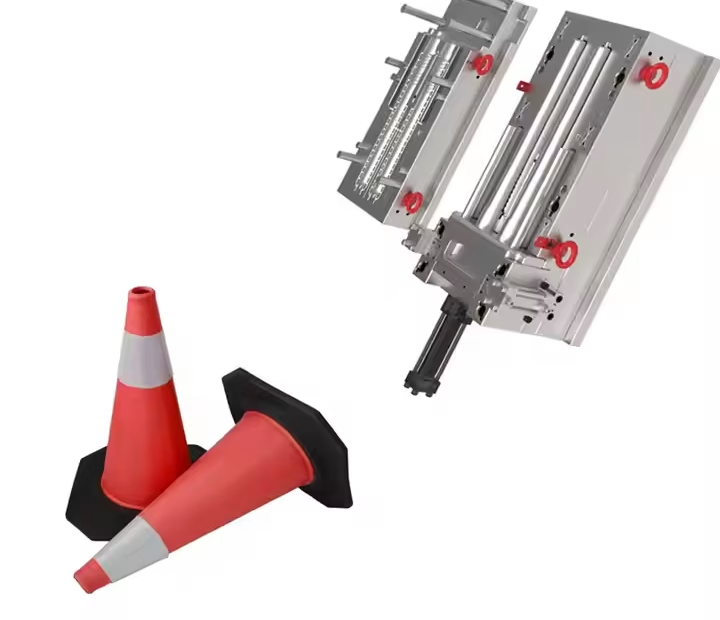
Traffic cones, as critical safety devices in road management, directly impact the efficiency of construction zones, accident response, and traffic control. The mass production of traffic cones relies heavily on precision mold technology. The design and manufacturing quality of molds not only determine product consistency but also influence cost control and market competitiveness. This article systematically analyzes the engineering principles of traffic cone molds, covering material selection, structural design, manufacturing processes, and industry trends.
Deconstruction of Technological Systems
1. Structural Design Innovations
Modern traffic cone molds adopt multidisciplinary integrated design principles, combining fluid dynamics, material mechanics, and visual engineering:
- Cavity Topology Optimization: ANSYS Polyflow melt flow simulations enable wall thickness gradient control (smooth transition from 3.8mm base to 1.5mm top), ensuring uniform injection stress distribution
- Functional Component Integration:
- Retroreflective strip positioning system: 0.05mm precision sliders ensure accurate embedding of 3M Diamond Grade Reflective Films
- Weight distribution design: Hexagonal honeycomb base structure (2.5mm±0.05 rib height) optimizes weight distribution
- Demolding System Innovation: 16-point hydraulic ejection mechanism with 5° angular slope prevents product deformation (ovality ≤0.3mm)
2.Molding Process Control
- Intelligent Temperature Field Regulation:
- Dual-loop temperature control system (mold temperature difference ≤0.8℃)
- Conformal cooling channels (55% cooling efficiency improvement)
- Pressure Curve Optimization:
- Four-stage injection control (80-120-100-60MPa)
- Dynamic pressure compensation algorithm (weight fluctuation ≤0.5%)
- Cycle Time Compression:
- High-speed injection technology (cycle time ≤28 seconds)
- Robotic automated part removal system (30% equipment utilization improvement)
unctional Requirements and traffic cone molds Design Criteria
Traffic cones must comply with stringent standards (e.g., GB/T 23827-2021), necessitating molds that achive:
- High Strength and Weather Resistance: Withstand vehicle impacts, UV exposure, and temperature extremes (-40°C to 70°C);
- Rapid Demolding: Injection cycles ≤30 seconds to ensure daily output exceeding 3,000 units;
- Precision Detailing: Reflective stripe slot width tolerance ≤0.1mm, cone inclination angle 70°±1°;
- Lightweighting: traffic cone molds weight ≤800kg to reduce energy consumption.
Material Selection and Heat Treatment Processes
Traditional P20 pre-hardened steel molds are being replaced by advanced alloys to meet demanding conditions:
1. Cavity Materials
- NAK80 Mirror Steel: Hardness HRC 40-42, polished to Ra 0.02μm, eliminating flow marks on plastic surfaces;
- S136 Corrosion-Resistant Steel: 13.6% chromium content resists PVC plasticizer corrosion, extending lifespan to 500,000 cycles;
- Gradient Composites: Diamond-like carbon (DLC) coatings reduce friction by 60% and demolding force by 35%.
2. Mold Frame
- GS-738 high-strength ductile iron (tensile strength ≥800MPa, thermal deformation ≤0.05mm/m);
- Hard chrome-plated guide pillars (HV 900 hardness) with 0.015–0.025mm clearance.
3. Heat Treatment
Vacuum quenching + triple tempering (250°C × 2h) ensures uniform hardness (±1 HRC) and residual austenite <5%.
Structural Design Innovations of traffic cone molds
1. Parting Surface Design
- Inclined Step Parting: 0.5mm step difference at 45° cone slope prevents flash;
- Dynamic Venting System: Eight Φ0.8mm micro-valves at the cone tip reduce gas retention to ≤0.3%.
2. Cooling System Optimization
Moldflow simulations guide spiral-unfolding channel design:
- Main channels (Φ12mm) 8mm from cavity surfaces;
- Branch channels intersect at 15°, maintaining ±2°C temperature variation.
A case study showed cooling time reduced from 18s to 11s, cutting energy use by 23%.
3. Ejection Mechanism Upgrades
- Pneumatic-Mechanical Dual Ejection: 0.5MPa air pre-ejection followed by six Φ8mm ejector pins (deformation <0.3mm);
- Reverse Taper Ejector Pins: 3° tip angle prevents part sticking.


Precision Manufacturing and Quality Control of traffic cone molds
1. Machining Equipment
- Cavity finishing: 5-axis high-speed milling (24,000 rpm spindle, ±0.01mm accuracy);
- Electrodes: Graphite EDM reduces wear by 40% vs. copper.
2. Critical Process Controls
- Mold surface grinding: #3000 diamond wheel (flatness ≤0.005mm);
- Cooling channel pressure test: 0.8MPa for 30 minutes (leakage <5ml/min);
- Trial parameters: Melt temp 210±5°C, injection pressure 80–120MPa, back pressure 0.5–1.0MPa.
3. Inspection Standards
- CMM: Cone height (450mm) tolerance ±0.15mm;
- Optical profile projector: Reflective slot position ≤0.05mm;
- Lifespan test: Ra ≤0.4μm after 200,000 cycles.
Conclusion
The precision and intelligence of traffic cone molds are reshaping road safety manufacturing. Emerging technologies like high-entropy alloys and digital twins promise molds exceeding 1 million cycles with full lifecycle carbon tracking. Manufacturers should prioritize innovations such as in-mold sensing, multi-material co-injection, and AI-driven health management systems. As road safety standards evolve, advancements in mold technology will remain vital for both productivity and public safety.
>>You may also like
Standards & References
The following industry standards are referenced in this article: