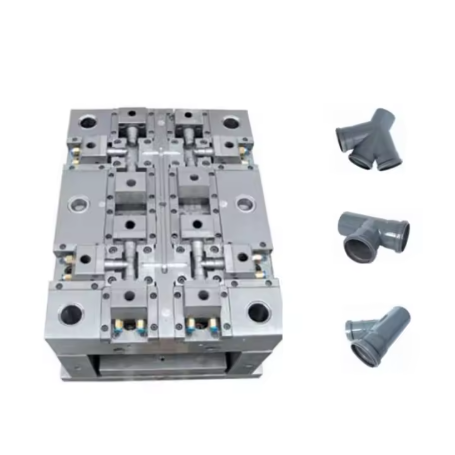
Material Selection for Tee Pipe Molds
Selecting the right steel for tee pipe molds is a critical decision that directly impacts production efficiency, part quality, and overall tooling costs. The ideal mold steel must balance wear resistance, toughness, and machinability while withstanding the harsh conditions of injection molding cycles.
Pre-hardened steels like 718H and NAK80 are popular choices for general-purpose tee pipe molds. These materials offer a good balance of mechanical properties with hardness ranging from 30-45 HRC, making them suitable for medium-volume production runs up to 500,000 cycles. Their uniform microstructure ensures consistent performance and predictable machining characteristics, which is essential for maintaining the precise dimensional tolerances required in pipe fittings.
For high-volume production or when processing abrasive materials, high-hardness steels such as H13 (DIN 1.2344) and S136 (DIN 1.2083) provide superior wear resistance. These materials can be heat-treated to 50-55 HRC and offer excellent resistance to thermal fatigue, a critical property when molding materials like glass-reinforced polypropylene commonly used in pipe manufacturing. S136 additionally provides exceptional corrosion resistance, making it ideal for molds requiring strict surface finish requirements or when using corrosive resins.
Tool steel selection should also consider the specific plastic material being molded. For example, when processing PVC, which releases corrosive hydrochloric acid during molding, corrosion-resistant steels like 2316 or 420 stainless steel variants are recommended to prevent premature mold degradation. The increasing adoption of bio-based and recycled plastics with higher filler contents further necessitates careful material selection to ensure mold longevity.
Injection Molding Process Parameters for Tee Pipes
The injection molding process for tee pipes presents unique challenges due to the part’s complex geometry with three intersecting channels. Achieving uniform wall thickness and preventing defects like weld lines and sink marks requires precise control of molding parameters and advanced process technologies.
Mold temperature control is paramount in tee pipe manufacturing. Conformal cooling systems, often produced using additive manufacturing, allow for uniform temperature distribution around the complex tee geometry. This technology reduces cycle times by up to 30% while minimizing warpage in the final part. For materials like PP and PE, optimal mold temperatures typically range from 40-80°C, depending on the specific grade and desired part properties.
Injection speed and pressure profiles must be carefully calibrated to fill the tee’s three branches uniformly. Multi-stage injection profiles are commonly employed, with slower initial fill rates to prevent jetting followed by increased speed to ensure complete cavity filling. Packing pressure is critical in the intersection area of the tee, where material tends to accumulate, requiring precise pressure control to avoid excessive residual stress and sink marks.
Advanced molding technologies like gas-assisted injection molding offer significant benefits for tee pipe production. By injecting nitrogen gas into the thickest sections of the part, manufacturers can reduce material usage by up to 20% while eliminating sink marks and improving dimensional stability. This technology is particularly effective for large-diameter tee pipes where material savings and weight reduction provide substantial cost benefits.
Process simulation software has become indispensable in tee pipe mold development. Mold flow analysis helps identify potential filling issues, air traps, and weld line locations before mold fabrication. Modern simulation tools can accurately predict fiber orientation in reinforced materials, allowing engineers to optimize gate locations and processing parameters to ensure structural integrity in the final part.
Industry Standards and Quality Control
Tee pipe molds must adhere to stringent industry standards to ensure the production of safe, reliable, and interchangeable pipe fittings. These standards govern everything from material selection to dimensional tolerances and performance requirements.
International standards such as ISO 15493 for plastic piping systems and ASTM D2466 for thermoplastic pipe fittings establish baseline requirements for mold design and production. These standards specify critical dimensions, pressure ratings, and testing protocols that directly influence mold design considerations like wall thickness uniformity and draft angles.
Dimensional accuracy is paramount in tee pipe manufacturing, with typical tolerances ranging from ±0.1mm to ±0.3mm depending on pipe size. To achieve these tight tolerances, mold makers employ precision machining techniques including 5-axis CNC milling and wire EDM, which can achieve positional accuracies of ±0.005mm. Coordinate measuring machines (CMM) with laser scanning capabilities are used to verify mold dimensions before production, ensuring compliance with design specifications.
Material certification plays a crucial role in quality control. Mold steels must meet specific standards such as DIN EN 10025 for structural steels or AISI/SAE standards for tool steels. Suppliers should provide material certificates including chemical composition, heat treatment records, and mechanical properties. This documentation is essential for traceability and ensuring the mold will perform as expected during production.
Validation and testing procedures are required to ensure tee pipe molds produce parts that meet performance requirements. Mold qualification typically involves producing sample parts that undergo pressure testing, dimensional inspection, and material property analysis. Statistical process control (SPC) is then implemented during production to monitor critical parameters and maintain consistent quality.
Surface Treatment and Finishing
The surface quality of tee pipe molds directly impacts both the aesthetic appearance of the molded parts and the mold’s performance characteristics. Proper surface treatment enhances wear resistance, reduces friction, and can significantly extend mold life.
Polishing and texturing are critical processes for tee pipe molds. For visible surfaces, mirror polishing (up to SPI A-3 finish) may be required to achieve the desired aesthetic quality. For functional surfaces, specific textures can be applied to control flow characteristics or hide minor defects. Laser texturing technology allows for precise control of surface patterns, which is particularly useful for creating grip surfaces or reducing glare in visible applications.
Hard coating technologies offer significant benefits for tee pipe molds. Physical vapor deposition (PVD) coatings like TiN, TiCN, and CrN can increase surface hardness by 200-300% while reducing friction coefficients. These coatings are especially effective when molding glass-filled materials, reducing wear and extending mold life by 2-3 times compared to uncoated steel.
Corrosion protection is essential for molds used with corrosive resins or in high-humidity environments. Passivation treatments for stainless steel molds, chemical nickel plating, and specialized coatings like Xylan provide effective corrosion resistance. For molds processing PVC or other corrosive materials, electroless nickel plating with phosphorus content above 10% offers excellent protection against chemical attack.
Release agents and surface modifiers play an important role in the molding process. Semi-permanent release coatings can reduce cycle times by minimizing part sticking and reducing the need for frequent cleaning. These coatings are particularly valuable for complex tee geometries where uniform release is challenging.
Structural Design Considerations
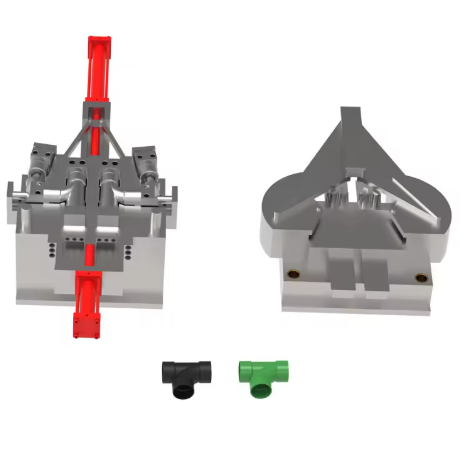
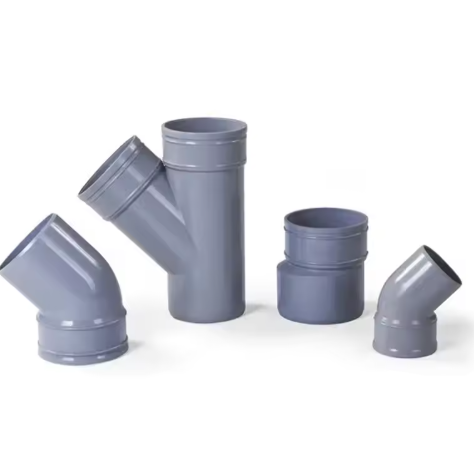
The structural design of tee pipe molds must balance functionality, manufacturability, and cost-effectiveness while ensuring consistent part quality. Several key design principles guide the development of effective tee pipe mold structures.
Gating and runner design significantly impacts tee pipe quality. Hot runner systems are increasingly preferred for tee pipe molds as they eliminate weld lines by allowing simultaneous filling of the three branches. Sequential valve gating can further optimize filling patterns, controlling the order in which melt enters each branch to minimize pressure differential and ensure uniform packing.
Ejection system design must accommodate the tee’s complex geometry. Stripper plates or sleeve ejectors are often used for the main pipe sections, while lifter mechanisms may be required for undercuts in branching areas. The ejection system must apply uniform force to prevent part distortion, particularly in thin-walled sections common in many pipe applications.
Mold cooling is critical for tee pipe production efficiency and part quality. Conformal cooling channels that follow the contours of the tee branches ensure uniform temperature distribution, reducing cycle times and minimizing warpage. For large-diameter tees, beryllium copper inserts in critical cooling areas can significantly improve heat transfer rates.
Parting line selection requires careful consideration in tee pipe molds. The optimal parting line position minimizes flash and simplifies mold construction while allowing for proper ejection. In some cases, complex tee geometries may require multi-piece molds with sliding components to accommodate undercuts or complex features.
Design for manufacturability principles should be applied throughout the mold development process. This includes simplifying mold geometry where possible, standardizing components to reduce costs, and ensuring adequate access for maintenance and repair. Modern CAD/CAM systems facilitate design optimization, allowing engineers to simulate mold performance and identify potential issues before manufacturing begins.
Future Trends in Tee Pipe Mold Technology
The tee pipe mold industry continues to evolve with advancements in materials, manufacturing technologies, and sustainability requirements. Several emerging trends are shaping the future of tee pipe mold design and production.
Additive manufacturing is revolutionizing tee pipe mold production. Direct metal laser sintering (DMLS) and other 3D printing technologies enable the creation of complex conformal cooling channels that were previously impossible with traditional machining. This technology reduces cycle times by up to 40% while improving part quality through more uniform cooling.
Smart mold technologies are gaining traction in the industry. Sensors embedded in molds can monitor temperature, pressure, and wear in real-time, providing valuable data for process optimization and predictive maintenance. This technology allows for proactive mold maintenance, reducing unplanned downtime and extending mold life.
Sustainable manufacturing practices are becoming increasingly important in tee pipe mold production. The use of recycled steel and bio-based lubricants reduces the environmental impact of mold manufacturing. Additionally, mold designs that minimize material usage and energy consumption during production align with the growing emphasis on sustainability throughout the plastics industry.
Advanced materials are expanding the capabilities of tee pipe molds. Nanocomposite tool steels offer improved wear resistance and thermal conductivity compared to traditional materials. These advanced materials allow for longer production runs and improved part quality, particularly when processing abrasive or high-temperature resins.
Digitalization and Industry 4.0 concepts are transforming tee pipe mold production. Digital twins of molds allow for virtual testing and optimization before physical production, reducing development time and costs. Integrated data management systems connect design, manufacturing, and production data, enabling continuous improvement and faster response to changing market requirements.
As the tee pipe industry continues to evolve, mold manufacturers must stay at the forefront of these technological advancements to remain competitive. By embracing new materials, manufacturing processes, and digital technologies, tee pipe mold producers can deliver higher quality, more efficient molds that meet the changing needs of the global piping industry.
>>You may also like
Standards & References
The following industry standards are referenced in this article: