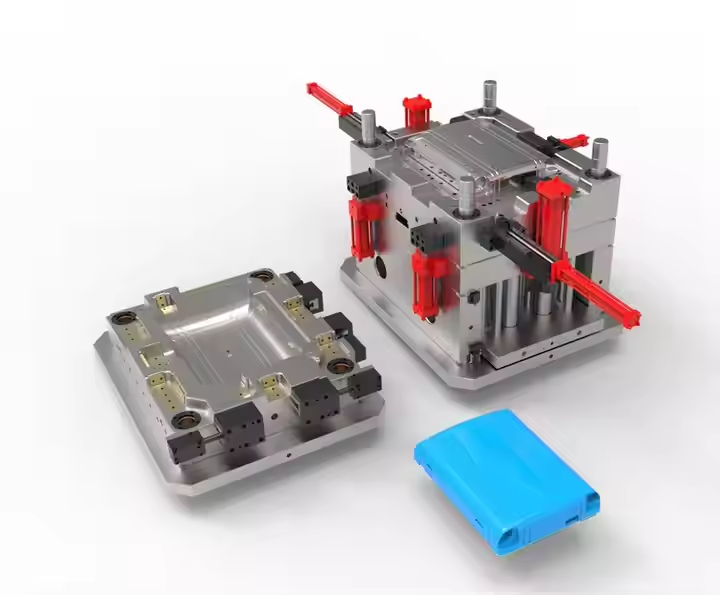
Amid accelerating globalization and consumer market upgrades, suitcases have become essential travel gear for modern individuals, driving continuous growth in market demand. From lightweight carry-ons to impact-resistant hard-shell suitcases, and from minimalist business designs to smart luggage, every product relies on a critical manufacturing component: mold production. As the core tool for suitcase manufacturing, suitcase molds are not only the foundation of industrial production but also a concentrated embodiment of technological sophistication and craftsmanship in modern manufacturing. This article explores the design philosophy, manufacturing processes, and strategic value of suitcase molds in industrial transformation.
Industry Significance and Technical Challenges of Suitcase Molds
Suitcase molds manufacturing spans material science, structural design, precision machining, and other disciplines, with technical complexities far exceeding ordinary plastic molds. As functional products, suitcases must simultaneously meet requirements for pressure resistance, impact resistance, lightweight construction, and airtightness, imposing stringent standards on mold precision and design.
Taking the widely used polycarbonate (PC) hard-shell suitcase as an example, its molds must achieve the following objectives:
- Ultra-Thin Wall Thickness Control: Case thickness typically ranges from 0.8-1.2mm, demanding extreme precision in mold runner design and cooling systems.
- Complex Structural Molding: Details like hidden pull rod grooves, honeycomb pressure-resistant structures, and multi-stage hinges require mold parting surface accuracy at the 0.01mm level.
- Surface Treatment Processes: Textured finishes such as matte, mirror, and embossed effects necessitate specialized electrical discharge machining (EDM) or etching on mold surfaces.
- Multi-Material Compatibility: Molds for high-end PC+ABS composite cases must accommodate differing material shrinkage rates and flow properties.
These technical requirements result in a 6- to 12-month development cycle for suitcase molds, with individual mold costs reaching millions, making them a core competitive asset for manufacturers.
Innovative Design: From Functionality to Smart Integration
Evolving consumer demands are driving transformative changes in suitcase molds design. While traditional molds focused on basic structural shaping, modern molds integrate cutting-edge innovations:
1. Lightweight Structural Design
Topology optimization technology, combined with finite element analysis (FEA), simulates stress distribution to optimize material allocation during mold design. For example, Samsonite’s Cosmolite series achieved a 20% weight reduction and 30% increased compressive strength through honeycomb-structured molds.
2. Smart Component Integration
Molds for GPS modules, power bank slots, and electronic locks require precise insert molding positions. Rimowa’s electronic-tag suitcase molds utilize in-mold assembly technology to seamlessly integrate electronic screens with the case body.
3. Eco-Friendly Process Innovation
To accommodate bio-based materials (e.g., sugarcane-derived PE), molds incorporate specialized temperature controls and anti-corrosion coatings. Delsey’s carbon-neutral series employs two-shot molding to form eco-friendly rubber edge buffers directly during production.
4. Customization Systems
Modular mold designs enable rapid swapping of inserts for personalized patterns and pull rod configurations. Japan’s Proteca leverages patented modular mold technology to offer its “Case DIY” service.

Precision Manufacturing: The Art of Millimeter-Scale Accuracy
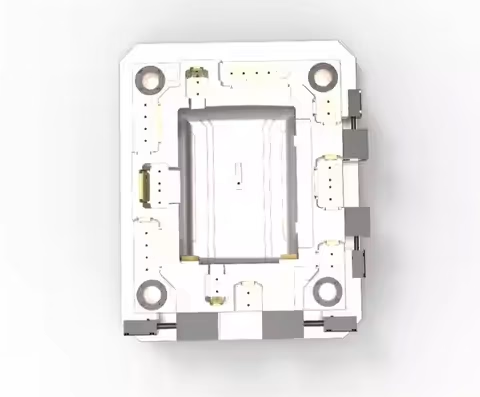
The machining precision of suitcase molds directly determines product quality. Industry leaders employ advanced manufacturing systems:
1. Five-Axis Machining Centers
German DMG MORI five-axis machines achieve mold cavity surface roughness of Ra0.2μm, ensuring flawless case surfaces. A luxury brand’s diamond-cut texture mold required over 2,000 machining hours.
2. Nanoscale Surface Treatment
Mirror EDM technology creates micron-level textures on mold surfaces. Travelpro’s metallic-finish cases use molds polished through 16 steps, achieving optical-grade smoothness.
3. Intelligent Temperature Control
Molds with distributed sensor networks and PID algorithms enable real-time thermal adjustments. Bric’s embossed series molds achieve 0.05mm surface differential control via dynamic temperature regulation.
4. Virtual Trial Technology
Moldflow software simulates flow patterns to predict weld lines and shrinkage. Samsonite reports virtual trials reduce mold modifications by 60% and shorten R&D cycles by 40%.
conclusion
Under the dual drivers of consumption upgrading and smart manufacturing, suitcase molds technology is undergoing revolutionary transformation. From breakthroughs in material science to digital twin applications, and from precision manufacturing to green production, each technological innovation is redefining the boundaries of luggage manufacturing. In the future, with the deep integration of AI algorithms and quantum computing, the mold industry will enter a new era of “predictive manufacturing,” delivering smarter and more durable travel solutions for global travelers.