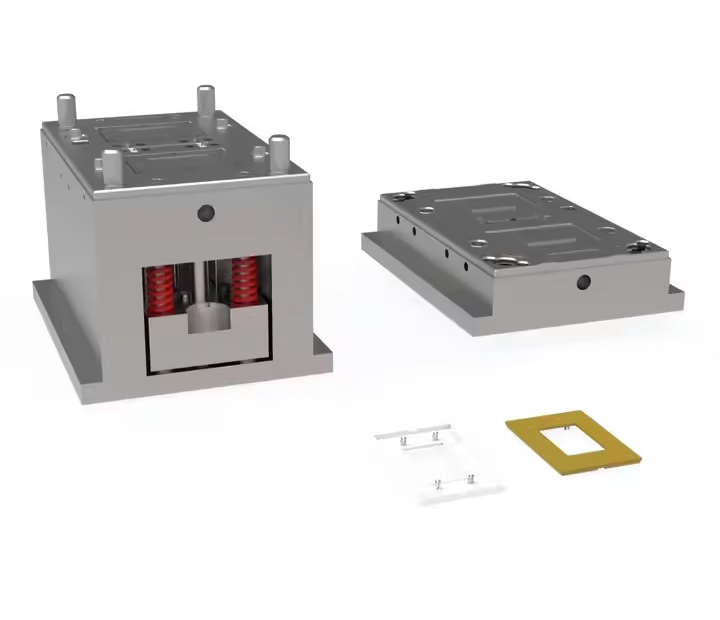
In modern building electrical engineering, socket panels serve as the terminal interface for power transmission, with their quality directly impacting electrical safety and user experience. The core determinant of socket panel quality lies in the injection molds used during production. This article provides an in-depth analysis of the design and manufacturing technology system for socket panel molds, revealing the precision engineering logic behind them.
Industry Demand Characteristics of Socket Panel Molds
According to International Electrotechnical Commission (IEC) statistics, over 3 billion socket panels are consumed globally each year, with 80% produced through injection molding. This mass production imposes unique requirements on molds:
- High Precision Requirements: Socket hole spacing tolerance must be controlled within ±0.02mm to ensure perfect engagement with plugs
- Rapid Production Cycle: Mainstream mold designs require 800,000-1 million shot lifespans with molding cycles compressed under 20 seconds
- Safety Redundancy Design: Must comply with GB2099.1 national standard for shock protection structures
- Surface Treatment Standards: Matte texture surface Ra value controlled within 0.8-1.6μm range
Core Design Challenges in Socket Panel Molds
Socket panels, as critical electrical interfaces in modern households and industrial equipment, demand socket panel molds that balance functionality, safety, and production efficiency. Key challenges include:
1. Complex Geometry Control
Typical panels feature multi-port configurations (e.g., 5-hole sockets), undercut structures (snap grooves), thin walls (1-2 mm), and fine surface textures. For example, a 5-hole socket mold requires ±0.2 mm precision across five ports within an 86×86 mm area. Advanced solutions include:
- Angled Ejector Pin Mechanisms: 15°-25° angles enable damage-free demolding of undercuts
- Optimized Parting Lines: Minimize visible seams by prioritizing the panel’s bottom surface
2. Material-Process Synergy
Polycarbonate (PC) dominates due to its high strength (Vicat softening point ≥145°C) and flame retardancy (UL94 V-0). However, its high melt viscosity (307-317°C) and low shrinkage (0.5%-0.7%) necessitate precise thermal control. Case studies show:
- Dual-Loop Temperature Control (±0.5°C accuracy) reduces warpage from 0.744 mm to <0.25 mm1
- Hybrid Hot/Cold Runner Systems: Graphene-embedded runners limit melt temperature variation to ±3°C, achieving 98.6% yield in 16-cavity molds
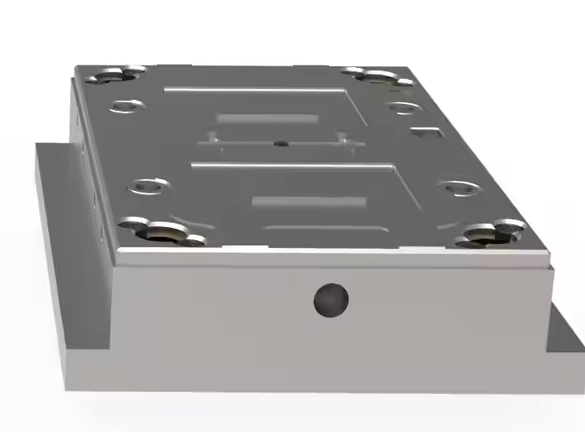
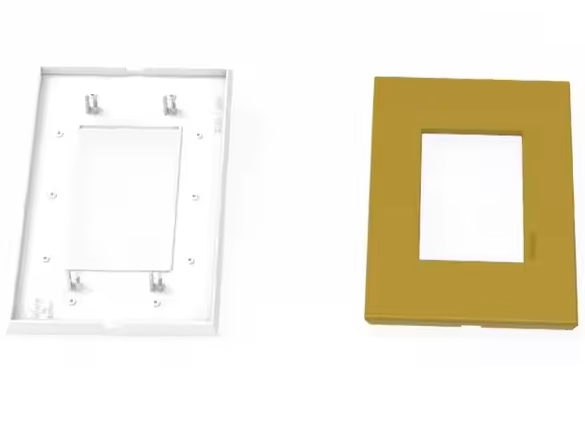
Technological Innovations Driving Performance
1. CAE-Driven Process Optimization
Moldflow simulations reveal critical improvements:
- Gate Redesign: Switching from edge gates to fan gates increased weld line strength by 42%
- Conformal Cooling Channels: Reduced cooling time by 25% and energy consumption by 18%
- Orthogonal Experimentation: Optimized parameters (317°C melt temp, 94°C mold temp, 7s packing) minimized warpage
2. Modular Design for Rapid Changeovers
Wenzhou Zhouyi Building Materials’ snap-in conductive module patent (CN222233940U) requires molds with:
- Quick-Change Inserts: Standardized H7/g6 interfaces and magnetic positioning cut mold change time from 4hrs to 15min
3. Additive Manufacturing Breakthroughs
Selective Laser Melting (SLM) produces conformal cooling channels with 0.3mm diameters, enhancing cooling efficiency by 40% vs. drilled channels. 3D-printed inserts achieve Ra0.8μm surface roughness and >500,000-cycle durability.
socket panel Molds Materials and Surface Treatment Technologies
Material selection directly impacts mold lifespan and product quality:
| Component | Preferred Material | Heat Treatment | Surface Treatment |
| Cavity/Core | S136 Mirror Steel | Vacuum Quenching HRC48-52 | Nano PVD Coating |
| Sliders | 8407 Hot Work Steel | Nitriding (0.1mm layer) | TD Treatment |
| Ejector Pins | SKD61 | Cryogenic Treatment | DLC Coating |
Through composite surface treatments, mold wear resistance improves by over 3×. One brand’s mold showed <0.008mm wear on critical components after 3 million cycles.
Industry Chain Collaboration & Sustainability
1. Material Innovations
- Bio-Based PC: CAS Ningbo’s castor oil-derived resin reduces carbon emissions by 42%
- CNT-Reinforced Composites: 2% carbon nanotube PC/ABS blends boost flexural modulus by 35% for EV charging panels
2. Green Manufacturing
- Closed-Loop Water Systems: Achieve 95% water reuse (120 tons/year savings per mold)
- In-Line Recycling: 99.3% material utilization via twin-screw extruder reprocessing
3. Smart Production Networks
Leading manufacturers like Shenzhen Jingmo Electronics deploy digital twin platforms, using vibration sensors and AI to predict component wear (92% accuracy), reducing unplanned downtime by 65%.
Conclusion
From traditional injection molds to AI-driven adaptive systems, socket panel molds evolution mirrors China’s manufacturing transformation. An ¥800,000 mold producing 3 parts/sec isn’t just shaping plastic—it’s encoding the logic of smart homes, NEV infrastructure, and Industry 4.0. As material genomics and distributed manufacturing mature, socket panel molds will become “thinking” production units, propelling the next revolution in electrical connectors.
>>You may also like
Standards & References
The following industry standards are referenced in this article: