1. Introduction
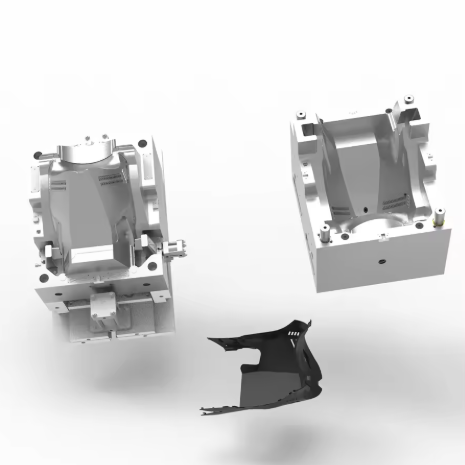
The scooter mold is a critical component in the production of two-wheeled vehicles, requiring specialized material selection and engineering to ensure structural integrity, dimensional precision, and manufacturing efficiency. Scooter molds must withstand high injection pressures, accommodate complex part geometries, and maintain tight tolerances while ensuring cost-effective production. This guide outlines material selection criteria, design considerations, and manufacturing processes specific to scooter mold applications, focusing on ISO 6411 compliance and lightweight design principles.
2. Material Selection for Scooter Molds
2.1 Pre-hardened Steel 718H
718H is the preferred material for mid-to-high volume scooter mold production, offering an optimal balance of hardness (33-38 HRC), toughness, and polishability. This nickel-enriched alloy provides excellent dimensional stability (±0.02mm/m) critical for scooter mold components like handlebars and footrests requiring precise fitment. The material’s superior machinability reduces manufacturing lead times by 15-20% compared to fully hardened steels, while its uniform microstructure ensures consistent performance across multi-cavity scooter molds. For standard scooter components produced in quantities of 50,000-300,000 units, 718H delivers a service life exceeding 500,000 cycles with minimal maintenance.
2.2 Corrosion-Resistant Stainless Steel S136
S136 stainless steel addresses the corrosion challenges in scooter mold applications involving PVC or acidic plastic materials. With 13-14% chromium content and heat-treated hardness of 48-52 HRC, this material provides exceptional resistance to pitting and chemical degradation (500+ hours salt spray resistance per ASTM B117). The scooter mold’s mirror polishing capability (Ra ≤0.012μm) ensures smooth surface finishes for visible components like scooter body panels and fairings. While 30-40% more costly than 718H, S136 extends scooter mold service life to 800,000+ cycles in aggressive environments, making it ideal for premium scooter models or coastal market applications.
2.3 Heat-Resistant Alloy H13
H13 hot work steel is specified for scooter mold components processing high-temperature resins such as glass-filled PA66. This chromium-molybdenum-vanadium alloy maintains 48-52 HRC at operating temperatures up to 600°C, resisting thermal fatigue in continuous production runs. The material’s high toughness (35 J/cm² impact resistance) prevents cracking in scooter mold cooling channels subjected to cyclic temperature variations. For critical load-bearing scooter components like frame brackets and suspension parts, H13’s superior strength-to-weight ratio enables thinner wall sections without compromising structural integrity, supporting the scooter mold’s lightweight design objectives.
3. Design Considerations for Scooter Molds
3.1 Structural Integrity and Load Distribution
Scooter molds must withstand injection pressures of 80-140 MPa while maintaining dimensional stability. Key design features include:
- Reinforced cavity walls: Minimum 6mm thickness with filleted corners to distribute stress
- Balanced gating systems: Fan-type or pin-point gates positioned to minimize weld lines
- Optimized cooling channels: 8-10mm diameter with 24-40mm spacing to ensure uniform temperature distribution
Finite element analysis (FEA) is recommended to validate scooter mold deflection under maximum clamping force, typically 600-800 kN for mid-size scooter components. For load-bearing parts like scooter frames, FEA simulation should include static stress tests at 1.5× design load to ensure safety margins.
3.2 Precision Manufacturing and Tolerance Control
Scooter mold components require tight dimensional control to ensure part interchangeability:
- Critical dimensions: ±0.05mm tolerance for mating surfaces (e.g., hinge points, fastener holes)
- Surface finish: Ra 0.4-0.8μm for functional surfaces, Ra ≤0.02μm for visible aesthetic components
- Parting line alignment: ±0.02mm to prevent flash and ensure consistent part quality
Advanced machining techniques such as 5-axis CNC milling and wire EDM are essential to achieve these tolerances in complex scooter mold geometries. Post-machining processes like cryogenic treatment (-196°C) can reduce residual stresses by up to 30%, further enhancing dimensional stability in high-precision scooter mold applications.
3.3 Lightweight Design Optimization
Modern scooter mold design incorporates several strategies to reduce weight while maintaining performance:
- Topology optimization: Computer-aided design tools to remove non-essential material from scooter mold bases and support structures
- High-strength alloys: Replacement of traditional steel with aluminum alloys (e.g., 7075-T6) for non-critical components, reducing weight by 30-40%
- Modular construction: Interchangeable cavity inserts to accommodate multiple scooter models in a single base mold
These lightweighting techniques not only reduce material costs but also lower machine energy consumption by 15-20% during scooter mold operation, supporting sustainable manufacturing practices.
4. Manufacturing Processes for Scooter Molds
4.1 Precision Machining and Tooling
The production of scooter molds demands advanced machining capabilities:
- CNC milling: High-speed machining centers with 0.1μm positioning accuracy for cavity detailing
- EDM operations: Wire EDM for complex shapes and small features; sinker EDM for texturing and surface finishing
- Grinding processes: Precision surface grinding to achieve flatness within 0.005mm/m for critical mating surfaces
Scooter mold manufacturers should implement statistical process control (SPC) for all machining operations, with control limits set at ±3σ of process capability. In-process inspection using coordinate measuring machines (CMM) ensures compliance with tight tolerance requirements before proceeding to assembly.
4.2 Heat Treatment and Surface Engineering
Proper heat treatment is essential to maximize scooter mold performance:
- Pre-hardened steels: Stress relief annealing at 550°C for 2 hours to stabilize dimensions
- H13 steel: Solution annealing at 1050°C followed by triple tempering at 550°C to achieve optimal toughness
- Stainless steels: Low-temperature nitriding at 500°C to produce 50-70μm case depth with 1000+ HV surface hardness
Surface treatments for scooter molds include:
- Chromium plating: 0.01-0.03mm thickness for wear resistance and easy release
- PVD coatings: TiN or CrN coatings (3-5μm) for enhanced abrasion resistance in high-volume production
- Laser texturing: Controlled surface patterns to improve part grip and aesthetic appearance
4.3 Assembly and Quality Assurance
Rigorous assembly procedures ensure scooter mold reliability:
- Guided alignment: Precision guide pins and bushings to maintain ±0.01mm parting line accuracy
- Hydraulic testing: 1.5× working pressure test on cooling channels for 30 minutes to verify integrity
- Trial molding: 50-piece production run with 100% inspection per ISO 6411 standards
Scooter mold validation protocols should include dimensional inspection, material certification verification, and performance testing under actual production conditions. Documentation must be maintained throughout the manufacturing process to support traceability and quality assurance requirements.
5. Industry Standards and Compliance
5.1 ISO 6411 and Safety Requirements
Scooter molds must comply with ISO 6411 standards for two-wheeled vehicle components, including:
- Mechanical properties: Tensile strength ≥300 MPa for structural components
- Impact resistance: 20 J minimum at -40°C for cold climate applications
- Fatigue testing: 10⁶ cycles at 50% of ultimate tensile strength
Additionally, scooter mold designs for electric scooter components must address electrical safety considerations, including creepage distances, clearance requirements, and insulation properties where applicable. Compliance with these standards ensures that scooter mold-produced components meet global market access requirements.
5.2 Quality Control and Inspection
Comprehensive quality control for scooter molds includes:
- Material verification: Spectroscopic analysis to confirm alloy composition and heat treatment reports
- Dimensional inspection: CMM measurements of all critical features with digital documentation
- Surface finish testing: Profilometer analysis to verify Ra values and texture specifications
- Performance validation: Cycle time studies and process capability analysis (Cp ≥1.33)
Statistical process control should be implemented for all critical scooter mold parameters, with control charts maintained for key characteristics such as dimensional stability, cycle time, and defect rates. This data-driven approach enables continuous improvement of scooter mold performance and longevity.
6. Maintenance and Longevity Strategies
6.1 Preventive Maintenance Program
To maximize scooter molds service life, implement the following maintenance schedule:
- Daily: Clean cavity surfaces and check for signs of wear or damage
- Weekly: Inspect cooling channels for blockages and verify temperature uniformity
- Monthly: Measure critical dimensions and validate alignment
- Quarterly: Recondition surface treatments and replace worn components
Preventive maintenance records should document all inspections and repairs, providing valuable data for scooter mold life cycle analysis and replacement planning. Predictive maintenance technologies, such as vibration analysis and thermal imaging, can further optimize maintenance intervals and reduce unplanned downtime.
6.2 Repair and Refurbishment
Common scooter mold repair techniques include:
- Laser welding: For localized damage to cavity surfaces without affecting dimensional integrity
- Electroplating: Reclamation of worn surfaces to restore original dimensions
- Polishing and re-texturing: Restoration of surface finish and aesthetic properties
Scooter mold refurbishment should be performed by qualified technicians using original design data to ensure compatibility with production requirements. Major repairs should include validation testing to confirm that performance meets original specifications before returning to service.
7. Advanced Technologies in Scooter Molds Manufacturing
7.1 Additive Manufacturing
3D printing technologies are transforming scooter mold production:
- Direct metal laser sintering (DMLS) : Production of complex conformal cooling channels that optimize heat transfer in scooter mold cavities
- Binder jetting: Rapid prototyping of scooter mold inserts for design validation and short-run production
- Hybrid manufacturing: Combination of additive and subtractive processes to produce high-performance scooter mold components with reduced lead times
These advanced manufacturing methods enable scooter mold designers to implement more efficient cooling strategies, reducing cycle times by 25-35% compared to conventional designs.
7.2 Digitalization and Industry 4.0
Smart manufacturing technologies are enhancing scooter mold production:
- Digital twins: Virtual replicas of scooter molds for process simulation and optimization
- IoT connectivity: Real-time monitoring of scooter mold temperature, pressure, and vibration during production
- AI-driven analytics: Predictive quality control and maintenance scheduling based on production data
These digital technologies improve scooter mold reliability, reduce waste, and enable data-driven decision making throughout the product life cycle.
8. Conclusion
The design and manufacture of scooter molds represent a sophisticated integration of material science, mechanical engineering, and advanced manufacturing technologies. By selecting appropriate materials (718H for general applications, S136 for corrosion resistance, H13 for high-temperature processes) and implementing ISO 6411-compliant design features, manufacturers can produce scooter molds that meet the demanding requirements of modern two-wheeled vehicle production.
The adoption of lightweight design principles, precision manufacturing techniques, and preventive maintenance strategies ensures that scooter molds deliver optimal performance, durability, and cost-effectiveness. As the scooter industry continues to evolve toward electric propulsion and sustainable mobility, scooter mold technology will play a critical role in enabling innovative designs, reducing production costs, and meeting increasingly stringent quality and safety standards.
By following the guidelines presented in this essential guide, scooter mold manufacturers can position themselves at the forefront of this dynamic industry, delivering high-quality, reliable tools that drive the production of safe, efficient, and environmentally responsible scooters for global markets.
>>You may also like
Standards & References
The following industry standards are referenced in this article: