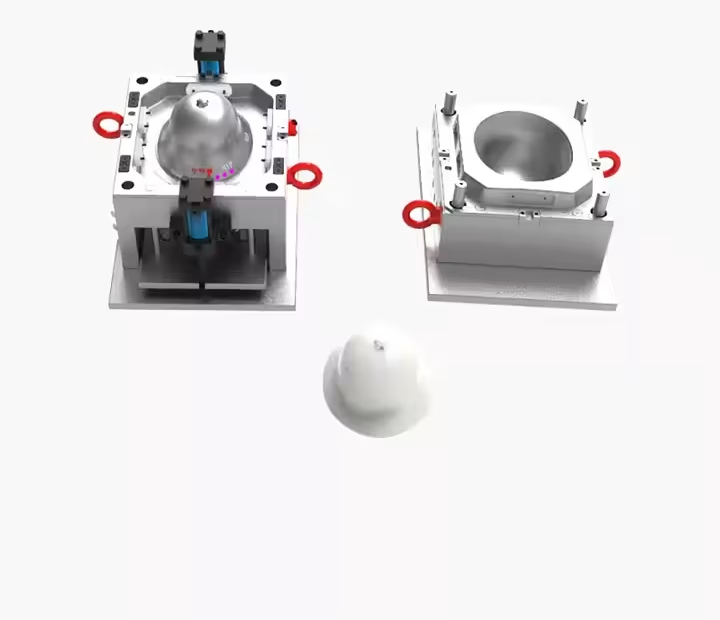
In modern industrial and construction sectors, safety helmets serve as the “first line of defense” to protect workers’ lives. Behind every helmet lies a sophisticated, efficient, and durable mold system. As the core tool for manufacturing safety equipment, the R&D and production of safety helmet molds not only determine product quality but also directly impact the safety of millions of workers. This article systematically explores the technological essence and industrial value of safety helmet molds from perspectives including technical principles, manufacturing processes, material innovation, industry challenges, and future trends.
Technical Principles and Functional Requirements of Safety Helmet Molds
1.Scientific Material Formulation
Safety helmet molds must withstand high-pressure injection (80-120MPa) and long-term thermal cycling (180-220°C), demanding strict material standards:
Special treatment: Local nitriding of deep cavity structures enhances corrosion resistance
Hot work mold steel: Predominantly H13 (4Cr5MoSiV1) steel for superior thermal stability and fatigue resistance
Surface treatment: PVD coating (TiAlN) increases surface hardness to HV2800+,extending mold lifespan by 30%-40%
2.Core Logic of Safety Protection
The protective performance of safety helmets stems from their unique structural design: the outer shell disperses impact forces, the inner liner absorbs energy through buffering, and the suspension system ensures stable wear. Molds must precisely replicate these structures to ensure every detail meets mechanical requirements. For instance:
- The thickness of top reinforcement ribs must be controlled at 1.5±0.2mm to balance puncture resistance and lightweight design.
- The curvature radius of the visor must align with the human head’s contour, with an error margin below 0.1mm.
3.Standardization Constraints in safety helmet molds Design
Global safety standards (e.g., EU EN 397, US ANSI Z89.1, China GB 2811) impose rigorous requirements on molds:
- Impact Resistance Test: Molded products must withstand impacts from a 5kg steel hammer dropped from 1m height.
- Penetration Resistance: Mold cavities must ensure products resist punctures by a 3kg cone dropped from 1m.
- Environmental Adaptability: Mold materials must endure temperature fluctuations from -30°C to 50°C.
These standards drive mold manufacturing precision to micrometer-level (±0.005mm) and demand lifespans exceeding 1 million cycles.
Manufacturing Processes Across the Supply Chain
1. End-to-End Production Workflow
- Digital Modeling: 3D design using software like UG/NX, optimized via topology algorithms (e.g., biomimetic honeycomb-structured liners).
- Precision Machining: Five-axis CNC milling for mold cores, EDM for micro-hole structures (surface roughness Ra ≤0.4μm).
- Heat Treatment: Vacuum quenching and tempering achieve steel hardness of HRC 52-54, enhancing toughness by 30%.
- Surface Coating: TiAlN coatings via PVD reduce friction coefficients to 0.15, tripling demolding lifespan.
2.Smart Manufacturing Innovations
Case Study: A German Manufacturer
- IoT sensors embedded in molds monitor real-time parameters: injection pressure (80-120MPa), temperature (200-280°C).
- AI algorithms predict cavity wear, auto-compensate dimensional deviations, boosting yield from 92% to 99.6%.
- Digital twin technology reduces virtual trial runs by 70%, shortening R&D cycles by 40%.
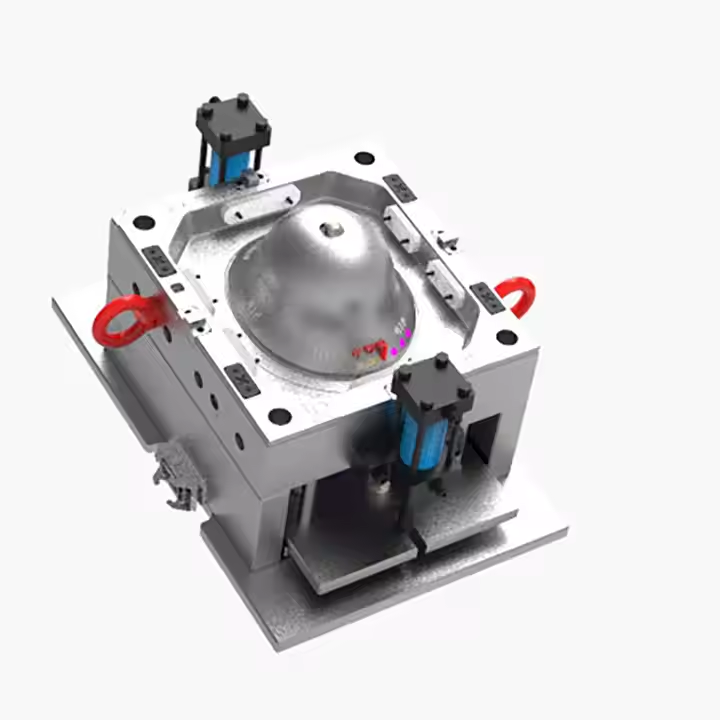

safety helmet molds Impact on Helmet Performance
1. Mechanical Performance Assurance
- Precision wall thickness control (3.0±0.1mm crown, 2.5±0.1mm sidewalls)
- 40% impact resistance improvement via rib structures (GB 2811-2019 compliant)
2. Functional Integration Innovations
- Sensor slot integration for smart modules
- Modular design enables rapid vent pattern switching
Industry Challenges and Solutions
Key Challenges
- Precision vs. Cost: Micro-hole processing (e.g., Φ0.3mm vents) increases mold costs by 25%.
- Customization Demands: Industry-specific designs (construction, mining) require mold changeovers exceeding 72 hours.
- Environmental Regulations: EU REACH restricts VOC emissions, pushing self-cleaning mold R&D.
Technological Breakthroughs
- Modular Design: 20 standardized modules enable “one mold, infinite variants,” cutting changeover to 4 hours.
- Additive Manufacturing: SLM-printed conformal cooling channels improve efficiency by 40%, reducing energy use 18%.
- Eco-Friendly Processes: Water-based demolding agents slash benzene emissions from 300mg/m³ to <5mg/m³.
Conclusion
From steam-era leather molds to Industry 4.0’s digital twins, the evolution of safety helmet molds epitomizes humanity’s relentless pursuit of life-preserving innovation. When a single mold’s cost equals the value of 100 helmets, the industry still obsesses over 0.01mm precision gains—because this could mean 1% fewer fatalities. As materials science, AI, and sustainability converge, safety molds will transcend industrial utility, embodying humanity’s commitment to technological ethics. This is manufacturing’s true purpose: building an iron wall to safeguard lives with cutting-edge technology.