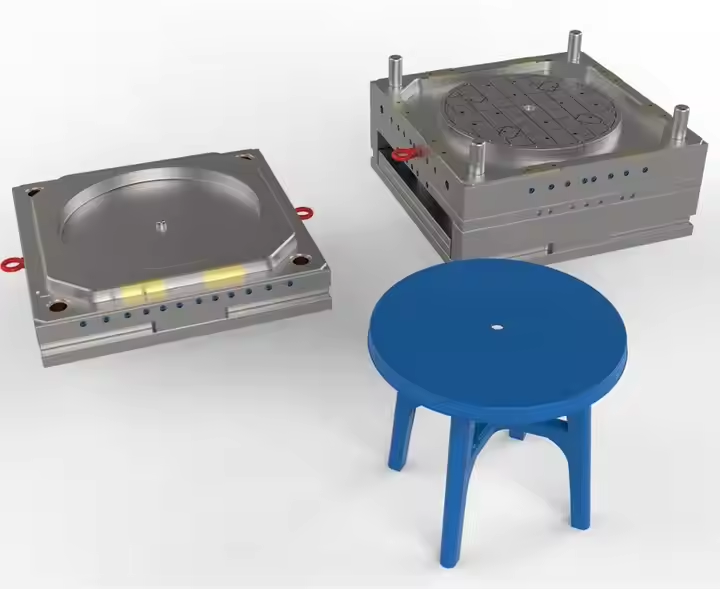
Molds are the mother of industrial products” – In today’s era of mass-produced plastic furniture, round table molds serve as core equipment for curved surface injection molding. Their precision directly determines the aesthetic integrity, structural stability, and production economy of tabletop products. With consumption upgrades driving demand for lightweight and customized solutions, mold design has evolved from traditional mechanical engineering to a multidisciplinary convergence of multiphysics simulation, topology optimization, and intelligent closed-loop control, ushering furniture manufacturing into the “micro-tolerance era.
Design Fundamentals: Structural Features and Core Principles
- Parting Surface and Cavity Optimization
- Invisible Parting Line Design: Stepped or curved parting structures minimize flash in visible areas with clamping clearance ≤0.03mm.
- Dynamic Shrinkage Compensation: For POM material’s localized shrinkage fluctuation (20‰-30‰), a 1000mm-diameter tabletop cavity requires pre-enlargement to 1020-1030mm, with gradient compensation via flow analysis.
- Gating and Ejection Systems
- Multi-Point Hot Runner Balancing: For 840-1200mm diameter tabletops, 8-12 valve-gate hot runners ensure melt pressure differential <5MPa, with gate remnants recessed 0.3-0.5mm.
- Pneumatic-Assisted Ejection: Ribbed bottom areas utilize pneumatic ejection + precision plates (±0.03mm tolerance), with draft angles ≥1.5° (visible) and ≥0.5° (non-visible).
- Material Compatibility Rules
- High-Gloss Tabletops: Cavities employ NAK80 mirror steel (HRC38-41), polished to Ra≤0.01μm to eliminate orange peel texture.
- Glass-Fiber Reinforced Materials: For PA+GF30 applications, nitrided H13 steel (HV900) extends lifespan to 500k cycles.
Material Science and Process Excellence
The exceptional performance of round table molds is rooted in the selection of advanced materials and the refinement of extreme processes.
- The “Arsenal” of Special Tool Steels:
- Pre-hardened Champion: P4410 / 1.2738 (German Standard): Delivers 32-36 HRC hardness out-of-the-box, offering an excellent balance of machinability and polishability. It is the mainstay for complex surfaces and large molds. Its high purity and uniform structure ensure minimal heat treatment distortion. After PVD/CVD coating (e.g., TiAlN, CrN), surface hardness can exceed 1200 HV, multiplying wear life.
- Mirror Polishing Star: 8Cr2S / Modified S136: Characterized by high purity and extremely low sulfur content. Special smelting and heat treatment processes yield ultra-fine carbide distribution, achieving Ra 0.05μm and below super-mirror finishes, perfectly replicating natural stone textures, wood grains, or high-gloss/matte effects. It is the top choice for high-end furniture and artistic tabletops.
- Longevity Workhorse: 2738HH / Optimized H13: Designed for high-volume production requiring extreme wear resistance. Addition of vanadium, molybdenum, and other strengthening elements enhances high-temperature strength and thermal fatigue resistance. Using vacuum high-pressure gas quenching combined with deep cryogenic treatment, mold life easily surpasses 1.2 million cycles, significantly reducing per-part cost.
- Cutting-Edge Exploration: Powder Metallurgy High-Speed Steel / Hard Alloy Inserts: Applied to high-wear areas like gates and ejector pins, achieving hardness above 65 HRC, offering multiple times the lifespan of traditional steels.
- Symphony of the Digital Process Chain:
- Deep CAD Modeling: Utilizing advanced NURBS surface technology to build seamless, joint-free round table contours, accounting for draft angles, shrinkage compensation, and other details.
- Precise CAE Simulation: Moldflow analysis covers filling, packing, cooling, and warpage modules. Optimizing variable cross-section conformal cooling channels keeps mold temperature field uniformity within ±3°C, eliminating hot spots, shortening cooling time by 30%, and drastically reducing residual stress deformation caused by temperature gradients.
- Intelligent CAM Machining: Five-axis high-speed machining centers (HSM) are the workhorses. Employing efficient strategies like trochoidal milling and vortex milling for complex surfaces delivers high surface quality in one step. Precision Electrical Discharge Machining (EDM) handles sharp corners and fine texture details, achieving accuracy up to ±0.005mm. High-Speed Hard Milling directly machines hardened steel (>50 HRC), eliminating electrode manufacturing and EDM steps.
- Surface Enhancement and Micro/Nano Manufacturing:
- Plasma Nitriding/Nitrocarburizing: Forms a dense compound layer on the mold surface, significantly enhancing wear resistance, anti-galling properties, and corrosion resistance.
- Micro/Nano Texturing: Creates fine wood grains, leather textures, geometric patterns, etc., on the mold surface via photochemical etching or laser processing, imparting unique tactile and visual effects to the tabletop.
Manufacturing process of Round Table Molds
- Five-Axis Machining for Cavity Formation
- Deep grooves utilize wire EDM machining (Ra 0.4μm) instead of EDM to prevent white layers; texture achieved via chemical etching (depth 0.1-0.3mm).
- Heat Treatment and Assembly Precision
- Vacuum quenching + double tempering for H13 steel maintains hardness gradient within HRC±1, reducing thermal cracks by 40%.
- CMM inspection: Flatness error <0.08mm, 3° locking surfaces prevent flash.
- Conformal Cooling Channel Technology
- 3D-printed stainless steel channels (10-15mm from cavity) improve cooling efficiency by 40%, shortening cycle time 25%; inlet temperature differential ≤2°C (precision molds).
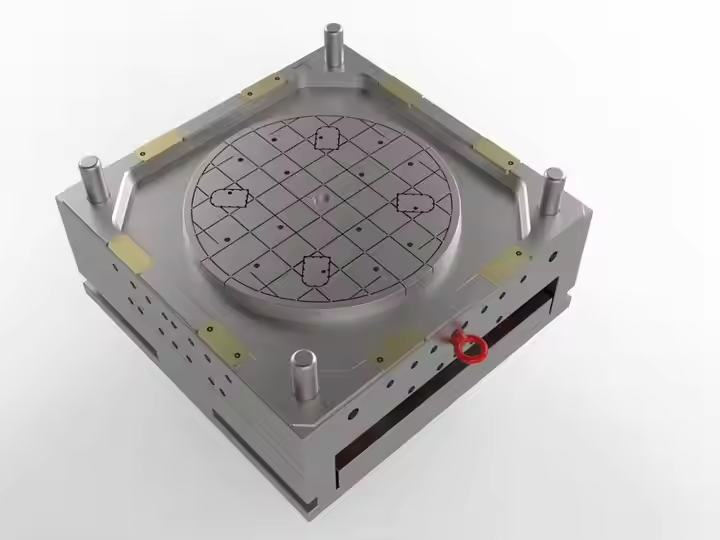
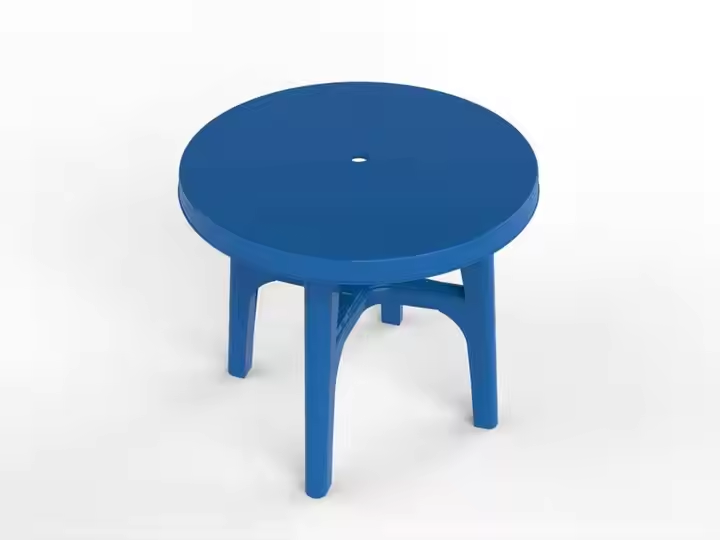
Application of Round Table Molds
- Plastic Material Solutions
- PP/PE Tabletops: Shrinkage 15-20‰, mold temp 40-60°C, 738 steel cavities ($4000/ton).
- Engineering Plastics (PC/PA): Mold temp controllers maintain 80-110°C, cavities require 2738 heat-resistant steel.
- Product-Specific Optimization
- Folding Table Hinges: 18-22° angled sliders + delayed opening ensure intact demolding.
- Freeform Surfaces: Topology-optimized supports (BESO algorithm) reduce weight 30% while maintaining load capacity.
- Volume-Driven Configuration
- <5k pieces/month: Domestic SM45 steel cuts cost 50%.
- 15k pieces/month: NAK55/2344 steel ensures 1M-cycle lifespan.
Conclusion
The round table molds, this precision equipment operating silently behind production lines, is truly an artifact born from the intersection of modern industrial civilization and spatial aesthetics. It is not merely a tool for shaping physical forms but a vessel carrying technological innovation and artistic expression. From the precision milling of five-axis machines in Huangyan workshops to the radiant artistic tabletops on international exhibition stages, Chinese manufacturing, with relentless dedication, continues to break through in materials, processes, and intelligence, constantly approaching the limits of precision and the peak of efficiency.
>>You may also like
Standards & References
The following industry standards are referenced in this article: