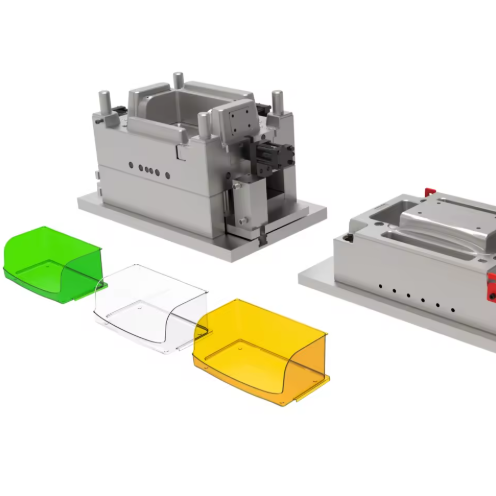
Material Selection for Refrigerator Storage Bin Molds
Selecting the right mold steel is critical for manufacturing high-quality refrigerator storage bins that meet food safety standards and durability requirements. The ideal material must balance wear resistance, corrosion resistance, and thermal conductivity while ensuring compliance with food contact regulations.
Common Mold Steel Types
- 718H (DIN 1.2738): A pre-hardened plastic mold steel with excellent polishability and machinability. Its hardness of 33-37 HRC provides sufficient wear resistance for mid-volume production runs (300,000-500,000 cycles). This steel is widely used for transparent or textured bin surfaces due to its ability to achieve mirror-like finishes (A1-A3 polish levels).
- S136 (DIN 1.2083): A corrosion-resistant stainless steel with superior chemical resistance, making it ideal for molds exposed to food-grade plastics and cleaning agents. Its hardness (28-32 HRC) and low carbon content minimize oxidation, ensuring the mold maintains precision over extended use. S136 is recommended for bins requiring frequent sanitization, such as those used in commercial refrigerators.
- NAK80: A nickel-hardened steel with exceptional surface finish capabilities (up to A0 polish) and dimensional stability. Its uniform hardness (38-42 HRC) eliminates the need for post-heat treatment, reducing production lead times. NAK80 is preferred for high-gloss bins where visual appeal is critical.
Material Selection Criteria
- Food Contact Compliance: All steels must meet FDA 21 CFR §177.2600 for plastic materials in contact with food. S136 and NAK80 are particularly suitable due to their low heavy metal leaching properties.
- Production Volume: For high-volume production (>1 million cycles), consider harder steels like H13 (DIN 1.2344) with 44-48 HRC, though its lower polishability may limit aesthetic applications.
- Cost Efficiency: 718H offers a balance of performance and cost for most residential refrigerator bins, while S136 is justified for premium or commercial-grade products.
Injection Molding Process Parameters
The injection molding process for refrigerator storage bins demands precise control to avoid defects like warpage, sink marks, and weld lines, which can compromise functionality and aesthetics.
Key Process Parameters
- Temperature Control:
- Melt Temperature: 220-260°C for PP (polypropylene) and 240-280°C for ABS (acrylonitrile butadiene styrene), the most common bin materials.
- Mold Temperature: 40-60°C for PP to reduce internal stress and 60-80°C for ABS to improve surface finish.
- Injection Speed and Pressure:
- Fill Speed: 50-80 mm/s to ensure uniform flow, with slower speeds (30-50 mm/s) near the end of fill to prevent flash.
- Hold Pressure: 60-80% of injection pressure (typically 80-120 MPa) to compensate for shrinkage, especially critical for thin-walled bins (1.5-3 mm thickness).
- Cooling Time: 15-30 seconds, depending on bin thickness. Optimized cooling channels (diameter 8-12 mm, spacing 30-50 mm) in the mold ensure uniform cooling and minimize cycle time.
Defect Prevention
- Warpage Control: Use mold flow analysis (MFA) to optimize gate placement and cooling channel design. For large bins (>500 mm length), consider sequential valve gating to balance pressure distribution.
- Sink Marks: Maintain a hold pressure-to-time ratio of 1:3 (e.g., 100 MPa for 3 seconds) and avoid abrupt transitions in wall thickness (>20% variance).
- Flash Reduction: Ensure mold clamping force (300-500 tons for standard bins) matches the projected area (cm²) multiplied by specific pressure (30-50 MPa).
Industry Standards and Quality Control
Refrigerator storage bins must adhere to strict standards for safety, durability, and performance.
International Standards
- ISO 10360-2: Specifies geometric tolerance for mold components, requiring dimensional accuracy of ±0.02 mm for critical features like bin rails and lids.
- ASTM D638: Tensile strength testing for plastic bins, with minimum values of 20 MPa for PP and 40 MPa for ABS to ensure load-bearing capacity (e.g., 5 kg for small bins, 15 kg for large bins).
- FDA Food Contact Testing: Compliance with migration limits (≤50 ppm for total extractables) per FDA 21 CFR §177.1520 for olefin polymers.
Quality Control Measures
- In-Process Inspection: Use coordinate measuring machines (CMM) to verify critical dimensions, such as bin depth (±0.5 mm) and lid fit clearance (0.3-0.5 mm).
- Material Testing: Perform melt flow index (MFI) tests (230°C/2.16 kg) to ensure plastic consistency, with PP typically ranging 2-10 g/10 min.
- Durability Testing: Conduct 10,000-cycle lid opening/closing tests and 500-hour temperature cycling (-20°C to 60°C) to simulate real-world use.
Surface Treatment and Structural Design
The surface finish and structural design of refrigerator bins directly impact usability, cleanability, and mold longevity.
Surface Treatment Techniques
- Polishing: Achieve SPI #A3 finish for transparent bins using diamond pastes (3-6 μm grit) and ultrasonic cleaning to remove residual particles.
- Texturing: Apply EDM or chemical etching for non-slip surfaces (e.g., Ra 1.6-3.2 μm) to prevent food sliding. Popular textures include orange peel (MT11010) and leather grain (MT11020).
- Corrosion Protection: For S136 molds, passivate with nitric acid (20-30% concentration) to form a protective oxide layer, extending mold life by 30% in humid environments.
Structural Design Best Practices
- Rib Design: Use rib height-to-thickness ratios ≤4:1 and draft angles ≥1° to prevent sink marks. Add fillets (R=0.5-1 mm) at rib intersections to reduce stress concentration.
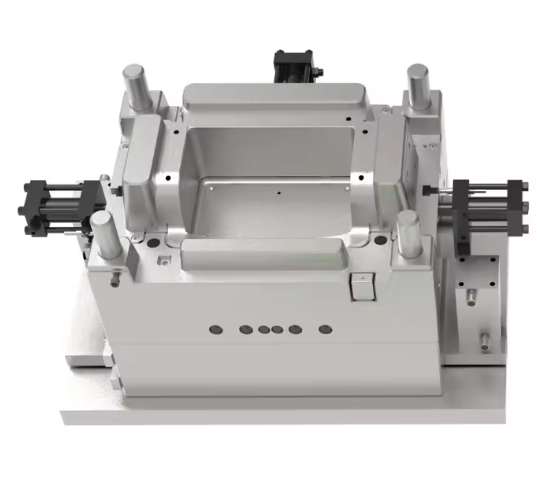
- Undercuts: Minimize undercuts (e.g., bin handles) to simplify mold design. When necessary, use side-action cores with hydraulic actuators for complex geometries.
- Stackability: Incorporate interlocking features (e.g., recessed rails) with tolerances of ±0.2 mm to ensure stable stacking without jamming.
Future Trends in Mold Technology
Advancements in materials and manufacturing technologies are reshaping refrigerator storage bin mold design.
Emerging Materials
- Bio-based Plastics: Mold steel compatibility with PLA (polylactic acid) and PHA (polyhydroxyalkanoates) requires modified cooling systems due to their lower thermal conductivity (0.15-0.2 W/m·K vs. PP’s 0.2-0.25 W/m·K).
- Recycled Plastics: Molds for PCR (post-consumer recycled) PP may need increased venting (0.03-0.05 mm gap) to release volatile compounds from additives.
Smart Manufacturing
- Digital Twins: Use Moldflow and CAD integration to simulate warpage and optimize cooling channels, reducing trial runs by 40%.
- Additive Manufacturing: 3D-printed conformal cooling inserts (e.g., using SLM with maraging steel) can reduce cycle time by 20-30% by improving heat transfer efficiency.
Sustainability: Lightweighting designs (e.g., lattice structures) and mold recycling (S136 scrap can be reclaimed and re-hardened) align with OEMs’ carbon neutrality goals.
By integrating these technical considerations—from material selection to smart manufacturing—manufacturers can produce refrigerator storage bins that balance performance, cost, and sustainability, meeting the evolving demands of the global appliance market.
FAQ
- What is a Refrigerator Storage Bin Mold?
A Refrigerator Storage Bin Mold is an injection mold used to manufacture plastic bins for refrigerator organization and storage. - What materials are commonly used with a Refrigerator Storage Bin Mold?
A Refrigerator Storage Bin Mold typically works with food-grade plastics such as PET, PP, or PS for safety and durability. - Is a Refrigerator Storage Bin Mold suitable for food-contact products?
Yes, a Refrigerator Storage Bin Mold can be designed to meet FDA or LFGB food-contact requirements. - Can a Refrigerator Storage Bin Mold be customized in size and shape?
A Refrigerator Storage Bin Mold can be fully customized to match specific bin dimensions, thickness, and design features. - What surface finishes are available for a Refrigerator Storage Bin Mold?
A Refrigerator Storage Bin Mold can support high-polish, matte, or textured finishes depending on visual and functional needs. - How long is the production life of a Refrigerator Storage Bin Mold?
A high-quality Refrigerator Storage Bin Mold can support hundreds of thousands to millions of injection cycles. - Does a Refrigerator Storage Bin Mold support transparent products?
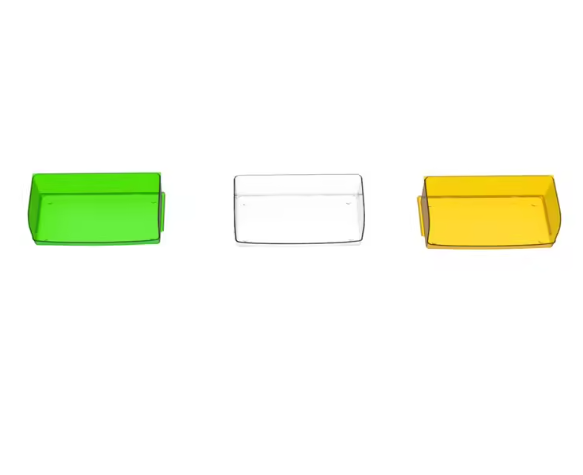
Yes, a Refrigerator Storage Bin Mold is often optimized for crystal-clear bins with excellent surface clarity. - What is the typical lead time for a Refrigerator Storage Bin Mold?
The lead time for a Refrigerator Storage Bin Mold usually ranges from 25 to 45 days, depending on complexity. - Can a Refrigerator Storage Bin Mold be designed for high-volume production?
A Refrigerator Storage Bin Mold can be engineered with multi-cavity layouts for efficient mass production. - What factors affect the cost of a Refrigerator Storage Bin Mold?
The cost of a Refrigerator Storage Bin Mold depends on cavity number, steel type, surface finish, and design complexity.
>>You may also like
Standards & References
The following industry standards are referenced in this article: