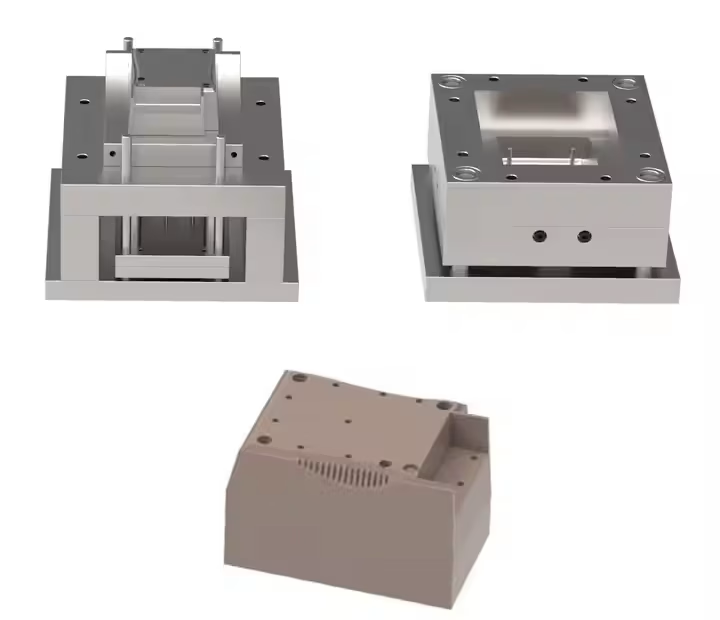
In the modern office equipment manufacturing industry, printers, as core output devices, rely heavily on the precision of their components. The printer base molds—the “foundation” supporting the entire machine—directly impacts not only the printer’s aesthetic quality but also its stability, thermal performance, and lifespan. This article explores the critical aspects of printer base molds design, advanced manufacturing processes, and emerging industry trends.
Core Considerations in printer base molds Design
Structural Mechanics Optimization
Printer bases must withstand the device’s weight, paper stack pressure, and dynamic operational loads. Finite Element Analysis (FEA) is used to simulate stress distribution, with rib layouts adjusted based on printer models (e.g., desktop vs. industrial). For instance, a leading A3 laser printer base employs a honeycomb reinforcement structure, achieving a 40% increase in load capacity while maintaining a lightweight 1.8kg design.
Integrated Thermal Management
Modern high-speed printers generate temperatures of 60–80°C, necessitating optimized cooling channels. Innovations include:
- Aerodynamically designed bottom airflow grooves and side vents
- Hybrid molding with embedded metal heat sinks
- Phase-change material cavities for temperature regulation
Precision Tolerance Control
To ensure seamless assembly with printer bodies and transmission components, dimensional tolerances are controlled within ±0.05mm. A global brand utilizes Moldflow software for shrinkage compensation, reducing flatness errors to 0.1mm/m² through cavity pressure optimization.
Advancements in Precision Manufacturing Technologies
Micro-Nano Fabrication Processes
- Microcellular foaming: South Korea’s LSMT employs supercritical CO₂ foaming to create 30μm closed-cell structures in 0.05 seconds, improving sound insulation by 15dB
- Metal 3D-printed inserts: EOS laser sintering produces mold cores with conformal cooling channels, shortening injection cycles by 18%
Intelligent Process Control
Siemens’ industrial cloud solutions enable:
- Mold temperature fluctuations controlled within ±0.5°C (vs. ±3°C in traditional methods)
- Real-time injection pressure compensation, achieving wall thickness variation <0.03mm
- AI-driven mold health diagnostics with 92% predictive maintenance accuracy
Hybrid Machining Technologies
Switzerland’s GF Machining Solutions integrates:
- 5-axis micro-milling (surface roughness Ra0.2μm)
- Micro-blasting (0.1mm textured patterns)
- Pulse electroplating (coating thickness 5μm±0.2μm)

Material Innovation Matrix
Functionally Graded Materials
BASF’s sandwich-structured material includes:
- Surface layer: 30% glass fiber-reinforced PA66 (hardness HR115)
- Middle layer: Foamed TPU (85% energy absorption)
- Base layer: Carbon fiber composite (flexural modulus 12GPa)
Self-Healing Material Applications
Cambridge University’s microcapsule system features:
- 50μm dicyclopentadiene-filled capsules
- Grubbs catalyst-triggered repair upon rupture
- 78% recovery of original mechanical strength
Bio-Based Material Breakthroughs
Covestro’s mass-balanced plastics:
- 70% sourced from recycled cooking oil
- 60% reduction in carbon footprint
- UL ECOLOGO certification compliance
Advanced Manufacturing Processes of printer base molds
Precision Machining Technologies
- 5-axis CNC milling: Achieves mold cavity surface roughness of Ra0.4μm
- EDM (Electrical Discharge Machining): Processes deep cavities and intricate features like snap-fit slots
- Laser texturing: Creates anti-slip patterns and micro-logos on printer base molds surfaces
Innovative Injection Molding Techniques
Tailored processes for material properties:
- Gas-assisted injection molding (GAIM): Produces bases with hidden cable channels, improving wall thickness uniformity by 30%
- Microcellular foaming: Reduces PC+ABS material density by 15% without compromising strength
- Two-shot molding: Integrates soft shock-absorbing pads with rigid bases in a single cycle
Smart Manufacturing Systems
A Japanese manufacturer’s intelligent printer base molds system features:
- Modular temperature zone control (8 independent zones)
- Real-time pressure sensing with auto-compensation
- Mold lifespan prediction (±500 cycles accuracy)
Breakthroughs in Material Science
Advanced Engineering Plastics
- Carbon fiber-reinforced nylon (PA-CF): Tensile strength up to 210MPa for industrial-grade bases
- LDS (Laser Direct Structuring) materials: Enable embedded circuitry for smart bases
- Bio-based polymers: DuPont’s EcoBlend reduces carbon footprint by 45%
Metal-Plastic Hybrid Technologies
- Magnesium alloy insert molding: Enhances load-bearing areas with lightweight metal frames
- Nanocoating treatments: Achieve 9H surface hardness and 5x wear resistance
3.3 Sustainable Material Innovations
HP’s patented process recycles 92% of cartridge plastics for base manufacturing, validated through rigorous lifecycle assessments.
Quality Control and Testing Protocols
4.1 Digital Inspection Systems
- Blue-light 3D scanning: Full-dimension inspection in 15 minutes
- Industrial CT scanning: Detects internal defects as small as 0.02mm³
- AI-powered weld line strength prediction: >95% accuracy
4.2 Environmental Simulation Testing
Compliance with:
- 1,000-hour damp heat testing (85°C/85% RH)
- 5–500Hz random vibration tests
- 1.2m free-drop impact validation
4.3 Global Certification Standards
Meets ISO 9001:2015, IEC 62368-1, and UL94 V-0 flame-retardancy requirements.
Conclusion
As printers evolve into 5G IoT-enabled smart devices, printer base molds must integrate sensor mounts, wireless charging modules, and enhanced recyclability. Emerging technologies like topology optimization algorithms and digital twins promise to slash design cycles by 50%, while closed-loop material recycling aligns with zero-waste goals. At the intersection of precision engineering and sustainable innovation, printer base molds are redefining the future of intelligent manufacturing.