
On supermarket shelves or within home storage spaces, plastic storage baskets are ubiquitous due to their lightweight, durable, and stackable nature, reliably supporting significant loads. The core enabling technology behind the efficient, large-scale, and consistent production of this essential everyday item is a sophisticated piece of industrial equipment: the plastic storage basket mold. The transformation from plastic pellets to the final basket form relies entirely on a highly complex system of precisely designed and manufactured metal molds.
I. Core Design Challenges Posed by Complex Geometry
Plastic Storage Basket Mold design forms the foundation of the production process and represents the focal point of technical difficulties. The primary design constraints stem directly from the product’s unique functional and geometric requirements:
- Uniform Wall Thickness & Cooling Control: Storage baskets require sufficient strength for load-bearing. Designers must strive for uniform wall thickness distribution. Non-uniform thickness leads directly to uneven cooling rates of the plastic, causing severe issues like differential shrinkage, warping, distortion, and even stress cracking, compromising the final product’s strength and dimensional accuracy.
- Deep Cavity Walls & Flow Resistance: Storage baskets typically feature deep side walls. During injection molding, molten plastic must flow long distances to completely fill these deep cavities. Flow resistance increases with distance; poorly designed flow paths or incorrect injection parameters easily result in incomplete filling at the extremities (short shots), weak weld lines (where flow fronts meet), or visible surface flow marks.
- Bottom Support Structures & Cooling Efficiency: To withstand weight and prevent sagging, basket bottoms are often designed with grid patterns or reinforcing ribs. The intersections of these grids and ribs are areas of material accumulation (known as hotspots). These regions cool significantly slower than thin wall sections. If the mold’s cooling channel design cannot effectively remove heat from these areas, it not only extends the production cycle time but also aggravates internal stress buildup, becoming a potential cause for product deformation or failure later in service.
- Surface Texture & Release Requirements: Bottom surfaces often include anti-slip textures to increase friction and durability, but this must be balanced against ease of release (de-molding). Excessively deep textures or insufficient draft angles can cause the part to stick in the mold. Furthermore, intricate textures impose higher demands on mold surface finishing. Internal side-wall smoothness impacts the user experience when placing or removing items and facilitates stable stacking of the baskets themselves.
- Compatibility with Stacking/Nesting Design: To optimize storage and shipping space, storage basket designs typically incorporate stacking or nesting features. plastic storage basket mold design must precisely guarantee the external contour dimensions and necessary taper angles to ensure mass-produced baskets stack or nest smoothly and stably.
II. Core Engineering Solutions: Critical Plastic Storage Basket Mold Systems
To overcome the aforementioned design challenges and achieve efficient production, plastic storage basket mold integrate multiple precision-engineered systems:
- Slide Action Systems (Side Actions):
- Function: Storage baskets often feature side handles, reinforcing structures, or complex bottom edges that create undercuts relative to the main mold opening direction, making simple core/cavity separation impossible for de-molding.
- Implementation: Molds incorporate sliding components, driven by angled leader pins or hydraulic cylinders. Before or during the initial opening motion, these slides must move along precisely calculated paths (usually perpendicular to the main opening direction) to clear the undercuts on the plastic part. Their precision of movement, reliability, and durability (achieved through high hardness and effective lubrication) are critical for mold life and product quality. Design requires meticulous calculation of slide travel distance, locking angles, and integration with cooling channels.
- Ejection System:
- Function: Once cooled and solidified, the molded part must be cleanly released from the mold core and cavity, overcoming adhesion and shrinkage forces, without causing damage.
- Implementation: Catering to the large bottom surface area of storage baskets, a combination of ejector pins and ejector blades is common. Blades provide broad support across large areas, ensuring uniform ejection force and preventing part distortion; pins act on localized critical structures or areas inaccessible to blades. The entire ejection system, driven by the injection molding machine’s ejector mechanism, must move precisely along fixed guides and fully retract before mold closing. The positioning of ejectors, applied ejection force, and draft angles are critical design factors.
- High-Efficiency Cooling System:
- Function: To minimize production cycle time (by reducing cooling time), eliminate hotspots, and achieve uniform part cooling rates to minimize warpage and residual stress.
- Implementation: A dense network of cooling channels is machined directly into the mold steel. Channel layout is paramount: channels should be positioned as close as possible to the cavity and core surfaces, particularly near deep wall sections, grid nodes, rib intersections, and other hotspot locations. Channel diameter, connection methods (series/parallel), and coolant flow control all impact cooling efficiency. Deep cavity molds often require baffle cooling channels or bubblers to direct coolant flow to specific areas. An optimized cooling system is fundamental for achieving high output, high quality, and low cost.
- Runner & Gating System:
- Function: To efficiently and reliably deliver molten plastic from the injection machine nozzle into the mold cavity, minimizing pressure loss and material waste.
- Implementation: Cold runner systems are typical. The sprue and runner channels must be sized and shaped to minimize pressure drop and temperature loss during filling and ensure balanced filling of all cavities (in multi-cavity molds). The gate, the entry point into the cavity, determines melt entry speed, shear heating, fill pattern, and potential weld line locations. Gate type (pin point, fan, submarine/tunnel, etc.), location, and size critically impact final product appearance, strength, and residual stress. Large storage baskets often require multiple gates to ensure filling balance and reduce the flow path length.
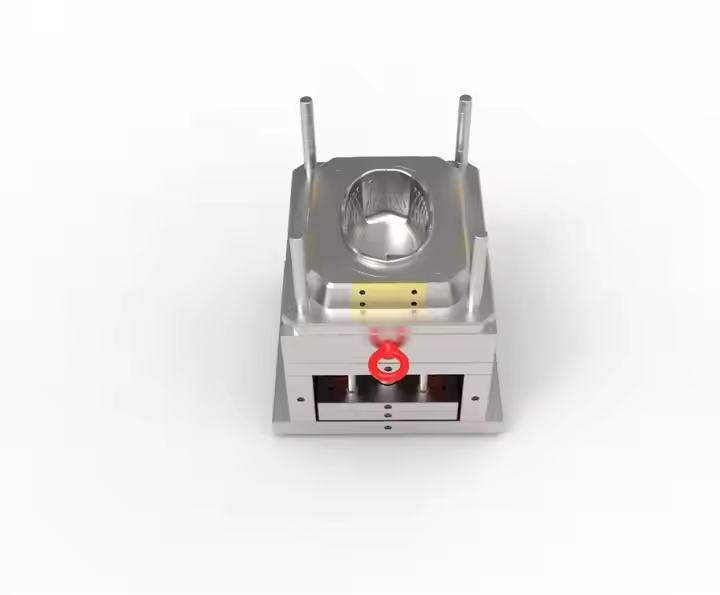
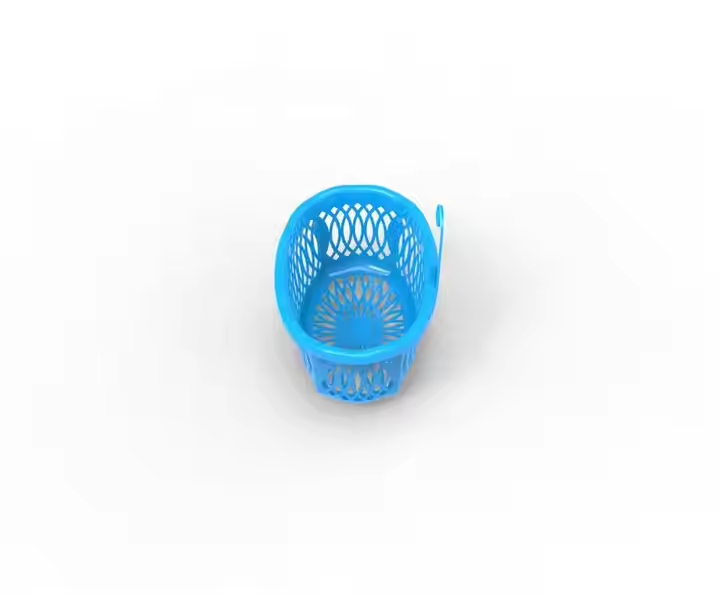
III. Material Selection: The Foundation of Plastic Storage Basket Mold Durability
Plastic Storage Basket Mold durability directly impacts service life, maintenance cost, and the long-term consistency of the produced parts:
- Core Mold Steels: Cavity and core blocks, slides, and ejector blades must utilize premium mold steels like pre-hardened types (e.g., P20/P20+Ni) or hardened tool steels (e.g., H13, S7). Key properties are high hardness (resisting plastic wear), excellent polishability (for smooth part surfaces), superior thermal conductivity (for efficient cooling), and adequate toughness (to resist impact and fatigue). Heat treatment processes are crucial for achieving final properties.
- Supporting Components: Guide pins and bushings are typically made from hardened high-carbon alloy steels; ejector pins and return pins often use tool steels or specialized ejector pin materials; mold plates use high-strength structural steels.
IV. Manufacturing of plastic storage basket mold
High-quality plastic storage basket mold result from advanced machining processes and strict quality control:
- Core Manufacturing Technologies:
- CNC Machining Centers: Handle roughing and finishing of mold bases and machining the core shapes of complex cavities and cores, offering high positioning accuracy and repeatability.
- Electrical Discharge Machining (EDM): Encompasses sinker EDM (for deep cavities, complex contours, sharp corners, ribs, slots where CNC struggles) and wire EDM (for high-precision cutting of slides, blades, plate holes, and corner reliefs). EDM is essential for achieving fine details and machining deep, narrow areas.
- Precision Grinding: Ensures critical flatness (e.g., mold plates), dimensional tolerances, and precise fits (e.g., guide pin/bushing interfaces, slide locking faces).
- Surface Finishing:
- Polishing: A progressive process using finer abrasives to eliminate machining marks, achieving a mirror finish (or desired textured surface) for smooth part release and aesthetic appeal.
- Surface Enhancement Treatments (Optional): Processes like nitriding or PVD coatings can significantly increase surface hardness, wear resistance, and corrosion resistance of critical components (e.g., slides, cavities), extending plastic storage basket mold life.
V. Commissioning & Production: Bringing Design to Reality
After assembly, plastic storage basket molds undergo rigorous commissioning (trial):
- Dry Cycling: Checks the smoothness and completion of plastic storage basket mold opening/closing actions, slide movements, and ejector retraction/repositioning, ensuring no binding or unusual noise.
- Sampling (Trial Shots): Produces parts using the intended production material. Based on these samples (inspected for fill completeness, dimensions, weight, appearance, warpage, stress marks, etc.), injection process parameters (temperature, pressure, velocity, time, hold pressure) are iteratively adjusted. Minor mold modifications (e.g., gate adjustments, runner polishing, coolant flow optimization) might also be necessary. The goal is to achieve product quality targets while optimizing production efficiency (cycle time minimization).
- Mass Production: Once validated, the plastic storage basket mold is installed on a high-tonnage injection molding machine for continuous operation. Here, the mold endures long-term exposure to frequent mechanical cycling, thermal fluctuations, and material abrasion. Its original design and manufacturing quality are tested, determining production stability and yield rate.
Conclusion
The plastic storage basket mold is far more than a simple metal container. It is a complex system integrating diverse engineering disciplines including mechanical design, material science, fluid dynamics, thermodynamics, and precision manufacturing. Each successfully produced basket stands as the culmination of ingenious plastic storage basket mold design, meticulous precision in execution, and exacting control during the process commissioning and refinement phases. These steel hearts, hidden within industrial workshops, beat at a steady rhythm, transforming inexpensive plastic pellets into the practical, reliable, and cost-effective everyday companions found in millions of homes and businesses. They embody the essence of modern mass manufacturing: utilizing robust, engineered solutions to precisely replicate design intent, shaping the tangible, commonplace yet indispensable world of everyday objects.
>>You may also like
Standards & References
The following industry standards are referenced in this article: