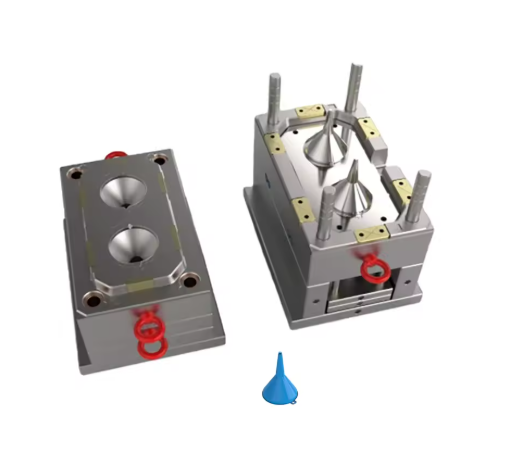
Plastic speaker molds represent a critical category of precision tooling requiring specialized material selection and manufacturing techniques to produce high-quality audio components. This technical guide outlines optimized mold steel solutions for manufacturing plastic speaker components, focusing on material properties, design considerations, and quality control protocols specific to acoustic applications. The document adheres to international standards for audio equipment manufacturing while maintaining compatibility with existing plastic speaker mold design frameworks established in previous guides.
Material Selection
Pre-hardened Steel 718H
Application Scenario: Structural components including speaker frames, brackets, and mounting hardware.
Performance Parameters:
- Delivery hardness: 32-36 HRC
- Dimensional stability: ±0.002mm/m after machining
- Machinability rating: 85% compared to standard P20 steel
- Polishing capability: Uniform finish up to Ra 0.8 μm
Heat Treatment: Pre-hardened to specification, no post-machining heat treatment required.
Advantages: Excellent dimensional stability for critical mounting features; reduces production lead time by 25% for multi-cavity molds; maintains tight tolerances in complex geometries with wall thickness variations down to 0.5mm; suitable for production volumes up to 300,000 units.
Corrosion-Resistant Steel S136
Application Scenario: Acoustic components including speaker cones, dust caps, and decorative trim.
Performance Parameters:
- Hardness: 48-50 HRC after hardening
- Surface finish:It can reach Ra 0.4 μm (high-gloss finish)
- Chemical resistance: Unaffected by common molding release agents and cleaning solutions
- Wear resistance: 500,000+ cycles without measurable surface degradation
Heat Treatment: 1050°C solution annealing followed by triple tempering at 200°C.
Advantages: Superior surface finish for acoustic components; minimizes flow lines that could disrupt sound waves; excellent corrosion resistance for extended mold life; reduces secondary finishing operations by 40% compared to conventional steels.
Mirror-Finish Pre-hardened Steel NAK80
Application Scenario: Small to medium-sized speaker molds requiring high cosmetic quality without secondary polishing.
Performance Parameters:
- Delivery hardness: 38-42 HRC
- Polishing performance: Direct finish up to Ra 0.2 μm without additional heat treatment
- Internal integrity: Ultrasonic tested to ensure no subsurface defects
- Machinability: Excellent for complex 3D contours and fine details
Heat Treatment: Specialized pre-hardening process eliminating the need for post-machining heat treatment.
Advantages: Eliminates the need for post-machining hardening; reduces production time by 30% compared to heat-treated steels; ideal for prototypes and medium-volume production runs (50,000-200,000 units); maintains dimensional stability in thin-walled sections down to 0.3mm.
Design and Manufacturing Guidelines
plastic speaker mold Geometry Essentials
- Tolerance specifications: ±0.02mm for voice coil mounting features; ±0.05mm for non-critical dimensions
- Concentricity requirements: ≤0.03mm total indicator reading (TIR) for magnet assembly locations
- Surface finish progression: #400 → #800 → #1200 grit sequence for acoustic surfaces
- Draft angles: 1.0-1.5° for external surfaces; 0.5° minimum for textured surfaces
Precise geometric control is essential for ensuring proper alignment of acoustic components, which directly impacts sound quality and performance.
Critical Manufacturing Processes of plastic speaker mold
- CNC machining: 5-axis capability for complex acoustic geometries with 0.005mm positioning accuracy
- EDM operations: Fine-finish EDM with surface roughness control to Ra 0.8 μm for functional surfaces
- Polishing methodology: Sequential diamond compound polishing for acoustic surfaces with progressively finer grits (3μm → 1μm)
- Texturing options: Uniform matte finish (Ra 1.6 μm) for non-acoustic surfaces to minimize visual defects
Special attention must be paid to maintaining consistent wall thickness in acoustic components, with maximum variation limited to ±0.1mm to ensure uniform vibration characteristics.
Tooling System Design
- Gating strategy: Submarine or edge gating for structural components; hot tip gating for acoustic surfaces to minimize flow marks
- Cooling configuration: Uniform cooling with 8mm diameter channels positioned 25mm from cavity surfaces
- Vent system: Micro-venting (0.015-0.02mm depth) at parting lines and flow fronts to prevent gas entrapment
- Ejection system: Balanced pin ejection with 0.05mm clearance to prevent surface marking on visible components
The cooling system design is particularly critical for speaker components, as uneven cooling can cause dimensional variations that affect acoustic performance.
Quality Control Standards
Material Verification
- Chemical composition: Spectrometric analysis confirming compliance with AISI/SAE standards
- Mechanical testing: Tensile strength and impact resistance verification per ASTM standards
- Microstructure evaluation: Grain size ASTM 7-8; carbide distribution rating ≤2 (ASTM E45)
- Surface integrity: 100% visual inspection for surface defects and machining anomalies
Dimensional Inspection
- Coordinate measuring: CMM with 0.001mm accuracy, measuring critical acoustic mounting features
- Concentricity measurement: Specialized fixtures to verify voice coil alignment features
- Surface finish verification: Profilometer readings at 5 critical locations per cavity
- Assembly verification: Mock-up testing with actual speaker components to ensure proper fit
Performance Validation
- Cycle life testing: Accelerated testing simulating 500,000 molding cycles
- Dimensional stability: Post-molding measurement after 24-hour cooling period
- Acoustic performance: Sound quality testing of molded components compared to reference standards
- Production validation: 1000-piece production run with statistical process control
Application and Maintenance Guidelines of plastic speaker mold
Processing Parameters
- Recommended resins: ABS, PP, and PC/ABS blends for structural components; specialized thermoplastic elastomers for surround components
- Melt temperatures: 220-250°C for ABS; 200-230°C for PP
- Plastic speaker mold temperatures: 60-80°C for structural components; 80-100°C for acoustic surfaces
- Cycle times: 30-45 seconds depending on part weight (5-30g)
Preventive Maintenance Program
- Cleaning protocol: Ultrasonic cleaning with neutral pH detergent every 500 production hours
- Inspection schedule: Critical dimensions verified every 10,000 cycles
- Polish maintenance: Touch-up polishing using 1μm diamond paste after 50,000 cycles for cosmetic surfaces
- Storage requirements: Climate-controlled environment (18-24°C, 40-60% RH) when not in use
Troubleshooting Guidelines
- Flow lines: Increase melt temperature by 10-15°C; optimize gate location; increase injection speed
- Sink marks: Increase packing pressure by 10-15%; extend packing time; optimize wall thickness distribution
- Warpage: Adjust cooling time; balance cooling between cavity and core; optimize holding pressure profile
- Flash: Verify proper mold alignment; check for worn guide pins; increase clamping force by 5-10%
Frequently Asked Questions of plastic speaker mold
What material is best for high-volume speaker production?
A: For production volumes exceeding 300,000 units, S136 offers the optimal balance of durability and surface finish quality. Its superior wear resistance maintains critical acoustic dimensions throughout extended production runs, while its excellent polishability ensures consistent part quality and appearance.
How does Plastic Speaker Mold steel selection impact acoustic performance?
A: Plastic speaker mold steel selection directly affects surface finish quality, which influences sound wave propagation. Smooth, uniform surfaces produced by premium steels like S136 and NAK80 minimize sound distortion caused by surface irregularities. Additionally, the dimensional stability of these steels ensures consistent part geometry, which is critical for maintaining uniform acoustic properties across production runs.
What are the key considerations for multi-cavity Plastic Speaker Mold?
A: Multi-cavity plastic speaker mold require special attention to balanced filling and cooling to ensure part-to-part consistency. Steel selection should prioritize uniform thermal conductivity and wear resistance to maintain cavity balance throughout the mold’s life. Pre-hardened steels like 718H and NAK80 are particularly well-suited for multi-cavity applications due to their consistent properties and dimensional stability.
>>You may also like
Standards & References
The following industry standards are referenced in this article: