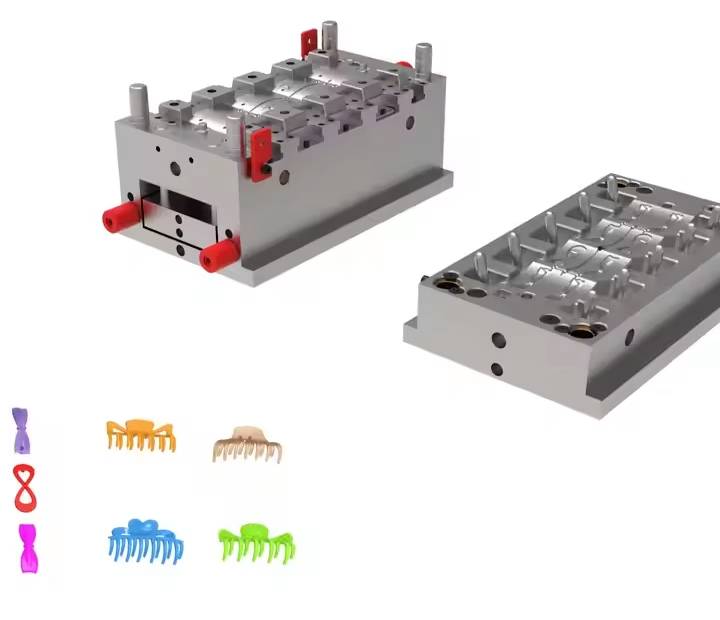
In the era of fast fashion and personalized consumption, the hair accessories industry demands accelerating product iteration and quality improvement. As the core equipment for plastic hairpin production, mold technology innovation directly determines the conversion efficiency from design concepts to end products. This article provides an in-depth analysis of plastic hairpin molds manufacturing systems, revealing technological breakthroughs and industrial value in this specialized field.
Plastic Hairpin Molds: The Precise Balance of Art and Engineering
Reverse Engineering for Styling Design
Modern Plastic Hairpin Molds development utilizes 3D scanning and CAD reverse modeling. Design sketches undergo parametric processing and are converted into 3D models with 0.02mm precision through topology optimization algorithms. For complex curved surfaces characteristic of hairpins, engineers employ Non-Uniform Rational B-Spline (NURBS) technology to reconstruct intricate patterns like petal textures and wave edges.
Structural Mechanics Simulation System
Finite Element Analysis (FEA) simulates molten material flow during injection molding, optimizing gate positions and cooling system layouts. For a bow-shaped hairpin case, Moldflow simulation reduced injection cycles by 18% and decreased product warpage below 0.15mm.
Modular Combination Design
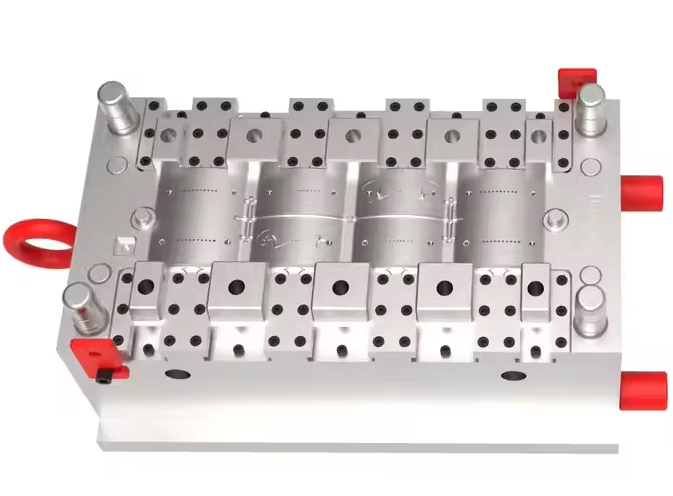
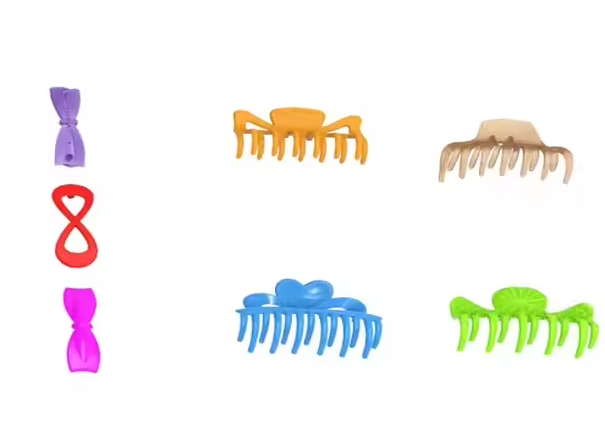
Industry leaders adopt modular strategies with 75% standardized base mold frames, enabling rapid cavity component changes. A “1+5” modular system allows single mold bases to accommodate 5 hairpin designs, reducing changeover time to 45 minutes.
Manufacturing Process of Plastic Hairpin Molds
Precision Machining Technology Matrix
- Cavity machining: 5-axis CNC centers achieve ±0.005mm accuracy, using carbide tools to mill mirror finishes on HRC62 S136 mold steel
- Electrode manufacturing: Graphite electrodes create detailed features via EDM with 0.02-0.03mm discharge gaps
- Surface treatment: PVD coating extends mold life beyond 1.5 million cycles, with TiN coating hardness reaching HV2300
Intelligent Temperature Control
Conformal cooling channels with IoT sensors enable dynamic mold temperature regulation. Advanced systems maintain ±1.5℃ fluctuations, improving shrinkage rate stability by 40%.
Micro-Injection Innovations
For miniaturized accessories (minimum wall thickness 0.3mm):
- Screw L/D ratio reduced to 16:1 with 500mm/s injection speed
- In-mold pressure sensors ensure ±0.2MPa packing accuracy
- Gas-assisted molding boosts hollow structure yield to 99.6%
Material Revolution: Eco-Friendly and Functional Breakthroughs
Bio-Based Material Adaptation
Mold modifications for PLA/PHA biodegradable materials:
- Gate size increased by 30% vs conventional materials
- Mold temperature elevated to 75-85℃ for better flow
- Dedicated venting systems prevent carbonization
Multifunctional Composite Molding
Solutions for metal powder/PETG composites:
- Hard chrome plating (0.015mm thickness)
- Wear-resistant inserts (tungsten steel HRA90)
- Precise mold temperature control at 110±2℃
Paint-Free Process Innovation
Mold texture transfer enables:
- Iridescent effects (VDI3400 A3 standard)
- Metallic brushing patterns (0.08mm etching depth)
- 3D relief designs (0.02mm texture precision)
Common Challenges & Solutions
Demolding Difficulties
- Causes: Insufficient draft angles (<1°), poor ejector pin layout.
- Solutions: Angled lifters, sliders, or mold release agents. Vacuum-assisted demolding addresses thin-wall sticking.
Surface Sink Marks or Flow Lines
- Optimization: Adjust packing pressure/time, add vents, or switch to high-flow materials (e.g., PP+30% glass fiber). Gas-assisted injection molding (GAIM) eliminates shrinkage in thick sections.
Short Mold Lifespan
- Regular maintenance (channel cleaning, wear repair) and surface treatments (chromium plating, nitriding). Laser cladding adds 0.1–0.3mm wear-resistant layers, tripling service life.
Color Inconsistency & Batch Variatio
- Masterbatch Dispersion: High-shear mixing screws paired with inline colorimeters ensure uniform pigment distribution.
- Environmental Control: Maintain workshop conditions at 23±2°C and ≤50% humidity to prevent resin moisture absorption.
Conclusion
The creation of a plastic hairclip reflects China’s manufacturing evolution from “scale-driven” to “tech-driven” excellence. At the intersection of precision engineering, AI, and material science, traditional mold-making is transforming into a hallmark of advanced manufacturing. As distributed production and global collaboration deepen, Plastic Hairpin Molds will no longer be confined to factories but become nodes connecting design, consumption, and circular economies. This journey isn’t just about technical mastery—it’s a reimagining of industrial thinking, proving that even the smallest tools can unlock boundless potential.