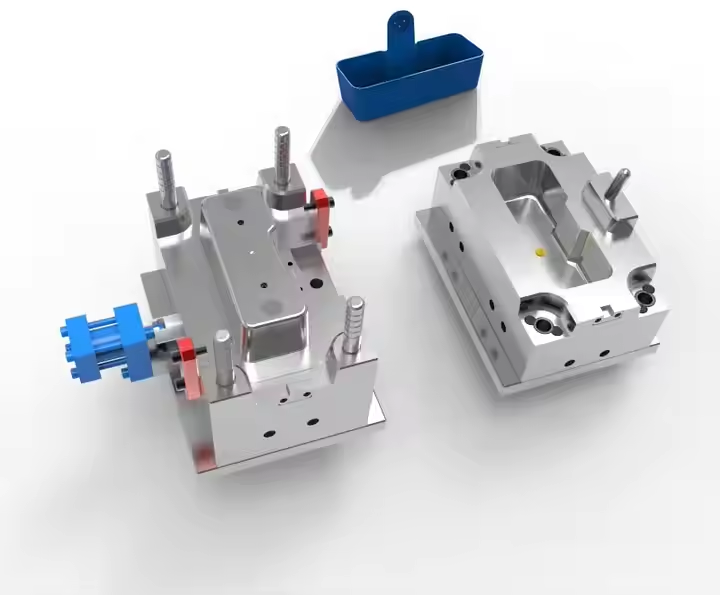
In today’s era of ubiquitous smart devices, plastic phone holders have become essential accessories for automotive, office, and home environments. Their mass production relies on high-precision mold technology, where the design and manufacturing quality directly determine product functionality, cost efficiency, and market competitiveness. This article systematically analyzes the core technical aspects of plastic phone holder molds from four dimensions: structural design, material science, manufacturing processes, and intelligent development.
Phone Holder Molds Structure Design
1. Scientific Logic of Parting Surface Design
Parting surface selection critically impacts product aesthetics, demolding efficiency, and mold longevity. Key principles include:
- Geometric Avoidance: Position parting lines on non-contact surfaces (e.g., holder backside). For holders with retractable clips, adopt “stepped + curved” composite parting surfaces (Figure 1).
- Mechanical Optimization: Validate load-bearing capacity via finite element analysis (FEA), ensuring deformation <0.02mm under injection pressure.
- Integrated Exhaust Design: Incorporate 0.04mm-wide × 0.15mm-deep micro-vent grooves along parting edges with vacuum valves (0.5MPa threshold), reducing fill time by 15%.
2. Innovative Gating System Solutions
For thin-walled, multi-rib structures (typical wall thickness: 1.5mm; ribs: 0.8mm):
- Hybrid Hot/Cold Runner System: Combine valve-gated hot runners (±1°C control) for main cavities with cold runners for auxiliary cavities, cutting energy consumption by 20%.
- Multi-Stage Gate Optimization: Use Φ1.2mm primary gates (pressure-controlled) with four Φ0.8mm auxiliary gates to eliminate weld lines (Figure 2).
- Melt Flow Simulation: Utilize Moldflow® to monitor shear rate distribution, keeping peak values below safety thresholds (e.g., <50,000 s⁻¹ for ABS).
3. High-Efficiency Cooling System Layout
Cooling performance dictates cycle time (target ≤20s). Key technologies:
- 3D Conformal Channels: Laser powder bed fusion (LPBF) manufactured spiral channels (R5mm curvature) improve temperature uniformity to ±3°C.
- Graphene-Enhanced Heat Dissipation: 20μm graphene coatings boost thermal conductivity by 40%.
- Zoned Dynamic Control: Integrate PID modules (±0.5°C) in hinge areas to prevent dimensional deviations from localized overheating.
Material Science and Process Synergy
Precision Injection Molding Controls
- Multi-Stage Injection:
- Phase 1 (Filling): 80mm/s velocity @ 80MPa for rapid mold filling.
- Phase 2 (Packing): 60MPa @ 4s to compensate shrinkage.
- Phase 3 (Cooling): 60°C (ABS)/100°C (PC) with vacuum-assisted cooling (-0.3MPa), reducing cycle time by 18%.
- In-Mold Stress Monitoring: Embedded fiber Bragg grating sensors maintain residual stress <15MPa through adaptive packing control.
Precision Manufacturing of Phone Holder Molds
1. Advanced Mold Steel Selection
- High-Longevity: Powder metallurgy steel ASP-23 (HRC 62-64) triples wear resistance vs. conventional H13.
- Corrosion Resistance: Duplex stainless steel 1.4462 (PREN ≥35) for glass-filled polymers.
2. Ultra-Precision Machining
- 5-Axis Micro-Milling: Achieve ±0.005mm tolerance on clip slots using Φ0.1mm carbide tools.
- Laser Cladding Repair: Stellite 6 powder deposition restores 98% hardness on worn surfaces.
- Digital Assembly Verification: Blue light scanning ensures <0.02mm deviation from CAD models.
3. Functional Surface Treatments
- DLC Coatings: 2-4μm diamond-like carbon layers reduce friction coefficient to 0.1, lowering ejection force by 30%.
- Micro-Texture Etching: Photochemical etching creates anti-slip patterns (Ra 3.2-6.3μm), eliminating secondary coating.

Quality Control Systems
- In-line Monitoring
Phone holder molds integrated with MES systems feature 16-channel pressure sensor arrays for real-time cavity pressure tracking. SPC (Statistical Process Control) limits ejection imbalance to ≤5%. - Automated Mold Correction
AI vision systems detect parting surface wear and trigger EDM (Electrical Discharge Machining) for automatic dimensional compensation (accuracy: 0.002mm). - Lifespan Prediction
An Archard wear theory-based model predicts remaining mold life (error ≤3%) by analyzing 12 parameters, including ejection cycles and clamping force variations.
Smart Manufacturing & Sustainable Transformation
1. Industry 4.0 Integration
- Smart Mold Systems: OPC UA-enabled sensors (pressure/temperature/displacement) enable real-time process optimization via MES connectivity.
- Digital Twin Applications: Lifecycle models predict maintenance needs (>85% accuracy), minimizing downtime.
2. Eco-Friendly Solutions
- Bio-Based Material Adaptation: Adjustable thermal compensation systems for PHA (1.8-2.5% shrinkage).
- Closed-Loop Recycling: 15% regrind blending reduces material costs by 12%.
3. Modular Design Revolution
- Quick-Change Systems: HASCO-standard modules enable function switching within 30 minutes.
- Additive Conformal Inserts: SLM-printed 18Ni300 inserts improve cooling efficiency by 50%.
Conclusion
Plastic phone holder molds development has evolved from standalone tooling to systemic solutions integrating materials science, precision engineering, and digital technologies. As biodegradable polymers, embedded electronics, and nano-manufacturing redefine industry requirements, continuous innovation in cross-scale simulation and smart process chains will be critical for maintaining global leadership in the intelligent accessories market.
>>You may also like
Standards & References
The following industry standards are referenced in this article: