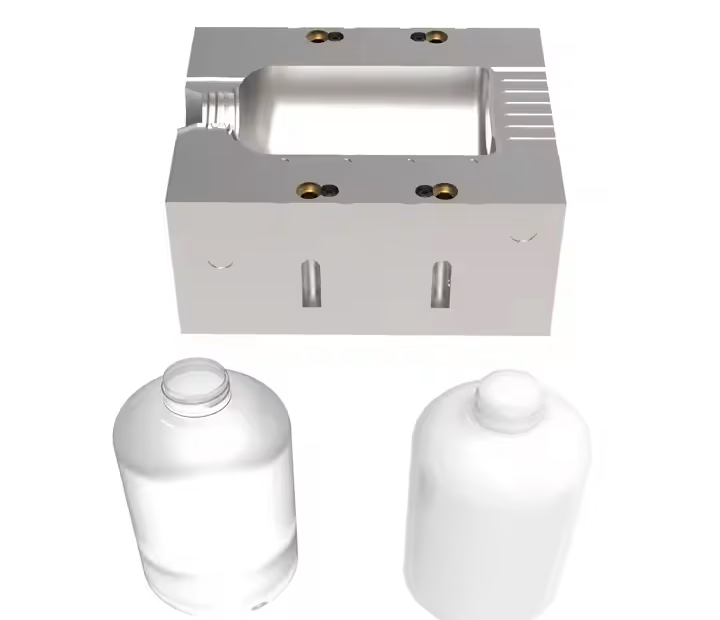
Plastic milk bottle molds are critical equipment in the packaging industry, with their design and manufacturing quality directly impacting product sealing performance, heat resistance, and production efficiency. Modern molds must comply with food-grade safety standards while balancing lightweight and eco-friendly requirements. Common materials include PET and HDPE, with PET being the mainstream choice due to its high transparency and chemical stability.
Critical Technical Dimensions in Milk Bottle Molds Design
1. Scientific Material Selection
- Cavity Steel: NAK80 pre-hardened mirror steel (HRC 40-45 hardness) balances wear resistance and polishing precision.
- Hot Runner System: Beryllium copper alloy thermal components with PID temperature control (±0.5°C accuracy).
- Surface Treatment: DLC (Diamond-Like Carbon) coating reduces surface roughness to Ra 0.01μm, lowering demolding force by 40%.
2. Fluid Dynamics-Optimized Structural Design
- Cavity Layout: 1×8-cavity fan-shaped arrangement ensures balanced injection pressure distribution.
- Gate Design: Valve-gate hot runners with variable cross-section channels eliminate weld line defects.
- Cooling System: Conformal cooling channels enable 3D temperature field uniformity, improving cooling efficiency by 30%.
3. Precision Manufacturing Process Chain
- Cavity Machining: Five-axis machining centers (±2μm accuracy) craft complex curved surfaces.
- Electrode Engineering: Graphite electrodes for EDM (Electrical Discharge Machining) achieve VDI18 surface precision in deep grooves.
- Assembly & Calibration: Laser trackers ensure mold base parallelism (error <0.02mm/m).
Production Process Flow
- Injection Molding Stage
- Material Preparation: PET must be dried at 150–180°C for 3–5 hours to reduce moisture content to ≤0.005%.
- Plasticization Parameters: Barrel temperature 270–290°C, injection pressure 70–140 MPa, and holding time of 2–4 seconds.
- Preform Formation: Hot runner systems minimize waste, with cooling times of 5–15 seconds and 0.5–1° draft angles to prevent deformation.
- Blow Molding Stage
- High-Pressure Blowing: A three-step process (total 4 seconds):
- First blow (1.75 seconds) for pre-forming;
- Second blow (0.12 seconds) to enhance crystallinity;
- Cold blow (0.5 seconds) for rapid solidification.
- Temperature Control: Mold temperature maintained at 145–170°C, with cooling water flow rates of 10–15 L/min.
- High-Pressure Blowing: A three-step process (total 4 seconds):
- Post-Processing
- Surface Treatment: Nitriding increases surface hardness to HV1000+ and triples wear resistance;
- Quality Inspection: Optical measuring devices ensure wall thickness uniformity (±0.1 mm tolerance), and burst pressure testing verifies ≥0.6 MPa performance.


Key Technical Parameter Optimization
- Temperature Control system
- Injection stage temperature deviation ≤±2°C, blow mold deviation ≤±1.5°C, dynamically adjusted via PID algorithms.
- Pressure Regulation
- Proportional valves maintain blow pressure fluctuations within ±0.05 MPa.
- Automation Integration
- Robotic systems enable automated demolding, trimming, and inspection, achieving line outputs up to 5,000 bottles/hour.
Mold Maintenance and Innovation Trends
- Maintenance Protocols
- Daily cleaning of mold residues, weekly lubrication of guide rails and ejector pins, and monthly inspection of cooling channel scaling.
- VCI vapor-phase rust inhibitors and humidity control (<40%) during storage.
- Technological Advancements
- Material Innovation: Bio-based PET (30% plant-derived) reduces carbon footprint;
- Smart Molds: IoT sensors monitor real-time stress and temperature, enabling predictive maintenance to cut downtime by 30%;
- Microfoaming Technology: Reduces wall density by 15% and material consumption by 12%.
Applications and Advantages of Plastic Milk Bottle Molds
Plastic milk bottle molds are widely used in the milk packaging industry, and their advantages are mainly reflected in the following aspects:
Efficient Production
Plastic milk bottle molds can achieve rapid molding, significantly increasing production efficiency. By optimizing mold design and manufacturing processes, the molding cycle can be shortened, thereby increasing the output per unit of time. For example, a well-designed cooling system can quickly cool the plastic in the mold, reducing the molding time.
Stable Quality
High-quality plastic milk bottle molds can ensure stable quality of the molded milk bottles. Accurate mold design and manufacturing processes can guarantee the dimensional accuracy, uniform wall thickness, and surface quality of the milk bottles. This not only helps to improve the sealability and compressive strength of the bottles but also enhances the appearance quality of the products.
Diverse Design
Plastic milk bottle molds can be designed in a variety of ways to meet different needs. For example, milk bottles of different shapes, sizes, and capacities can be designed to cater to the diverse requirements of consumers. In addition, special structural designs can be incorporated into the molds, such as ergonomic grooves for easy gripping and connectable bottle mouths, to enhance the functionality and appeal of the milk bottles.
Conclusion
Plastic milk bottle molds – these seemingly cold industrial devices – are actually bridges connecting creativity and reality. They sculpt everyday containers with micron-level precision, bearing the gentleness of liquid in steel bodies. When we hold a milk bottle, we feel not just the warmth of HDPE, but the crystallization of industrial civilization forged by engineers’ wisdom and sweat. In the sustainable development wave, the mold industry is using innovation as its paddle, driving the plastic packaging industry toward a greener, smarter future.