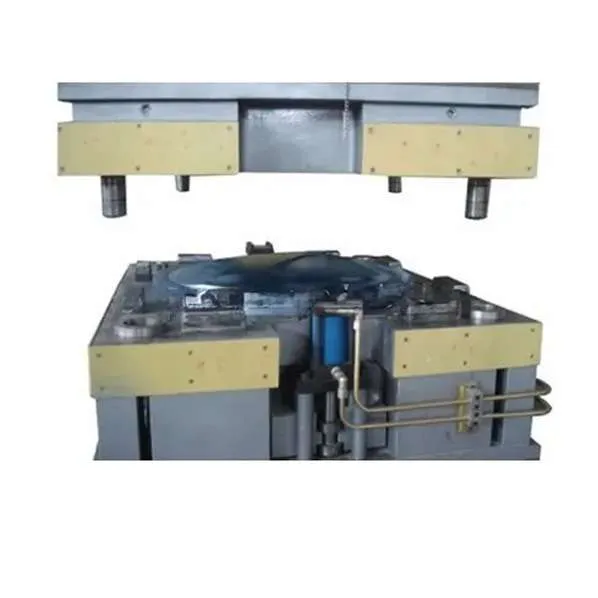
Manhole covers serve as critical access points to underground infrastructure networks, requiring molds that deliver exceptional structural integrity, dimensional accuracy, and production durability. With municipal engineering standards evolving toward higher load capacities (up to C400 classification) and extended service life (≥20 years), mold technology must address the unique challenges of manhole cover manufacturing. This guide outlines the specialized mold steel selection, design principles, and manufacturing processes specific to manhole cover production, emphasizing material performance requirements and quality control standards for municipal applications.
Manhole cover mold Steel Material Selection: Balancing Strength and Durability
Core Performance Requirements
Manhole cover molds demand a unique combination of material properties:
- High load-bearing capacity: Ability to withstand clamping forces exceeding 1000 kN for large-diameter covers (≥800mm)
- Wear resistance: Surface hardness ≥50 HRC to maintain dimensional stability through 100,000+ molding cycles
- Thermal fatigue resistance: Capacity to endure temperature fluctuations from 20°C to 200°C without microcracking
- Impact toughness: ≥15 J/cm² at room temperature to prevent catastrophic failure during demolding
- Corrosion resistance: Protection against concrete alkalinity and atmospheric exposure
Material Selection by Application
Hot Work Die Steel H13
Ideal for concrete manhole cover production, offering excellent thermal fatigue resistance during steam curing processes. Typical heat treatment: 1020°C quenching followed by triple tempering at 560°C, achieving 48-52 HRC with impact toughness of 20-25 J/cm². Mold service life: 150,000-200,000 cycles for standard designs.
Pre-hardened Steel 718H
Preferred for composite manhole covers (SMC/BMC molding) with complex surface textures. Delivered in pre-hardened condition (32-36 HRC) eliminating post-machining heat treatment. Superior polishability (Ra 1.6 μm) enables production of anti-slip patterns with 0.5mm detail resolution. Service life: 80,000-120,000 cycles.
High Chromium Tool Steel Cr12MoV
Economic solution for ductile iron manhole cover molds. Contains 11-13% chromium for exceptional wear resistance, achieving 58-62 HRC after quenching. Requires careful preheating (200-300°C) to prevent cracking. Service life: 60,000-80,000 cycles for simple designs.
Powder Metallurgy Steel ASP-60
Premium choice for precision-engineered manhole covers with integrated locking systems. Nanostructured material provides 60-62 HRC hardness with 12 J/cm² toughness, eliminating traditional strength-toughness tradeoffs. Service life exceeds 300,000 cycles with proper maintenance.
Cost-Benefit Analysis
Based on lifecycle cost per 10,000 units produced:
- H13: $0.85 per unit (150,000 cycle life)
- 718H: $1.05 per unit (100,000 cycle life)
- Cr12MoV: $0.92 per unit (70,000 cycle life)
- ASP-60: $0.78 per unit (300,000 cycle life)Long-term production (>200,000 units) favors ASP-60 despite higher initial investment.
Manhole cover mold Design and Manufacturing Considerations
Critical Design Parameters
Cavity Configuration
- Round covers: One-piece cavity design with diameter tolerance ±0.5mm
- Square covers: Four-point alignment system maintaining diagonal tolerance ≤1mm
- Locking mechanism integration: Positioning accuracy ±0.3mm for security features
- Draft angles: 1-3° on vertical surfaces to facilitate demolding of heavy covers (50-80kg)
Ejection System
- Hydraulic ejection with 8-12 evenly distributed cylinders
- Ejection force: 500-800 N per cylinder for concrete products
- Synchronization tolerance: ±0.5mm to prevent cover warping during demolding
Cooling System
- Spiral channel design with 150-200mm spacing for uniform temperature distribution
- Water flow rate: 8-12 L/min per circuit
- Temperature control precision: ±2°C to ensure consistent curing
Manufacturing Processes of Manhole Cover Mold
Large Format Machining
- 5-axis gantry milling centers with 2000×1500mm work envelopes
- Positioning accuracy: ±0.015mm/m
- Roughing allowance: 3-5mm to minimize residual stresses
- Finishing tools: Carbide end mills with 0.2mm corner radius
Surface Treatment
- Plasma nitriding: 0.15-0.2mm case depth with 800-1000 HV surface hardness
- Laser texturing: 3-5mm depth anti-slip patterns with 0.1mm resolution
- Polishing standards: Ra 3.2-6.3 μm for functional surfaces, Ra 1.6 μm for cosmetic areas
Quality Verification
- Coordinate measuring machine (CMM) inspection with 5μm point accuracy
- 3D laser scanning for complex contour verification
- Pressure testing: 1.5× design load (up to 600 kN) for 1-hour duration
Quality Control Standards
Dimensional Accuracy Requirements
- Diameter/length: ±1mm (standard), ±0.5mm (precision class)
- Thickness variation: ≤0.8mm across entire surface
- Flatness: ≤2mm per 1000mm dimension
- Embedment depth tolerance: ±0.5mm for frame integration
Performance Testing
- Cycle fatigue test: 100,000 load cycles (0-100% design load)
- Thermal shock resistance: 500 cycles (-40°C to +120°C)
- Wear resistance: Taber abrasion test ≤0.1g loss per 1000 cycles
Application-Specific Guidelines
Concrete Manhole Covers
- Mold features: Integral lifting lugs, drainage channels
- Typical material: H13 with nitrided surface
- Production parameters: 60-90 second cycle time, 80-90°C mold temperature
Composite Manhole Covers
- Mold features: Precision texture patterns, undercut locking systems
- Typical material: 718H with polished surfaces
- Production parameters: 5-10 minute cycle time, 150-180°C mold temperature
Ductile Iron Manhole Covers
- Mold features: Venting systems for gas evacuation
- Typical material: Cr12MoV with ceramic coating
- Production parameters: 2-3 minute cycle time, 200-300°C preheat temperature
Maintenance and Lifespan Optimization
Preventive Maintenance Schedule
- Daily: Lubrication of guide pillars (0.5g grease per point), surface cleaning
- Weekly: Cooling channel inspection, pressure testing (8 bar)
- Monthly: Dimension verification using CMM, ejection force measurement
- Annual: Nitride layer thickness testing, cavity surface mapping
Repair Techniques
- Minor wear: Laser welding with matching filler material (spot size 0.3-0.5mm)
- Surface restoration: EDM recutting for worn texture patterns
- Warpage correction: Thermal stress relieving (550°C hold for 4 hours)
Frequently Asked Questions
Q1: What Manhole cover mold steel offers the best balance for high-volume production?
A1: ASP-60 provides the lowest lifecycle cost for volumes exceeding 200,000 units, offering 300,000+ cycle life with minimal maintenance requirements. For medium volumes (80,000-150,000 units), H13 delivers excellent thermal fatigue resistance at moderate cost.
Q2: How can Manhole cover mold life be extended in corrosive environments?
A2: Combine 316 stainless steel mold inserts with PVD coating (TiAlN, 3-5μm thickness) for chemical resistance. Implement a rigorous maintenance program including deionized water cooling and post-production cavity coating with corrosion inhibitor (8-12μm film thickness).
Q3: What design modifications reduce demolding issues with heavy covers?
A3: Incorporate 3° draft angles on all vertical surfaces, install synchronized ejection with position feedback, and implement a vacuum assist system (80-90 kPa) to reduce demolding force requirements by 30-40%.
Conclusion
Manhole cover mold steel selection requires careful consideration of production volume, material type, and performance requirements. H13 remains the workhorse for concrete applications, while 718H excels in composite manufacturing. For high-volume precision production, ASP-60 offers unmatched durability despite higher initial investment.
>>You may also like
Standards & References
The following industry standards are referenced in this article: