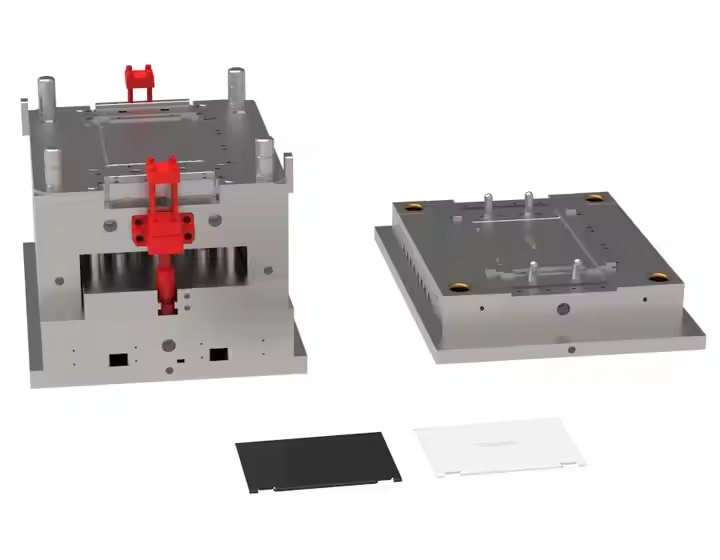
In the pursuit of extreme lightweight design in the laptop industry, steel maintains strategic importance in mold manufacturing due to its unique performance advantages. This article analyzes the critical role and technological breakthroughs of Laptop Casing Molds manufacturing from four perspectives: material properties, design innovation, manufacturing processes, and technological evolution.
Material Selection: Balancing Performance and Cost
Modern steel laptop casing molds materials form a multi-level technical matrix:
- Dominance of Tool Steels
Hot work tool steels (e.g., SKD61, H13 standards) remain the primary choice for complex structural molds, offering 520MPa yield strength at 550°C and over 100,000 thermal fatigue cycles. With 55HRC hardness treatment, they achieve 0.01mm repeat positioning accuracy, proving exceptional in critical component molds like hinges. - Corrosion-Resistant Stainless Steel
Precipitation-hardening stainless steel achieves 1380MPa tensile strength and 2000-hour salt spray resistance through solution treatment and aging processes. Its mirror-polished surface reaches Ra≤0.01μm roughness, making it indispensable for premium laptop mirror-finish laptop casing molds. - Advanced High-Conductivity Alloy Steel
Next-gen high thermal conductivity mold steel (42W/m·K) reduces injection cycles by 15%. In typical applications, cooling time for 0.5mm wall thickness structures is compressed to 3.8 seconds. Combined with conformal cooling technology, mold temperature variation is controlled within ±0.5°C.
Microstructural Engineering of Steel
Modern steel laptop casing molds breakthroughs originate from atomic-scale material design:
- Nanoscale Precipitation Control
Niobium (Nb) and Vanadium (V) microalloying in H13 tool steel generates 5-15nm MC-type carbonitrides. At 2.3% precipitation volume fraction, high-temperature strength increases 40% (480MPa yield strength at 600°C) while maintaining 25J/cm² impact toughness. This nano-strengthening mechanism limits dimensional variation to ±0.003mm/m after 2 million injection cycles. - Gradient Grain Architecture
Surface Mechanical Attrition Treatment (SMAT) creates 50μm-deep gradient nanostructures (10-200nm grains) over 5-10μm equiaxed core grains. This achieves 750HV surface hardness (120% improvement) and triples bending fatigue life. - Metastable Austenite Design
TRIP steels (e.g., AMAX 15-5PH) utilize strain-induced phase transformation, converting 12% retained austenite to martensite during forming. This absorbs >30% impact energy, effectively suppressing microcrack propagation in 0.2mm thin-wall structures.
Digital Twin-Driven Laptop Casing Molds Design
Multiphysics-coupled virtual design systems redefine traditional workflows:
- Multiscale Modeling Framework
Integrated continuum mechanics (macroscale), crystal plasticity (mesoscale), and molecular dynamics (microscale) models predict dislocation density distribution (<8% error) in 1.5mm ultra-thin walls, guiding rib topology optimization. - Thermo-Mechanical-Flow Coupling
ANSYS-Fluent co-simulation calculates transient thermal stress (120°C/s gradients), polymer pressure (80MPa peak), and structural deformation (0.07mm max displacement). Cooling time predictions show ≤0.8s deviation from experimental data. - AI-Augmented Design
Deep Reinforcement Learning (DRL) generative systems reduce mold weight 18% while meeting ≥15,000N/mm stiffness constraints. One hinge mold design cycle was compressed from 6 weeks to 72 hours.
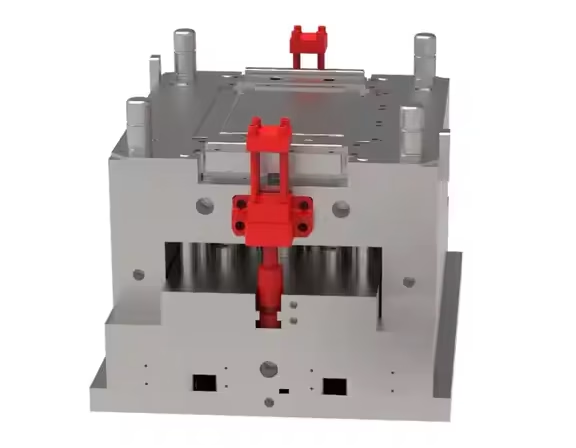
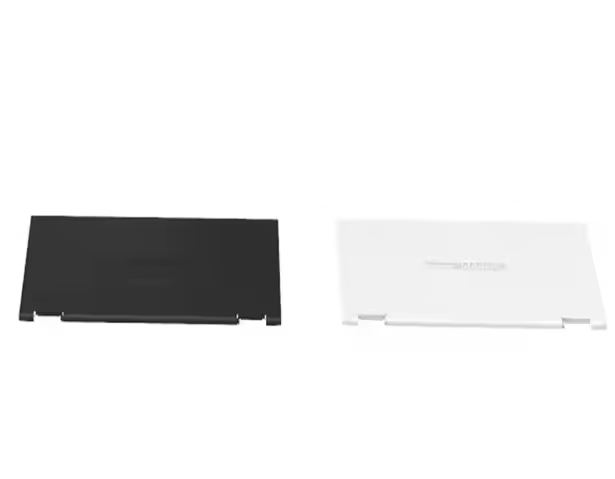
Engineering Evolution in laptop casing molds Design
Steel properties drive unique design methodologies:
- Ultra-Thin Wall Challenges
Steel’s rigidity enables wall thickness reduction to 0.3mm (vs. 0.8mm for traditional materials). Topology-optimized “fishbone” rib arrays (0.2mm width, 1.5mm spacing) achieve 20,000N/m bending stiffness in 1.2kg molds, meeting ultra-thin laptop structural requirements. - Hot Runner System Innovation
Multi-cavity independent temperature control systems with 32-point sensing enable ±0.3°C dynamic adjustment, controlling PC+ABS flow front velocity variation within 2% to eliminate weld lines. Typical molds reduce gates from 12 to 4, cutting runner volume by 60%. - In-Mold Assembly Integration
Servo-driven in-mold assembly systems complete 6-axis precision part assembly within single cycles. This enables hinge-shell integration, reducing assembly steps by 70% with ≤0.03mm positioning error.
Precision Manufacturing Technologies of laptop casing molds
Steel processing reaches nanoscale precision:
- Micro-EDM Technology
0.03mm electrodes create 15:1 aspect ratio micro-hole arrays (0.05mm diameter) with Ra0.02μm roughness. This achieves 3% uniformity deviation in starlight effect molds with 2 million optical micro-holes. - Laser Cladding Surface Enhancement
WC-Co coatings form 0.1mm reinforced layers, increasing local hardness to 72HRC. Treated hinge surfaces show 300% wear resistance improvement, enduring 500,000 open-close cycles. - Intelligent Heat Treatment
Nitrogen-hydrogen atmosphere gradient quenching (800°C→200°C at 5°C/s) reduces residual stress to 35MPa, achieving ±0.002mm/m dimensional stability. Critical for molds with >10:1 length-width ratios.
Conclusion
Driven by lightweight and precision demands, laptop casing molds undergo three revolutions:
- Material Innovation: Metallic glass (65HRC, 200% toughness improvement) enters validation
- Process Breakthroughs: Femtosecond laser achieves 0.005μm microstructures
- Manufacturing Paradigm: Distributed smart production enables 72-hour delivery
By 2028, steel molds will dominate 60%+ laptop casing production. With atomic-layer deposition (ALD) and quantum strain sensing (10^-6 accuracy), steel molds are entering a nanometer-precision era.
>>You may also like
Standards & References
The following industry standards are referenced in this article: