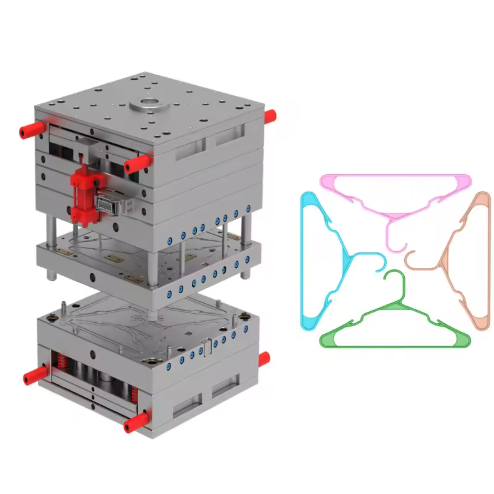
Material Selection for Hanger Molds
Selecting the right mold steel is critical for hanger mold performance, as it directly impacts durability, surface finish, and production efficiency. Three primary steel grades dominate the industry: P20, 718H, and S136, each offering distinct advantages based on production requirements.
P20 Steel serves as the workhorse for general-purpose hanger molds. This pre-hardened steel (28-32 HRC) balances cost and performance, making it ideal for low to medium-volume production runs (up to 500,000 cycles). Its machinability allows for intricate designs, while its moderate hardness resists wear during standard PP/ABS injection processes. However, P20 lacks the corrosion resistance needed for extended production or aggressive cleaning agents, limiting its use in high-moisture environments.
718H Steel addresses the limitations of P20 with enhanced hardness (33-38 HRC) and improved polishability. This pre-hardened steel contains nickel and chromium additives that boost wear resistance, extending mold life to 1-1.5 million cycles. Its superior surface finish capabilities make it suitable for hangers requiring high aesthetic standards, such as clothing retail applications. The alloy’s uniform microstructure minimizes distortion during machining, ensuring consistent part dimensions across production runs.
S136 Steel represents the premium option for high-end hanger molds. This stainless steel grade (48-52 HRC after heat treatment) offers exceptional corrosion resistance and polishability, achieving mirror-like finishes (Ra 0.02-0.05 μm). These properties make it indispensable for transparent or colored hangers where surface clarity is critical. While S136 commands a 30-40% price premium over P20, its 2-3 million cycle lifespan and reduced maintenance costs justify investment for high-volume production or medical-grade applications requiring strict hygiene standards.
Material selection should align with production volume, hanger material, and surface requirements. For standard PP hangers with simple designs, P20 provides cost-effective performance. 718H suits mid-range applications needing improved durability and finish, while S136 is reserved for high-end, high-volume, or corrosive environments.
Injection Molding Parameters for Hanger Production
Optimizing injection parameters is essential to achieve consistent hanger quality while maximizing production efficiency. The choice of polymer—typically PP or ABS—dictates specific processing conditions, with temperature control and pressure management being critical variables.
Polypropylene (PP) remains the most common hanger material due to its balance of strength, flexibility, and cost. For PP hangers, barrel temperatures should be set between 180-220°C, with nozzle temperatures 5-10°C higher to prevent premature solidification. Mold temperatures of 40-60°C promote proper crystallization, reducing internal stresses that cause warping. Injection pressure ranges from 600-900 bar, with holding pressures at 60-70% of injection pressure to minimize sink marks in thick sections like hook reinforcements.
ABS (Acrylonitrile Butadiene Styrene) offers superior impact resistance and surface finish, making it suitable for premium hangers. Processing temperatures are higher than PP, with barrel settings of 220-260°C and mold temperatures of 60-80°C to enhance flow and reduce residual stress. ABS requires higher injection pressures (800-1200 bar) due to its higher viscosity, particularly for intricate designs with thin ribs or logos. A 2-3 second delay before applying holding pressure helps prevent jetting and ensures complete cavity filling.
Regardless of material, cycle time optimization directly impacts productivity. Typical cycle times range from 25-45 seconds for PP hangers and 35-55 seconds for ABS, with cooling time accounting for 50-60% of the cycle. Conformal cooling channels—especially in 718H or S136 molds—can reduce cooling time by 20-30%, significantly increasing throughput.
Common defects like flash, short shots, or sink marks can often be resolved through parameter adjustments. Flash typically indicates excessive injection pressure or worn mold components, while short shots may require increased temperature or pressure. Sink marks in thick sections respond well to extended holding time or slightly higher holding pressure. Process validation should include at least 50 consecutive production cycles to ensure stability before full-scale production.
Industry Standards and Quality Control
Hanger mold manufacturing must adhere to stringent industry standards to ensure product safety, consistency, and performance. The primary standard governing hanger production is GB/T 2811-2019, which specifies requirements for load capacity, dimensional tolerance, and material properties.
Load capacity testing is a critical component of GB/T 2811-2019 compliance. Hangers must withstand 30N of force for 1 minute without permanent deformation, with premium models requiring 50N capacity. Mold design must account for this by incorporating adequate wall thickness (1.5-3mm for PP, 2-3.5mm for ABS) and reinforcing critical stress points like hook bases. Finite element analysis (FEA) during mold design helps identify potential failure points before production.
Dimensional tolerance standards demand precision across key dimensions. Hook opening width must maintain ±0.5mm tolerance, while overall length variation should not exceed ±1mm. These requirements necessitate tight mold tolerances (±0.02mm for critical features) and regular maintenance checks using coordinate measuring machines (CMM). Steel selection plays a role here—S136’s dimensional stability under thermal cycling ensures consistent part dimensions over extended production runs.
Material safety is another focus of modern standards, particularly for hangers used in direct contact with clothing. Molds must be designed to prevent material degradation, with polished surfaces (Ra ≤ 0.8 μm) minimizing polymer shear and additive breakdown. For food-grade applications, S136’s corrosion resistance prevents contamination from cleaning agents, while mold venting systems must be optimized to eliminate trapped gases that could introduce impurities.
Quality control protocols should include 100% visual inspection for surface defects, with periodic sampling for dimensional and mechanical testing. Statistical process control (SPC) charts track critical parameters like cycle time, pressure, and temperature, enabling early detection of process drift. Compliance with these standards not only ensures product quality but also facilitates market access in regulated regions.
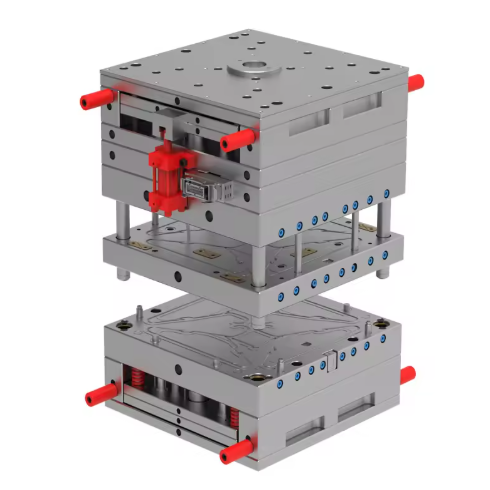

Surface Treatment Technologies
Surface finish directly impacts both hanger aesthetics and functionality, with mold surface treatment playing a pivotal role in achieving desired part characteristics. The choice between mechanical polishing and chrome plating depends on production requirements, material selection, and end-use application.
Mechanical polishing is the foundation of mold surface preparation, with finishes ranging from functional (Ra 0.8-1.6 μm) to mirror (Ra 0.02-0.05 μm). For standard PP hangers, a #4 finish (Ra 0.4-0.8 μm) provides adequate release properties and hides minor flow lines. Premium hangers, particularly those made from ABS or transparent materials, require mirror polishing (Ra ≤ 0.05 μm) to achieve high-gloss surfaces. This process involves progressive grit refinement (from 400# to 8000#) followed by diamond compound buffing, with S136 steel yielding the best results due to its homogeneous microstructure.
Chrome plating offers enhanced durability and release properties for high-volume production. The process involves electroplating a 5-15 μm layer of chromium onto the mold surface, creating a hard (800-1000 HV), wear-resistant barrier. Chrome-plated molds exhibit 30-50% longer service life compared to polished steel, making them ideal for production runs exceeding 1 million cycles. The plating also improves corrosion resistance, a critical advantage when processing materials with acidic additives or using aggressive cleaning agents.
Specialized treatments like PVD (Physical Vapor Deposition) coatings are emerging for demanding applications. Titanium nitride (TiN) coatings (2-5 μm thick) offer superior hardness (2000-3000 HV) and low friction coefficients, reducing cycle times by improving material flow. These coatings are particularly effective for glass-filled polymers or hangers with intricate geometries where release is challenging.
Surface treatment selection should consider both initial cost and long-term performance. Mechanical polishing is most cost-effective for low to medium volumes, while chrome plating or PVD coatings provide better value for high-volume production. For medical or food-contact applications, electroless nickel plating offers a viable alternative to chrome, providing corrosion resistance without hexavalent chromium.
Structural Design Principles for Hanger Molds
Effective hanger mold design balances functionality, manufacturability, and cost, with structural elements directly influencing part quality and production efficiency. Key considerations include draft angles, wall thickness, and reinforcement strategies.
Draft angles are critical for mold release and part quality. Minimum draft angles of 1-1.5° per side are recommended for PP hangers, increasing to 2-3° for ABS to account for its higher friction. Insufficient draft causes scuffing and part distortion, while excessive draft reduces usable hanger space. The hook area requires special attention—draft angles here should be minimized (0.5-1°) to maintain hook strength while ensuring proper release.
Wall thickness uniformity prevents sink marks, warping, and internal stresses. Ideal wall thickness ranges from 1.5-2.5mm for PP and 2-3mm for ABS, with variations not exceeding 20% to ensure consistent cooling. Thick sections (e.g., hook bases) should be cored out or reinforced with ribs (height ≤ 3× wall thickness, width = 0.5× wall thickness) to maintain strength without increasing material usage. Ribs should be spaced at least 3× wall thickness apart to avoid knit lines.
Gate design significantly impacts part quality and cycle time. Edge gates are preferred for hanger molds, positioned on the non-visible edge of the hook to hide gate vestiges. Gate size should be 50-70% of the wall thickness, with larger gates (1.5-2mm) for ABS to prevent jetting. Hot runner systems offer advantages for multi-cavity molds, reducing material waste by 15-20% and enabling faster cycle times through precise temperature control.
Cooling system design is often overlooked but critical for productivity. Conventional straight cooling channels should be placed 15-20mm from the cavity surface, with channel diameter matching wall thickness (8-12mm typical). For complex geometries, conformal cooling using 3D-printed inserts can reduce cooling time by 25-40%, though this requires compatible steel grades like 718H or S136.
Ejection systems must provide uniform force to prevent part deformation. Ejector pins (3-5mm diameter) should be positioned in non-visible areas, with spacing not exceeding 60mm to ensure balanced ejection. For large hangers, sleeve ejectors around the hook area distribute force evenly, while lifters may be necessary for undercuts in decorative designs.
By integrating these structural principles with appropriate material selection and process parameters, manufacturers can produce high-quality hangers efficiently while minimizing mold maintenance and downtime. The optimal design balances part functionality with manufacturing practicality, ensuring both product performance and production economics.
Hanger Mold – FAQs
1. What materials can be used with a hanger mold?
Common materials include PP, PS, ABS, and recycled plastics, depending on strength and flexibility requirements.
2. Can the hanger mold be customized?
Yes, hanger molds can be customized in size, thickness, hook style, logo, and cavity number.
3. How many cavities can a hanger mold have?
Single-cavity to multi-cavity designs are available, depending on machine capacity and output needs.
4. What mold steel is usually used for hanger molds?
P20, 718, H13, or S136 steel are commonly used, based on expected production volume and budget.
5. What is the typical mold life for a hanger mold?
With proper maintenance, a hanger mold can reach 300,000 to over 1,000,000 shots.
>>You may also like
Standards & References
The following industry standards are referenced in this article: