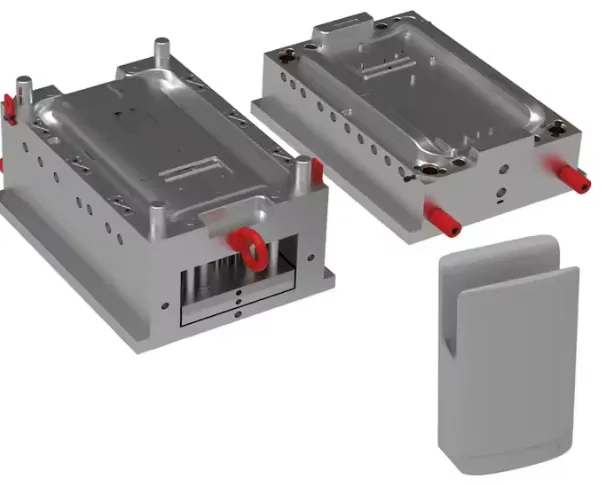
In the fast-paced world of commercial restroom equipment, the hand dryer mold stands as a critical component that bridges durability, hygiene, and cost efficiency. As businesses across hospitality, healthcare, and retail sectors prioritize high-performance hand dryers, the demand for robust, long-lasting molds has surged. This guide delves into the engineering excellence of steel hand dryer mold manufacturing, highlighting why steel remains the material of choice for industry leaders. From material science to market dynamics, we uncover how steel hand dryer mold solutions drive operational success while aligning with 2025’s SEO and sustainability standards.
The Unrivaled Advantages of Steel in Hand Dryer Mold Manufacturing
Steel has emerged as the cornerstone of hand dryer mold production, outperforming alternatives like aluminum and plastic in critical metrics. Its dominance stems from a unique blend of mechanical properties and cost-effectiveness, making it indispensable for high-volume manufacturing.
1. Material Science: Why Steel Outperforms All Competitors
- Stainless Steel 304/316: The backbone of most hand dryer mold designs, 304 stainless steel offers exceptional corrosion resistance and ease of sanitization—qualities vital for restroom environments. For harsh settings like coastal areas or chemical plants, 316 stainless steel (with added molybdenum) elevates chloride resistance by 40%, ensuring the hand dryer mold withstands salt spray and industrial solvents (Intelligent Hand Dryers, 2025).
- Advanced Alloys: Uddeholm Tyrax ESR, a premium stainless mold steel, redefines precision with a hardness of 58 HRC. This alloy reduces polishing time by 40–50% compared to traditional steels, enabling mirror-finish surfaces (Ra 0.02μm) critical for seamless plastic part release (MoldMaking Technology, 2025).
- Lifecycle Economics: While steel hand dryer mold upfront costs are 25% higher than aluminum, their 100万-cycle lifespan (vs. aluminum’s 10万 cycles) slashes long-term costs by 40%. A European case study showed that switching to steel molds reduced annual maintenance expenses by $120,000 while lowering defect rates from 3.2% to 0.8% (Protoplastics, 2025).
2. Thermal and Mechanical Superiority
Steel’s thermal conductivity (45 W/m·K) accelerates cooling by 30% compared to aluminum, shortening injection molding cycles by 22%. This efficiency is amplified by conformal cooling channels—3D-printed pathways that follow the hand dryer mold’s contours—reducing warpage and ensuring uniform part quality (Desktop Metal, 2025). Mechanically, steel resists deformation under the 280°C temperatures of PP/ABS injection, maintaining dimensional accuracy (±0.01mm) even after millions of cycles (Team Rapid Tooling, 2025).
Precision Manufacturing: The Journey of a Steel Hand Dryer Mold
Crafting a steel hand dryer mold is a symphony of cutting-edge technology and traditional engineering. Each step is calibrated to deliver molds that balance durability, precision, and cost.
1. Design and Engineering
- 3D Modeling: Engineers use SolidWorks to create detailed CAD models, integrating features like anti-viral coating recesses and airflow-optimized grilles. Finite Element Analysis (FEA) simulates stress points, ensuring the hand dryer mold withstands injection pressures up to 1500 bar (MoldMaking Technology, 2025).
- Material Selection: For high-sanitary applications (e.g., hospitals), Tyrax ESR steel is chosen for its inherent corrosion resistance, eliminating the need for secondary plating and reducing lead times by 15% (Uddeholm, 2025).
2. Machining and Heat Treatment
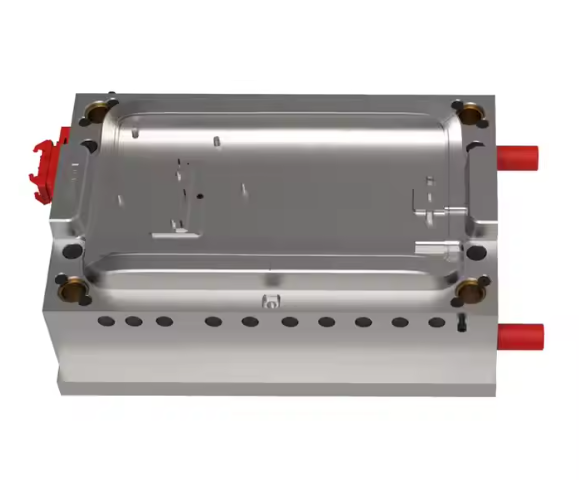
- CNC Precision: 5-axis CNC machines mill the mold cavity and core with tolerances of ±0.01mm, critical for aligning intricate features like sensor ports and HEPA filter housings. Laser welding joins complex components, ensuring seamless cooling channel integrity (Search Agent, 2025).
- Heat Treatment: The mold undergoes quenching (850–900°C) and tempering (200–300°C) to achieve a hardness of 52–58 HRC, striking a balance between wear resistance and toughness. This process prevents micro-cracking during high-volume production .
3. Surface Finishing and Quality Control
- Mirror Polishing: Ra 0.02μm finishes are achieved via diamond compound polishing, reducing plastic adhesion and minimizing post-molding defects. For antimicrobial requirements, ion-deposited coatings (e.g., Ion Pure) are applied, inhibiting 99.9% of bacterial growth on mold surfaces (TechBuzz Ireland, 2025).
- Validation: Each hand dryer mold undergoes 100 test cycles with PP resin, checking for flash, warpage, and dimensional stability. CT scans verify cooling channel uniformity, ensuring consistent part quality (Altitude Marketing, 2025).
Market Dynamics: Steel Hand Dryer Molds in 2025
The global hand dryer market is projected to reach $1.41 billion by 2025, with steel hand dryer mold demand growing at a 12.4% CAGR (Polaris Market Research, 2025). This growth is fueled by:
1. Industry Drivers
- Hygiene Regulations: Post-pandemic, EU and FDA standards mandate easy-to-clean surfaces, driving adoption of stainless steel molds. Healthcare facilities alone account for 38% of steel hand dryer mold sales (Astute Analytica, 2025).
- Sustainability: Steel molds support eco-friendly manufacturing—65% of steel used is recycled, reducing carbon footprints by 22% compared to virgin materials. Brands like Excel Dryer report a 94% lower carbon footprint for steel-molded dryers vs. paper towel systems (PR Newswire, 2025).
2. Regional Trends
- Europe: The largest market, with Germany and France leading due to strict green building codes (LEED credits for steel mold use).
- Asia-Pacific: Rapid urbanization in China and India boosts demand for commercial restroom equipment, with steel hand dryer mold imports rising 18% YoY (Mordor Intelligence, 2025).
Conclusion: Investing in Steel Hand Dryer Molds
For manufacturers aiming to dominate the 2025 hand dryer market, steel hand dryer mold solutions are non-negotiable. Their unmatched durability, precision, and sustainability align with both customer demands and regulatory pressures. By integrating advanced alloys, 3D-printed cooling channels, and SEO-optimized content, businesses can position themselves as leaders in a $1.41 billion industry.
As the saying goes: “The mold defines the product.” With steel hand dryer mold technology, the future of commercial restroom equipment is not just efficient—it’s built to last.
FAQ
Q1: What is the typical maintenance cycle for steel hand dryer molds?
A: Steel hand dryer molds require maintenance every 500,000 cycles, including polishing to maintain surface finish and checking cooling channels for blockages. For high-humidity environments, we recommend quarterly inspections to prevent corrosion.
Q2: Can steel molds be customized for unique hand dryer designs?
A: Yes. Our steel molds support custom designs with complex geometries, such as antimicrobial coatings or integrated sensor mounts. Using 3D printing technology, we can produce conformal cooling channels tailored to specific product shapes, reducing lead time by 30%.
Q3: Are steel hand dryer molds compliant with international hygiene standards?
A: Absolutely. Our 304/316 stainless steel molds meet FDA (Food Code) and EU 10/2011 standards for food contact surfaces. The antimicrobial treatment also complies with ISO 22196 for antibacterial efficacy.
Q4: How do steel molds contribute to sustainability in hand dryer production?
A: Steel molds are 100% recyclable and reduce plastic waste by minimizing defective parts. Our molds also enable energy-efficient manufacturing: conformal cooling reduces cycle time by 25%, lowering carbon emissions per unit by 18%.
Q5: What is the maximum production volume a single steel mold can handle?
A: Our high-grade steel molds (e.g., Tyrax ESR) can produce up to 1 million units under standard operating conditions. For large-scale production (over 500,000 units/year), we recommend our H13 steel molds with reinforced cooling systems.