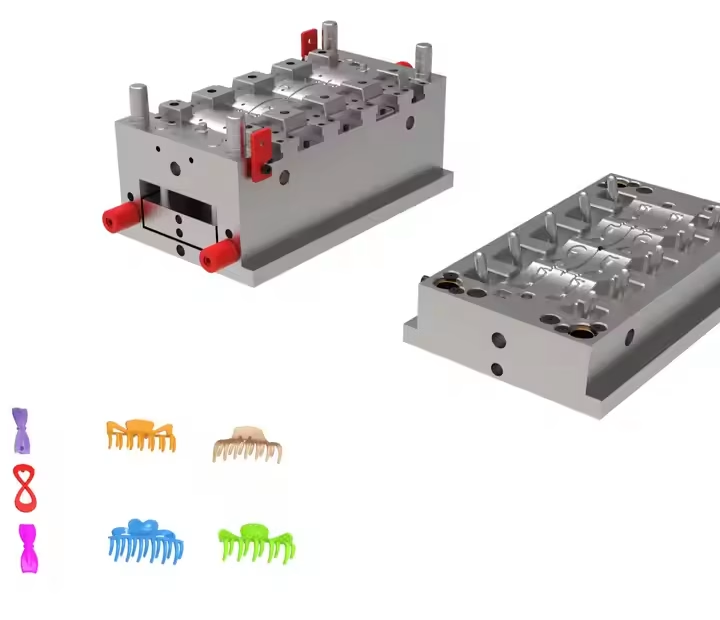
In the microscopic world of fashion accessories, hairpin molds undertake the critical mission of transforming design concepts into tangible products. As precision manufacturing carriers characterized by high hardness and wear resistance, modern molds demonstrate the perfect fusion of industry and art at 0.01mm precision levels through breakthroughs in material science. This article structurally analyzes the full-chain innovation from R&D to application of hairpin molds, revealing how material properties underpin this billion-dollar hidden industry.
Material Genome: Building Blocks of Precision Manufacturing
1.1 The Hidden Code of Material Properties
- Hardness Index: Mold matrix hardness consistently maintained at 58-62 HRC ensures cavity deformation <0.003mm after 1 million injections
- Thermal Stability: Thermal expansion coefficient controlled within 1.2×10⁻⁶/℃ under continuous 300℃ operation
- Corrosion Resistance: Special surface treatment enables 2000-hour salt spray testing without corrosion
Breakthrough: A German enterprise’s gradient heat treatment process creates a super-hard protective layer (1500HV microhardness) on the mold surface while maintaining core toughness, tripling service life.
1.2 Scientific Decision-Making in Material Selection
| Property Dimension | Technical Parameter | Implementation Path |
| Wear Resistance | Wear ≤0.01mm/100k cycles | Vanadium/molybdenum alloying |
| Polishability | Surface roughness Ra0.02μm | Five-stage mirror polishing |
| Cost Efficiency | 18% cost reduction per mold | Composite matrix+coating design |
Manufacturing Process Of Hairpin Molds
2.1 Three Stages of Precision Machining
Rough machining (±0.1mm) → Heat treatment → Semi-finishing (±0.02mm) ↓ Cryogenic treatment → Precision machining (±0.005mm) → Nanoscale polishing
Innovation: Slow wire cutting for hairpin spring slots achieves ±0.002mm tolerance on 0.3mm structures – 1/30th of human hair diameter.
2.2 Intelligent Inspection System
- Online Monitoring: 32-channel sensors track temperature/pressure in real-time
- 3D Comparison: White-light scanner completes complex surface deviation analysis in 0.8s (1.5μm accuracy)
- Life Prediction: Stress-field simulation model predicts remaining lifespan (<5% error rate)
Standard: Per VDI 3400, mold surface texture reproduction reaches 600dpi for hair strand clarity.
2.3 Green Manufacturing Practices
- Laser cladding repairs worn cavities, improving material utilization by 65%
- Intelligent temperature control reduces energy use by 30% (22kg CO₂/mold saved)
- Digital twin platform cuts trial runs, saving 12 tons of materials annually
Factory Verification: Plasma nitriding elevates surface hardness to 1200HV for a Dongguan-based enterprise, extending maintenance intervals from 30k to 200k cycles.
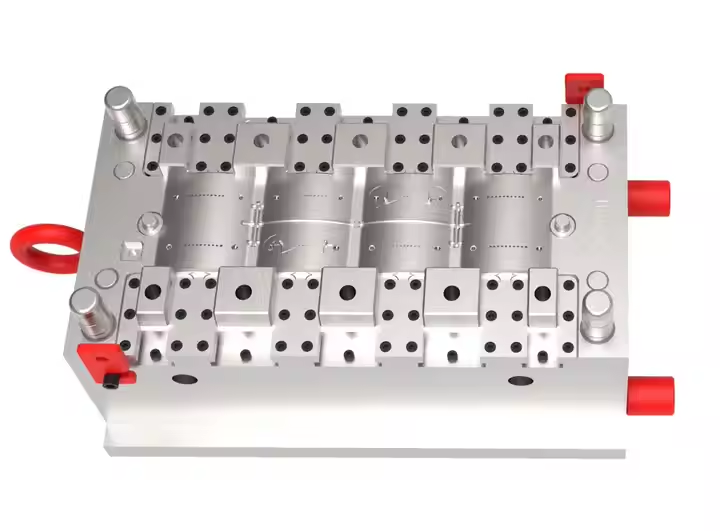

Design Innovation: Dynamic Balance Between Function and Aesthetics
3.1 Microscale Mechanical Design
- Snap-fit structures: 0.12-0.25mm precision interference fit
- Thin-wall molding: Flow balance control for 0.8mm wall thickness
- Stress relief: Topology optimization reduces residual stress by 32%
Case: Conformal cooling in wave-pattern molds decreases injection deformation from 0.15mm to 0.03mm, boosting yield to 99.8%.
3.2 Visual Revolution in Surface Treatment
- Micro-texturing: 8000dpi bio-inspired patterns
- Composite coating: 0.003mm anti-adhesion layer cuts demolding force by 45%
- Smart color-shifting: Thermochromic ink transfer enables dynamic hues
Breakthrough: Japanese electron-beam texturing directly engraves optical-grade mirror surfaces (Ra0.008μm).
Application Expansion of Hairpin Molds
4.1 Smart Wearables
- Integrated micro-sensor cavities (0.5×0.3mm structures)
- Antenna-molding co-development enables wireless transmission
- Flexible circuit encapsulation ensures bendability
Flagship Product: A health-monitoring hairpin with 24 signal channels (<0.5% data error).
4.2 Medical-Grade Development
- ISO 22196-certified antimicrobial coating
- Zero-gap molding prevents bacterial growth
- Biocompatible material parameter database
Clinical Data: Medical fixation clips show only 0.007mm corrosion after 6-month simulated body fluid exposure.
4.3 Cultural-Tech Integration
- 3D-scanned cultural relic patterns (0.02mm accuracy)
- Multi-layer coating replicates cloisonné textures
- Dynamic light-mold interaction creates 3D effects
Conclusion: The Evolution of Hidden Champions
From traditional manufacturing to intelligent creation, hairpin molds exemplify the grand symphony of material science and precision engineering. Beneath their million-cycle durability lies the genetic code reshaping future manufacturing. As 3nm chip fabrication standards converge with hairpin molds surface treatments, and metaverse tools merge with conventional development processes, we witness the dawn of a new era – where every hairpin stands as a monument to microscopic precision, and every hairpin molds becomes a manifesto of industrial aesthetics.
>>You may also like
Standards & References
The following industry standards are referenced in this article: