
In the global fast-moving consumer goods industry, disposable plastic utensils hold a significant position due to their convenience and low cost. Plastic forks, as a foundational category, rely heavily on disposable plastic fork molds design and manufacturing technologies. From fast-food chains to airline catering, and from food delivery services to household gatherings, the demand for plastic forks is supported by highly efficient industrial production enabled by precision mold engineering. This article delves into the manufacturing processes, material selection, industry challenges, and sustainable innovations in disposable plastic fork molds.
Manufacturing Process of disposable plastic fork molds
The production of disposable plastic forks primarily hinges on injection molding technology, with its core components being the injection molding machine and the mold. As the “foundation of industrial manufacturing,” molds directly determine the dimensional accuracy, surface finish, and production efficiency of the forks.
1. Mold Structure Design
Disposable plastic fork molds typically adopt a multi-cavity design, where a single mold contains dozens or even hundreds of fork cavities to maximize output per injection cycle. For example, a standard mold can produce 120 forks per cycle, with each cycle lasting 15–30 seconds, enabling daily production volumes exceeding hundreds of thousands. The parting line of the mold must be meticulously designed to eliminate burrs on fork tines and handles, while an ejector pin system ensures swift demolding.
2. Material Fluidity and Temperature Control
Polypropylene (PP) and polystyrene (PS) are the dominant raw materials, with melting temperatures of 160–180°C and 180–240°C, respectively. The mold incorporates an internal network of cooling channels that circulate water to rapidly reduce temperature, shortening cycle times. Uneven cooling can lead to warping or reduced structural integrity.
3. Surface Treatment Technologies
Mold cavities undergo electroplating or nitriding to enhance wear resistance and minimize plastic adhesion. High-end molds may employ mirror polishing to achieve food-grade smoothness without secondary processing.
Material Selection: Balancing Performance and Cost
Plastic forks must meet requirements such as heat resistance (withstanding temperatures above 60°C), flexibility, and food safety compliance. Material selection involves trade-offs between properties and costs:
- Polypropylene (PP): Accounts for ~70% of production. Offers high heat resistance and durability, suitable for semi-transparent or colored forks, but costs more.
- Polystyrene (PS): Prized for rigidity and low cost, ideal for white forks, but prone to brittleness and breakage.
- Biodegradable Plastics (PLA/PBAT): Emerging eco-friendly materials require adjusted mold temperatures (PLA molds at 180–220°C) but face production challenges due to thermal instability.
Engineering Challenges in disposable plastic fork molds Design
1. Precision in Microstructures
Fork tines, often just 1–2 mm thick, demand high-precision machining (e.g., slow wire-cutting) to maintain sharpness and prevent incomplete filling. Moldflow simulation software optimizes gate placement to ensure uniform material distribution.
2. Demolding Angles and Venting Design
Handles require a 0.5°–1° draft angle to prevent damage during ejection. Venting slots (0.02–0.04 mm deep) prevent air traps that cause defects like short shots or burn marks.
3. Lifespan and Maintenance Costs
Standard steel molds endure 1–3 million cycles, while heat-treated alloy molds exceed 10 million. Regular cleaning and anti-corrosion treatments are critical, especially in humid environments where oil sealing is necessary.
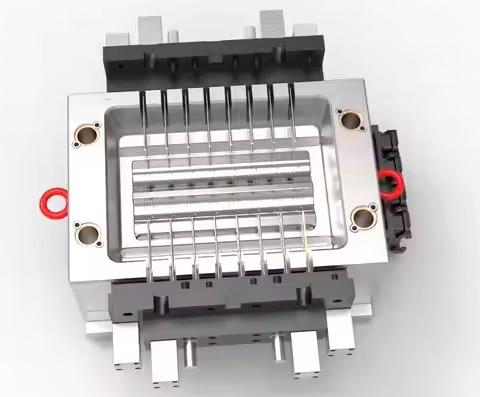

Material Selection and Precision Manufacturing of disposable plastic fork molds
Mold Steel and Surface Treatments
| Component | Recommended Material | Key Properties |
| Cavity/Core | NAK80, S136 | Mirror polish (Ra ≤0.1 μm), corrosion resistance |
| Sliding Units | H13 (nitrided) | Hardness ≥50 HRC, wear resistance |
| Mold Base | P20 Pre-hardened Steel | Cost-effective for mass production |
DLC (diamond-like carbon) coatings reduce PLA sticking and extend mold life by 30%
Machining Processes and Precision Control
- Rough Machining: CNC milling removes 80% of material, leaving 0.5 mm for finishing.
- Precision Machining:
- EDM for tine tip radii (±0.005 mm precision);
- Slow wire-cutting for insert fitting surfaces.
- Heat Treatment: Quenching and tempering achieve cavity hardness of 52–56 HRC and tensile strength up to 1,500 MPa.
Conclusion
The evolution of disposable plastic fork molds reflects the tension between industrialization and sustainability. Moving forward, the industry must balance precision engineering with material innovation—leveraging smart molds to reduce energy consumption and bio-based materials to overcome degradation challenges. The next generation of molds may not only be production tools but also catalysts for a circular economy.