1. Introduction
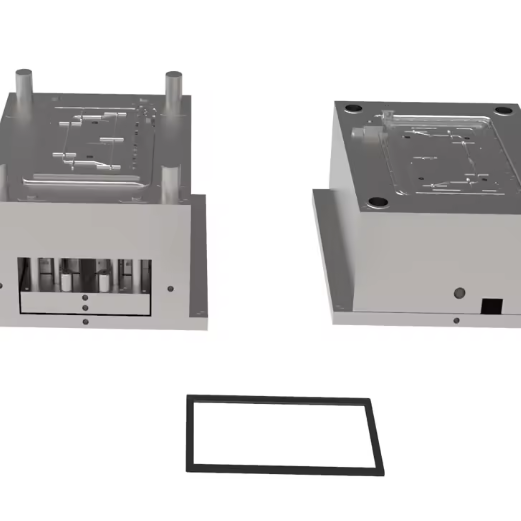
The display frame mold is a critical component in the production of electronic visual devices, requiring precise material selection and engineering to ensure dimensional accuracy, surface quality, and manufacturing efficiency. Display frame molds must accommodate thin-walled structures, maintain tight tolerances for screen alignment, and provide superior surface finishes while withstanding high-volume production cycles. This guide outlines material selection criteria, design considerations, and manufacturing processes specific to display frame mold applications, focusing on ISO 13406-2 compliance and lightweight design principles.
2. Material Selection for Display Frame Molds
2.1 Pre-hardened Steel 718H
718H is the preferred material for medium-to-high precision display frame molds due to its excellent mechanical properties and cost-effectiveness. This nickel-enriched alloy (1.0-1.5% Ni) offers a hardness range of 33-38 HRC and superior polishability, making it suitable for producing display frames with Class A surface finishes. The display frame mold fabricated from 718H exhibits excellent dimensional stability (±0.02mm/m) and can withstand 500,000+ cycles, ideal for mass production of display components. Its thermal conductivity (45 W/(m·K)) enables efficient cooling, reducing cycle times by 15-20% compared to conventional P20 steel in display frame mold applications.
2.2 Corrosion-Resistant Stainless Steel S136
For display frame molds requiring enhanced durability and corrosion resistance, S136 stainless steel provides exceptional performance through its high chromium content (13-14%). This martensitic stainless steel achieves 48-52 HRC after heat treatment and demonstrates superior corrosion resistance (500-hour salt spray resistance per ASTM B117), making it indispensable for display frame mold components exposed to humid environments or chemical cleaning agents. The material’s mirror polishing capability (Ra ≤0.012μm) ensures scratch-resistant surfaces for visible display bezels. While approximately 40% more costly than 718H, S136 extends display frame mold service life to 800,000+ cycles in aggressive conditions, providing long-term economic benefits for premium display models.
2.3 Mirror-Finish Steel NAK80
NAK80 pre-hardened steel has emerged as a game-changer for display frame molds requiring exceptional surface quality without secondary heat treatment. With a delivery hardness of 38-42 HRC and uniform microstructure, this material eliminates the need for post-machining heat treatment, reducing production lead times by 25%. Its superior polishability allows display frame molds to achieve Ra ≤0.02μm surface finishes, critical for high-end display applications where optical clarity is paramount. The display frame mold fabricated from NAK80 exhibits minimal dimensional distortion during machining, ensuring the precise fit required for seamless screen integration.
3. Design Considerations for Display Frame Molds
3.1 Precision Dimensional Control
Display frame molds must maintain exceptional dimensional accuracy to ensure proper screen alignment:
- Tolerance control: ±0.05mm for critical mounting features
- Flatness requirement: ≤0.02mm/m across the mold surface
- Parallelism: ≤0.01mm between mating surfaces
- Wall thickness uniformity: ±5% variation for thin-walled sections
Advanced finite element analysis (FEA) is recommended to validate display frame mold deflection under clamping force, ensuring maximum deformation does not exceed 0.1mm at full clamping pressure. The display frame mold design should incorporate precision locating pins with 0.005mm clearance to maintain consistent part positioning.
3.2 Cooling System Optimization
Efficient thermal management in display frame molds reduces cycle time and ensures dimensional consistency:
- Conformal cooling channels: 6-8mm diameter with 25-35mm spacing
- Beryllium copper inserts: Embedded in thick-walled sections to accelerate heat transfer
- Temperature uniformity: ±2°C across the cavity surface
- Flow rate: 2-3 m/s to achieve turbulent flow
For large display frame molds (over 500mm in length), cooling time typically constitutes 60-70% of total cycle time (30-45 seconds), necessitating optimized channel layouts. Moldflow simulation should be employed to validate cooling efficiency and prevent warpage in thin-walled display components.
3.3 Lightweight Design Strategies
Modern display frame mold design incorporates several strategies to reduce weight while maintaining performance:
- Topology optimization: Computer-aided design tools to remove non-essential material from mold bases
- High-strength aluminum alloys: For non-critical components, reducing weight by 30-40%
- Modular construction: Interchangeable cavity inserts to accommodate multiple display sizes
- Thin-wall core design: Minimum 12mm core thickness with strategic rib reinforcement
These lightweighting techniques not only reduce material costs but also lower machine energy consumption by 15-20% during display frame mold operation, supporting sustainable manufacturing practices.
4. Manufacturing Processes for Display Frame Molds
4.1 Precision Machining Requirements
The production of display frame molds demands advanced machining techniques:
- 5-axis CNC milling: For complex geometries with positional accuracy of ±0.005mm
- Wire EDM: For intricate features and narrow slots with ±0.002mm tolerance
- Surface grinding: Flatness within 0.005mm/m for critical mating surfaces
- Ultrasonic polishing: To achieve Ra ≤0.02μm surface finish on visible areas
Display frame mold components larger than 600mm require segmented machining with subsequent assembly, ensuring each segment maintains positional accuracy within 0.01mm. Critical surfaces must be finished to Ra ≤0.4μm to prevent light reflection issues in final display products.
4.2 Surface Treatment Technologies
Display frame mold surfaces require specialized treatment to ensure optimal performance:
- PVD coating: Titanium nitride (TiN) or chromium nitride (CrN) coatings (3-5μm thickness) for enhanced wear resistance
- Electrolytic polishing: For mirror finishes and reduced friction
- Nitriding: 0.1-0.3mm case depth for surface hardness of 800-1000 HV
- Laser texturing: For controlled light diffusion on non-visible surfaces
The surface treatment process must be validated through rigorous testing, including adhesion strength (≥50 N/cm) and wear resistance (≤0.1mg loss after 100,000 cycles) to ensure long-term performance of the display frame mold.
4.3 Assembly and Validation
Precise assembly is critical for display frame mold performance:
- Guide pillar parallelism: ≤0.01mm over full stroke
- Clamping force distribution: Uniform within 5% across mold surface
- Hydraulic circuit integrity: 1.5× working pressure test for 30 minutes
- Trial molding: 50-piece production run with dimensional inspection per ISO 286 standards
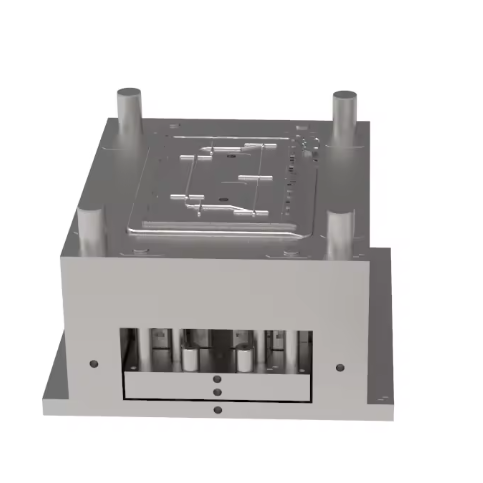
Large display frame molds should incorporate adjustable tie-bar supports to compensate for thermal expansion. The assembly process must include laser alignment verification at each stage to ensure the final display frame mold meets all dimensional requirements for screen compatibility.

5. Quality Control and Industry Standards
5.1 ISO 13406-2 Compliance
Display frame molds must comply with ISO 13406-2 Class II standards for visual display equipment:
- Pixel defect tolerance: Maximum 2 Type 1/2 defects per million pixels
- Surface flatness: ≤0.1mm/m for LCD mounting surfaces
- Color uniformity: ΔE ≤3.0 across display viewing area
- Impact resistance: 15 J at 23°C per IEC 62262 standard
The display frame mold design must incorporate features that facilitate compliance testing, including standardized measurement references and alignment targets. Documentation should include detailed dimensional records and material certifications to support regulatory approval.
5.2 Dimensional Inspection Protocol
Comprehensive inspection ensures display frame mold accuracy:
- Coordinate measuring machine (CMM) inspection: 3D scanning with 0.001mm resolution
- Optical comparator: For profile verification of complex curves
- Surface finish analysis: Ra and Rz values verified using confocal microscopy
- Mold flow simulation validation: Fill time and pressure distribution analysis
Statistical process control (SPC) should be implemented for all critical display frame mold parameters, with control limits set at ±3σ of process capability. Any out-of-specification condition requires root cause analysis and corrective action documentation.
6. Maintenance and Longevity Strategies
6.1 Preventive Maintenance Program
A structured preventive maintenance regimen extends display frame mold service life:
- Daily: Clean cavity surfaces and check for debris
- Weekly: Inspect cooling channels for blockages
- Monthly: Verify alignment and parallelism of guide pillars
- Quarterly: Measure wear on critical components and re-polish as needed
- Annually: Complete disassembly and replacement of worn components
Maintenance records should document all display frame mold service activities, providing valuable data for optimizing maintenance intervals and predicting mold life expectancy.
6.2 Repair and Refurbishment Techniques
When display frame mold components require repair, specialized techniques ensure minimal impact:
- Laser welding: For localized repair of damaged cavity surfaces
- Electroplating: Rebuilding worn surfaces to original dimensions
- Polishing rejuvenation: Restoring surface finish after extended use
- Coating reapplication: Renewing PVD or nitride layers
Post-repair validation requires 10-piece test molding and comparison to original CAD data to ensure the repaired display frame mold meets all performance specifications.
7. Advanced Technologies in Display Frame Mold Manufacturing
7.1 Additive Manufacturing
3D printing technologies are transforming display frame mold production:
- Conformal cooling inserts: Optimized cooling channels following complex geometries
- Binder jetting: For producing intricate mold cores with internal features
- Hybrid manufacturing: Combining additive and subtractive processes for complex components
Additive manufacturing reduces display frame mold lead times by 30-50% for complex geometries and enables cooling time reductions of 25-40% compared to conventional machining.
7.2 Digital Twin Technology
Industry 4.0 technologies are enhancing display frame mold development:
- Virtual mold tryout: Using advanced CAE software to simulate the injection molding process
- Real-time monitoring: Sensor integration for temperature and pressure tracking
- Predictive maintenance: Machine learning algorithms to optimize service intervals
These digital technologies improve display frame mold reliability, reducing unplanned downtime by 30-40% and improving overall equipment effectiveness (OEE) by 15-20%.
7.3 Lightweighting and Material Innovation
Advanced materials are enabling new possibilities in display frame mold design:
- High-strength low-alloy (HSLA) steels: Reducing section thickness without compromising strength
- Metal matrix composites: For enhanced thermal conductivity and reduced weight
- Ceramic coatings: Improving wear resistance while maintaining surface finish
These innovations enable the production of lighter, more efficient display frame molds that support the trend toward thinner, lighter display devices.
8. Conclusion
The design and manufacture of display frame molds require a specialized approach that balances precision, surface quality, and production efficiency. By selecting appropriate materials (718H for general applications, S136 for corrosion resistance, NAK80 for mirror finishes) and implementing robust quality control measures, producers can create display frame molds capable of meeting the stringent requirements of modern display manufacturing.
The display frame mold industry continues to evolve through the integration of additive manufacturing, digital twin technology, and advanced materials. These innovations enable the production of more complex, durable, and cost-effective display components while supporting the trend toward thinner, lighter, and higher-performance visual devices.
By following the guidelines presented in this essential guide, engineers and manufacturers can develop display frame mold solutions that deliver consistent quality, maximize production efficiency, and support the ongoing evolution of display technology. The future of display frame mold technology will undoubtedly bring further advancements in materials, processes, and digitalization, ensuring the industry remains at the forefront of manufacturing innovation.
>>You may also like
Standards & References
The following industry standards are referenced in this article: