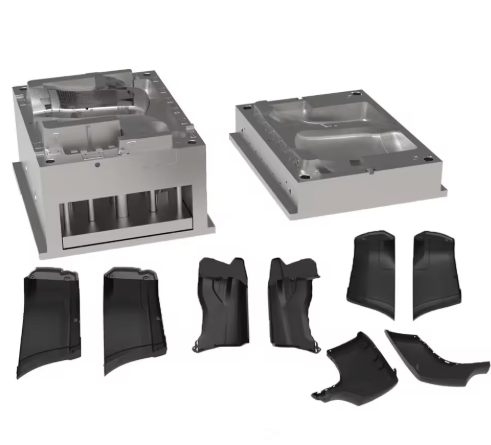
The global automotive mold market is undergoing transformation driven by demands for lightweighting and durability. Metal materials have emerged as critical enablers, with pre-hardened steel alloys playing a significant role in automotive applications. bumper corner mold has become indispensable tools, offering precision engineering capabilities that meet the stringent requirements of modern automotive manufacturing.
Modern bumpers are complex safety systems integrating sensors, cameras, and pedestrian protection structures. Achieving intricate geometries and surface finishes demands molds with exceptional dimensional stability and repeatability. This steel delivers on these requirements while providing production cost advantages compared to alternative materials. As the industry moves toward electric vehicles and autonomous driving technologies, the role of high-performance automotive mold will only intensify.
Material Properties: The Science Behind Superior Molding
P20 steel is a pre-hardened mold steel alloy engineered specifically for high-performance automotive tooling applications. This versatile material combines optimal hardness with excellent machinability, making it ideal for producing complex steel molding tooling like bumper corner molds that require intricate details and superior surface finishes.
Mechanical Properties are defined by its pre-hardened condition of 28-32 HRC, providing an ideal balance between machinability and wear resistance. This hardness range ensures the mold maintains dimensional stability during extended production runs while allowing for intricate detailing required for modern bumper designs. The material exhibits excellent tensile strength and impact resistance, preventing micro-cracking around stress concentration areas like sensor mounting pockets.
Chemical Composition is precisely controlled to achieve optimal performance: Carbon (C) 0.28-0.40% provides hardness and wear resistance; Chromium (Cr) 1.4-2.0% enhances hardenability and corrosion resistance; Molybdenum (Mo) 0.3-0.55% improves toughness and thermal stability. This alloy composition ensures the automotive mold maintains its properties during molding cycles and resists degradation from mold release agents and cleaning solutions.
Heat Treatment Process further optimizes material performance. The steel undergoes quenching at 850-880°C followed by tempering at 550-600°C to achieve the desired hardness range. This heat treatment imparts uniform properties throughout the mold section, eliminating soft spots that could lead to premature wear. The process also reduces internal stresses, minimizing distortion during machining and ensuring dimensional stability in service.
Technical Advantages of Pre-hardened Steel Bumper Corner Molds
The adoption of bumper corner mold in automotive manufacturing delivers measurable improvements in production efficiency, part quality, and total cost of ownership. These advantages stem from the material’s unique combination of properties tailored to the specific challenges of bumper corner molding.
High Polishability stands as a defining technical benefit, enabling surface finishes from #2000 to #4000 grit that produce Class A surfaces on molded bumpers. This eliminates secondary finishing operations and ensures consistent paint adhesion across production runs. The material’s uniform microstructure allows for progressive polishing without orange peel formation, critical for achieving the high-gloss finishes demanded by automotive OEMs.
Dimensional Stability ensures consistent part geometry throughout the mold’s service life. This steel maintains tight tolerances even under thermal cycling conditions, with minimal expansion and contraction during molding cycles. This stability is particularly valuable for bumper molds incorporating sensor mounting features that require precise alignment with vehicle chassis components. The material’s low distortion tendency eliminates the need for frequent mold re-calibration.
Extended Service Life provides exceptional return on investment. With proper maintenance and optional Nitriding treatment, steel molding tooling can achieve 300,000+ mold cycles, making it ideal for high-volume production programs. The material’s wear resistance ensures consistent part quality even after extended use, while its repairability allows for surface reconditioning to extend mold life beyond initial projections.
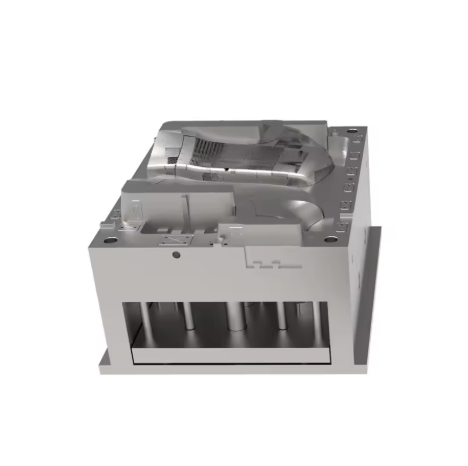
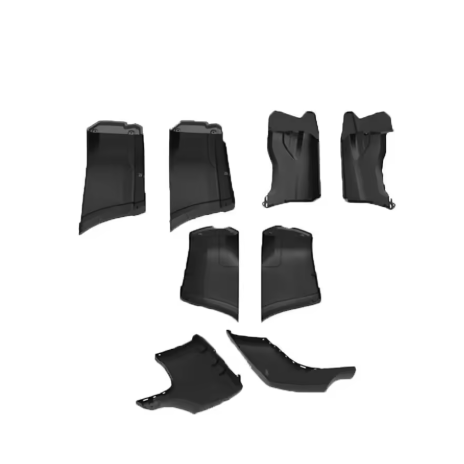
Manufacturing Process: Precision Engineering of Pre-hardened Bumper Corner Mold
The production of bumper mold involves a specialized sequence of processes that transform raw steel into precision tooling. This manufacturing workflow combines advanced metallurgical processing with digital engineering to ensure mold accuracy and performance.
Tool Design and Engineering begins with detailed CAD modeling of the bumper corner geometry, incorporating draft angles, parting lines, and ejection systems. Finite element analysis (FEA) simulates molding pressures to optimize mold wall thickness and cooling channel placement. Modern automotive mold designs integrate sensor mounting features and alignment systems with tight tolerances to accommodate automated molding cells. Computer-aided manufacturing (CAM) generates toolpaths for high-speed CNC machining, ensuring efficient material removal while maintaining precision.
Steel Preparation and Conditioning ensures optimal material properties before machining. The steel arrives in pre-hardened condition (28-32 HRC) but undergoes stress relief annealing to minimize distortion during machining. The steel is inspected for uniformity using ultrasonic testing to detect any internal defects that could compromise mold performance. For large molds, material is normalized to ensure consistent hardness throughout the workpiece, preventing machining inconsistencies.
CNC Machining Operations transform the steel block into a precision mold cavity. Roughing operations remove excess material using high-feed end mills, followed by semi-finishing to establish basic mold geometry. High-speed finishing with carbide and ceramic tools achieves the required dimensional tolerances of ±0.02mm for critical surfaces. The steel molding tooling then undergoes EDM (Electrical Discharge Machining) for complex features inaccessible by conventional machining, such as deep ribs and narrow slots in sensor mounting areas.
Heat Treatment and Surface Enhancement optimize mold performance. Optional nitriding treatment increases surface hardness to 65-70 HRC while maintaining core toughness, significantly extending wear resistance and service life. The mold surfaces receive progressive polishing from #400 to #4000 grit, with critical aesthetic areas polished to the highest specifications. Final processes include laser engraving of part numbers and alignment marks, followed by comprehensive inspection using coordinate measuring machines (CMM) to verify all dimensions against CAD models.
Application Scenarios: Optimizing P20 Steel Bumper Corner Mold for Diverse Bumper Technologies
Bumper mold demonstrates exceptional versatility across the spectrum of automotive bumper manufacturing processes, adapting to different materials and production volumes while maintaining precision and efficiency.
Thermoplastic Bumper Systems represent the largest application segment, particularly for high-volume passenger vehicles. These molds excel in processing polypropylene (PP) and PP/glass composites commonly used in bumper construction. The material’s excellent thermal conductivity ensures uniform cooling and reduced cycle times, while its wear resistance handles the abrasive nature of glass-filled thermoplastics. This steel provides the dimensional stability required for tight-fitting bumper assemblies across temperature extremes.
Thermoset Composite Bumpers benefit from the steel’s ability to withstand elevated cure temperatures required for epoxy and polyester matrix systems. These high-performance bumpers demand exceptional surface quality for Class A paint finishes. The material delivers consistent #2000-#4000 grit finishes that eliminate secondary surface preparation. Its durability ensures mold integrity even with aggressive mold release agents used in thermoset processing.
Hybrid Bumper Assemblies combining metal reinforcements and composite panels present unique molding challenges that steel molding tooling addresses effectively. The material’s rigidity minimizes deflection during insert molding operations, maintaining critical alignment between metal and composite components. Its machinability allows for complex cooling channel designs that precisely control temperature distribution across dissimilar materials, reducing residual stresses in hybrid structures.
Conclusion: The Future of Automotive Molding with Pre-hardened Steel Technology
As automotive manufacturing continues its trajectory toward lightweight, high-performance vehicles, bumper corner mold has established itself as a critical enabler of this transformation. The material’s unique combination of precision, durability, and cost-effectiveness addresses the industry’s most pressing challenges, from complex bumper geometries to efficient production cycles.
The technical advantages of these molds—from exceptional polishability to extended service life—directly support the automotive industry’s evolution toward electric and autonomous vehicles. As bumpers integrate more sensors and structural functions, the dimensional stability offered by this steel becomes increasingly valuable. Manufacturers that adopt this technology position themselves to meet both current production demands and future innovation requirements.
Looking ahead, emerging developments in surface treatments and machining technologies promise to further enhance the mold capabilities. These advancements will likely extend service life while maintaining the material’s inherent advantages in machinability and cost-effectiveness. For automotive engineers and manufacturers, the message is clear: steel molding tooling represents not just a current solution, but a strategic investment in the future of vehicle production.
In an industry defined by constant innovation, these bumper corner molds stand out as a technology that delivers immediate benefits while enabling the next generation of automotive design and manufacturing excellence. Their adoption reflects a broader industry shift toward materials that offer not just incremental improvements, but transformative capabilities that redefine what’s possible in automotive component production.
>>You may also like
Standards & References
The following industry standards are referenced in this article: