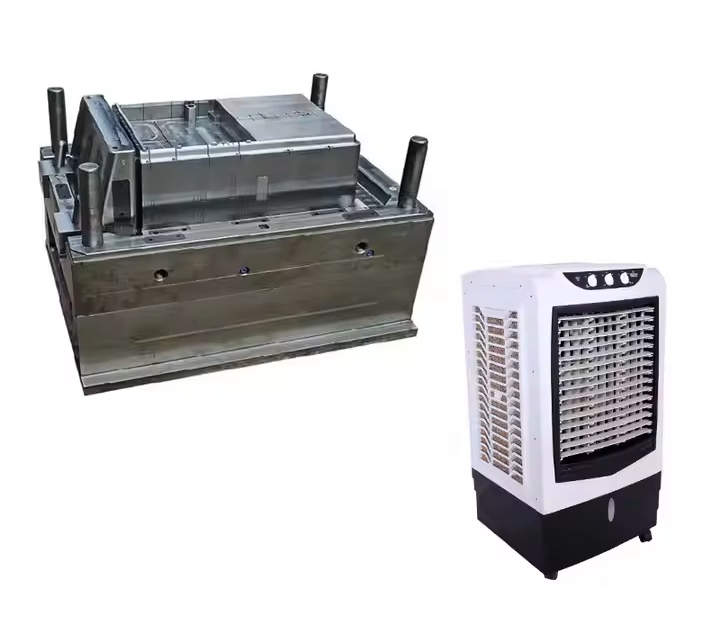
Blowers, as critical pneumatic equipment in industrial fields, are widely used in ventilation, cooling, waste gas treatment, and other applications. The manufacturing quality of their core components directly determines equipment efficiency and service life. Molds, as key tools in the production process, form the foundation for ensuring blower performance. This article delves into the technical essentials and development trends of blower molds from the perspectives of design, material selection, processing technologies, and industry applications.
Industry Demands and Technical Challenges for Blower Molds
Key blower components include impellers, housings, and inlets. Among these, the impeller, as the core dynamic component, directly influences airflow performance metrics such as air volume, pressure, and energy consumption. Mold precision determines critical aspects of impeller blades, including 3D curvature, surface finish, and dynamic balance. Current industry requirements for blower molds include:
- High Precision: Modern impellers often feature 3D twisted blades, requiring mold cavity surface tolerances within ±0.02 mm to ensure aerodynamic performance.
- Complex Geometry Compatibility: Centrifugal blower volutes require spiral involute structures, necessitating multi-directional mold parting capabilities.
- High-Temperature Resistance: Components made from aluminum alloys or engineering plastics (e.g., PPS) demand molds capable of withstanding prolonged high-temperature injection or die-casting processes.
- Cost-Effective Durability: Molds must withstand over 100,000 production cycles while minimizing per-unit costs.
Design Fundamentals: Fluid Dynamics and Structural Optimization
1. CFD-Driven Mold Design
Modern mold design has shifted from experience-based to data-driven approaches. Computational Fluid Dynamics (CFD) software (e.g., ANSYS Fluent) simulates impeller airflow to reverse-engineer optimal mold cavity geometries. Examples include:
- Designing blade inlet angles to prevent airflow separation, requiring precise replication of theoretical curves in mold surfaces.
- Aligning volute diffuser expansion angles with energy conversion efficiency, ensuring parting lines match airflow directions.
2. Parting Surface and Ejection System Design
Complex impeller geometries challenge mold parting strategies:
- Slider-angle lifter hybrid systems prevent blade damage during ejection.
- Interference analysis via software (e.g., Siemens NX) optimizes ejector pin layouts.
3. Cooling System Innovation
Temperature uniformity critically impacts component quality:
- Conformal cooling channels via 3D printing reduce injection cycles by 20%.
- Localized cooling in die-casting molds prevents porosity in aluminum alloys.
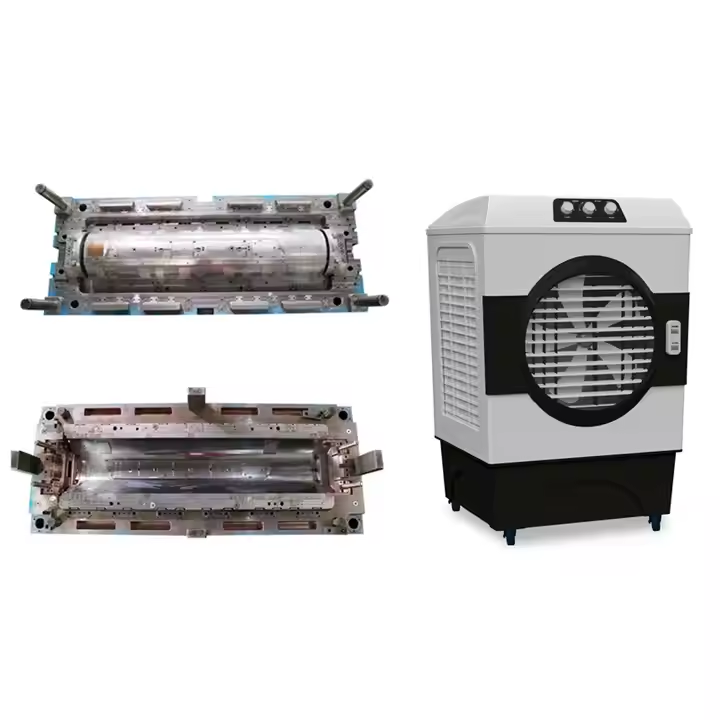
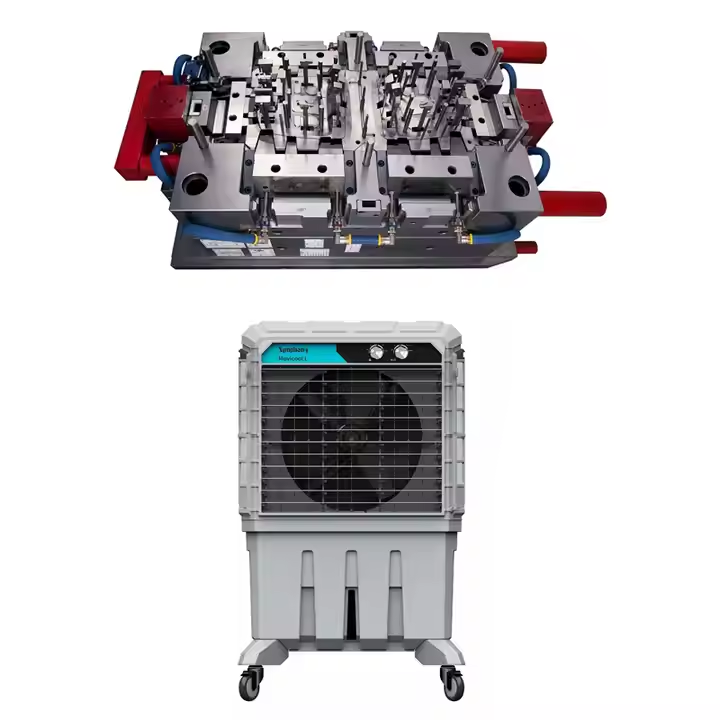
Advanced Manufacturing Technologies of Blower molds
1. Precision Machining
- Five-Axis Machining: Processes complex impeller cavities at spindle speeds up to 20,000 rpm, achieving surface roughness Ra ≤0.4 μm.
- Electrical Discharge Machining (EDM): Processes deep cavities and narrow slots with ±5 μm accuracy.
- High-Speed Milling (HSM): Utilizes TiAlN-coated tools to enhance efficiency and tool life.
2. Additive Manufacturing Breakthroughs
Metal 3D printing transforms traditional mold production:
- Selective Laser Melting (SLM) creates conformal cooling inserts, boosting cooling efficiency by 30%.
- Gradient material printing forms wear-resistant surfaces (e.g., tungsten carbide) for extended durability.
3. Surface Treatment
- PVD Coatings: TiCN or Diamond-Like Carbon (DLC) layers reduce friction and corrosion.
- Micro-Arc Oxidation: Generates 50-100 μm ceramic coatings on aluminum die-casting molds, tripling thermal fatigue resistance.
Case Studies of Blower molds
Case 1: High-Speed Centrifugal Impeller Die-Casting Mold
- Material: H13 hot-work tool steel (HRC 48-52).
- Structure: Four-slider parting with hydraulic core-pulling.
- Process: Die-casting at 680°C ±10°C with dual-loop cooling.
- Outcome: 120,000-cycle lifespan; impellers meet G2.5 dynamic balance.
Case 2: Plastic Volute Injection Mold
- Material: S136 stainless steel (mirror-polished to Ra 0.1 μm).
- Innovation: Gas-assisted injection molding (GAIM) reduces sink marks and enhances strength.
- Efficiency: 90-second cycle time; defect rate <0.5%.
Industry Applications of Blower Molds
1. Emerging Applications
- Environmental Protection: Corrosion-resistant molds (e.g., duplex stainless steel) for desulfurization blowers.
- New Energy: ±0.01 mm precision molds for hydrogen fuel cell air compressor impellers.
2. Smart Manufacturing
- Mold IoT: Embedded sensors enable predictive maintenance via real-time temperature/pressure monitoring.
- AI-Driven Design: Machine learning optimizes gating systems, reducing trial runs.
3. Sustainability
- Lightweighting: Topology optimization reduces mold weight by 15-20%, lowering energy consumption.
- Remanufacturing: Laser cladding repairs mold damage, extending service life.
Conclusion
Modern blower molds have evolved into multidisciplinary products integrating aerodynamics, material science, and digital manufacturing. With AI and IoT integration, intelligent molds will achieve self-sensing, self-decision, and self-optimization capabilities, propelling the blower industry toward greater efficiency, intelligence, and sustainability. Enterprises mastering core mold technologies will dominate high-end equipment manufacturing.