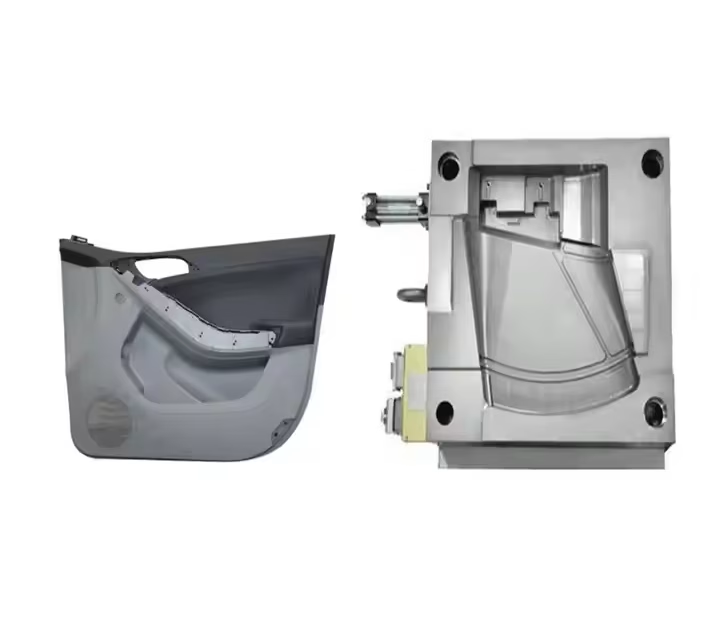
As a critical component of automotive interior and exterior trim, door panels not only provide functional protection and sealing but also serve as a key element in vehicle aesthetic design. In automotive manufacturing, the development and manufacturing quality of automotive door panel molds directly determine product precision, production efficiency, and overall vehicle quality. This article delves into the design principles, manufacturing technologies, application scenarios, and future trends of automotive door panel molds, offering systematic insights for industry professionals.
Key Design Considerations for Automotive Door Panel Molds
1. Structural Design and Functional Integration
Modern automotive door panel molds design requires a holistic approach, balancing structural integrity (e.g., inner/outer panels, reinforcing ribs) with functional integration (e.g., speaker grilles, storage compartments, electronic module slots). For instance, premium models often incorporate touch controls or ambient lighting, necessitating precise spatial design for wiring and assembly. CAD/CAE software enables 3D modeling and simulation to optimize mold cavity alignment with product geometry.
2. Material Selection and Process Optimization
Common mold materials include pre-hardened steels like P20 and 718H (hardness HRC 30-40 for wear resistance). With lightweighting trends, aluminum alloys treated with surface nitriding are gaining traction. Injection molding remains dominant, but parameters like mold temperature (±1°C control for high-gloss paint-free materials) must be tailored to polymers like PP, ABS, or PC/ABS blends to avoid surface defects.
3. Ejection and Cooling System Design
Complex ejection systems (lifters, sliders, hydraulic cylinders) are critical for demolding intricate geometries. For example, a German automaker’s automotive door panel molds employs 16 synchronized lifters to address deep-cavity demolding challenges. Conformal cooling via 3D-printed conformal channels boosts cooling efficiency by over 30%, reducing cycle times.
Core Manufacturing Technologies
1. High-Precision Machining
Mold cavity tolerances must be within ±0.02 mm. Five-axis CNC machines (e.g., DMG MORI DMU series) handle roughing and semi-finishing, while critical surfaces require wire EDM (±0.005 mm precision) and mirror-finish EDM (Ra ≤0.1 μm roughness). Tesla’s Model Y automotive door panel molds, for instance, leverage GF Machining Solutions’ automated tool-changing systems to cut machining time by 15%.
2. Surface Treatment and Coating
Advanced coatings enhance durability. PVD coatings like CrAlN achieve surface hardness exceeding HV 3000, with 5x better corrosion resistance. Japan’s TD (Thermal Diffusion) treatment creates 10–15 μm vanadium-carbide layers, ideal for molds processing glass-fiber-reinforced polymers.
3. Intelligent Inspection and Debugging
CMMs and blue-light scanners streamline quality control. A Chinese automaker’s digital twin system reduced physical trial runs from 8 to 2 by detecting 90% of defects virtually. Laser trackers ensure real-time calibration during mold assembly, optimizing component alignment.
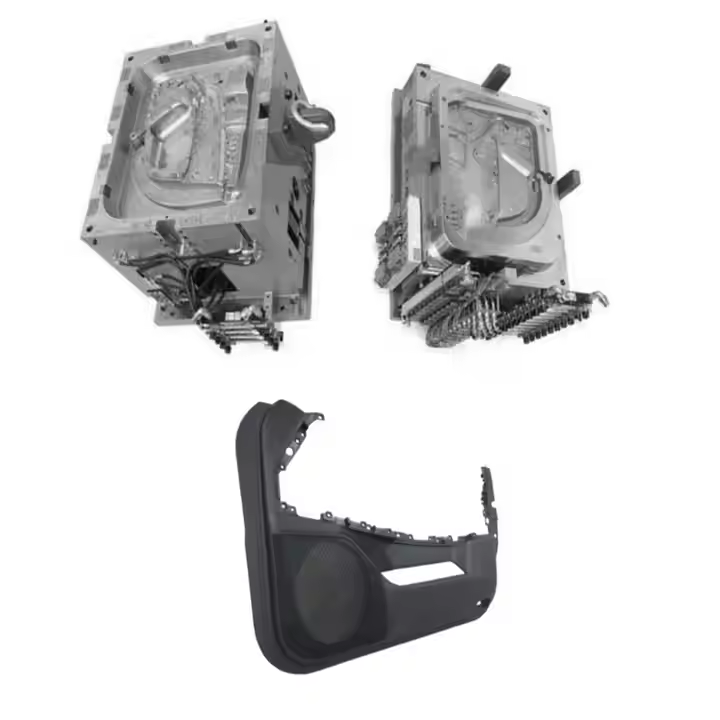
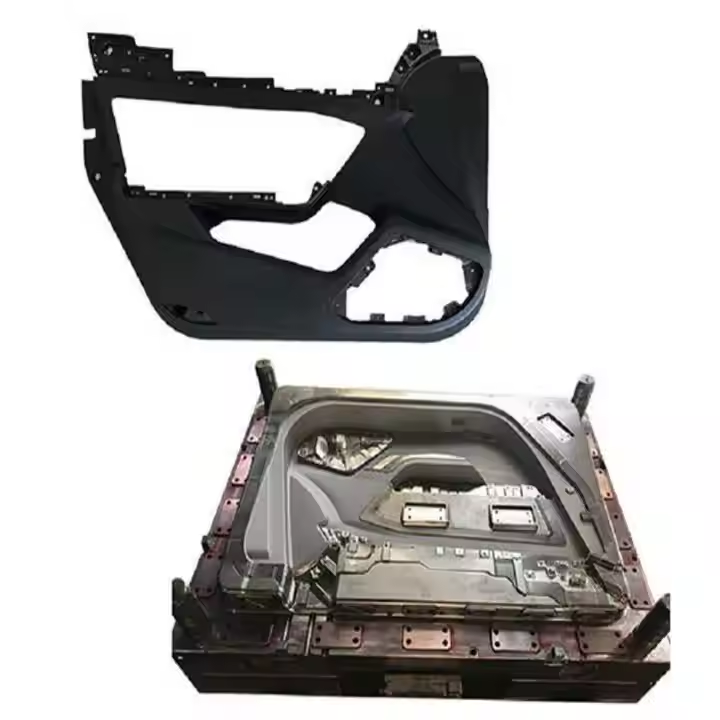
Advanced Manufacturing Processes
1. Precision Machining
| Process Stage | Technical Highlights | Accuracy Standards |
| Cavity Machining | 5-axis HSM (20,000rpm) | ±0.02mm contour |
| Electrode Fabrication | Graphite EDM engraving | Ra0.4μm surface finish |
| Surface Treatment | Mirror polishing (#15000 grit) | ≥95GU gloss level |
2. Specialized Techniques
TiAlN coatings: 3-5μm coatings extending mold life >800,000 cycles
Laser texturing: 0.1-0.3mm depth patterns for leather/woodgrain effects
Micro-porous EDM: 0.2mm vent holes addressing gas traps
Case Studies
Case 1: Hidden Door Handle Molds for EVs
NIO ET5’s electrically retractable door handles demand a hybrid “slider + lifter + gas-assisted molding” design. With 0.1 mm gap control, the mold ensures seamless operation. Mold flow analysis optimized gate positions to eliminate weld lines, addressing strength concerns.
Case 2: Ultra-Thin Ambient Lighting Integration
Mercedes-Benz EQS’s 1.2 mm-thick LED strips use two-shot molding: transparent PC is first injected, followed by a light-blocking white layer via rotary molds. Zone-controlled mold temperatures enable molecular-level bonding, achieving uniform light diffusion.
Common Issues & Solutions
1. Warpage Control
- Cause: Uneven residual stress distribution
- Solutions:
- Balanced runner system design (<5% flow imbalance)
- Dynamic mold temperature control (±0.5℃)
- Reinforcement ribs (40-60% wall thickness)
2. Weld Line Elimination
- Cause: Melt front meeting angle <135°
- Solutions:
- Adjusted melt temp (220-240℃ for PP)
- Weld line relocation structures
- Gas-assisted molding implementation
Conclusion
As electric vehicles demand higher interior quality and customization grows, automotive door panel molds are rapidly evolving toward ultra-precision, intelligence, and flexibility. Future breakthroughs in 3D-printed conformal cooling, AI-assisted design, and sustainable manufacturing will determine competitiveness in the automotive industry’s transformation. Only through deep integration of technological innovation and advanced manufacturing can moldmakers lead this industrial revolution.
>>You may also like
Standards & References
The following industry standards are referenced in this article: