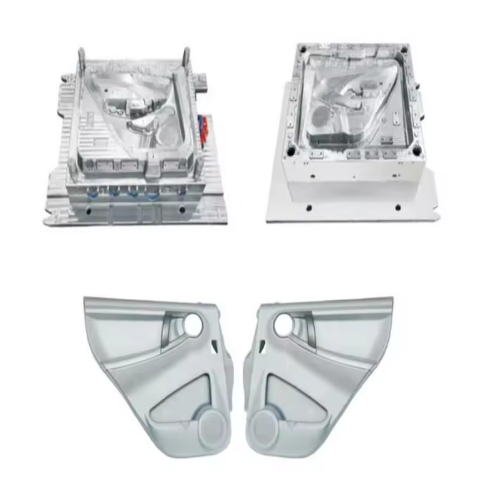
Material Selection for Automotive Door Panel Molds
Selecting the appropriate mold steel is critical for automotive door panel manufacturing, as it directly impacts production efficiency, part quality, and tooling longevity. The following steel grades represent industry standards for door panel mold applications, each offering distinct advantages based on production requirements:
P20 Steel serves as the entry-level standard for low-to-medium volume production. With a hardness range of 28-32 HRC and excellent machinability, P20 provides a cost-effective solution for simple door panel designs. Its balanced mechanical properties make it suitable for PP and ABS molding where surface finish requirements are moderate. However, its limited wear resistance (typically 500,000-800,000 cycles) necessitates careful maintenance for extended production runs.
718H Steel represents a step up in performance, offering enhanced hardness (32-36 HRC) and improved polishability. This pre-hardened steel excels in producing door panels with Class A surfaces, particularly when using ABS with aesthetic requirements. Its superior toughness compared to P20 reduces the risk of stress cracking during high-pressure injection, making it ideal for complex door panel geometries with intricate rib structures.
Material selection should consider production volume (low: <500,000 shots; medium: 500,000-1,000,000 shots; high: >1,000,000 shots), resin type (PP requires less wear resistance than glass-filled materials), and surface finish requirements (Class A vs. functional). For example, luxury vehicle door panels typically utilize S136 or NAK80 for superior aesthetics, while commercial vehicle applications often opt for 718H or 7CrSiMnMoV to balance performance and cost.
Injection Molding Process Parameters for Door Panel Production
Achieving consistent quality in automotive door panels requires precise control of injection molding parameters, with specific considerations for the two primary resin types: polypropylene (PP) and acrylonitrile butadiene styrene (ABS).
PP Molding Parameters demand careful temperature management to balance flowability and dimensional stability. Barrel temperatures should be maintained between 180-230°C, with nozzle temperatures set 5-10°C higher to prevent premature solidification. Mold temperatures typically range from 40-60°C, optimizing both cycle time and part warpage control. Injection pressure requires precise staging: 80-100 MPa for filling, 60-80 MPa for packing, and 30-50 MPa for holding. The packing phase is critical for door panels, with a duration of 15-25% of the total cycle to minimize sink marks in thick sections like armrest bases.
ABS Molding Parameters necessitate tighter temperature control to manage its higher viscosity and heat sensitivity. Barrel temperatures range from 220-260°C, with a recommended melt temperature of 235-245°C for optimal flow. Mold temperatures are typically maintained at 60-80°C to enhance surface finish and reduce internal stresses. Injection pressures are generally higher than PP, with filling pressures of 90-120 MPa and packing pressures of 70-90 MPa. ABS requires longer cooling times (25-40 seconds depending on part thickness) to prevent dimensional distortion in large door panel surfaces.
Process Optimization Techniques play a crucial role in door panel manufacturing. For PP, implementing a two-stage injection profile helps prevent jetting in thin-walled sections, while ABS benefits from a slower fill rate to minimize weld line visibility. Both materials require careful venting, especially in door panel ribs and mounting points, to avoid burn marks and gas traps.
Common Defect Solutions include: adjusting hold pressure for sink marks (typically increasing by 5-10 MPa), optimizing cooling channel layout for warpage control, and fine-tuning injection speed to eliminate flow lines. For glass-reinforced PP door panels, increasing mold temperature by 5-10°C helps reduce fiber orientation issues that can cause surface defects.
Cycle Time Considerations balance productivity with quality. Typical cycle times range from 45-60 seconds for standard door panels, with PP generally 10-15% faster than ABS. Implementing conformal cooling can reduce cooling time by 20-30%, significantly improving production efficiency without compromising part quality.
Industry Standards and Quality Requirements
Automotive door panel molds must adhere to stringent industry standards that ensure dimensional accuracy, material performance, and production reliability. Two primary standards govern mold manufacturing: JB/T14214-2023 and ISO 20457, each addressing critical aspects of mold quality.
JB/T14214-2023 specifies technical requirements for plastic injection molds, with particular relevance to door panel tooling. This Chinese national standard mandates:
- Mold base material selection (minimum 45# steel for structural components)
- Dimensional tolerance control (±0.02mm for critical mounting features)
- Surface finish requirements (Ra ≤ 0.8μm for cavity surfaces)
- Mold testing procedures, including 100 consecutive shot trials without failure
- Marking requirements for mold identification and maintenance tracking
ISO 20457 provides international standards for plastic mold components, establishing:
- Uniform tolerance classes for mold inserts (IT8-IT10 for functional surfaces)
- Material performance requirements for mold steels (minimum hardness values, impact resistance)
- Testing methods for evaluating mold wear resistance and thermal stability
- Design guidelines for mold safety features, including ejection system interlocks
Automotive OEM Specifications often exceed general industry standards, with additional requirements such as:
- Dimensional stability over 1,000,000 cycles (±0.1mm maximum variation)
- Surface finish classifications (Class A for visible door panel surfaces)
- Material certification documentation (heat treatment records, material test reports)
- Mold maintenance accessibility (standardized mounting positions, quick-change features)
Quality Control Procedures essential for door panel molds include:
- Coordinate measuring machine (CMM) inspection of critical dimensions
- Surface roughness testing using profilometers
- Mold flow simulation validation before machining
- Pressure and temperature mapping during initial sampling
- Fatigue testing for high-volume production molds
Compliance Documentation required for automotive qualification includes:
- Material certificates for all mold components
- Dimensional inspection reports
- Mold flow analysis results
- Trial run documentation with process parameters
- Maintenance and repair records
Adherence to these standards ensures that door panel molds meet the rigorous requirements of automotive production, delivering consistent part quality, extended tool life, and compatibility with automated manufacturing systems.

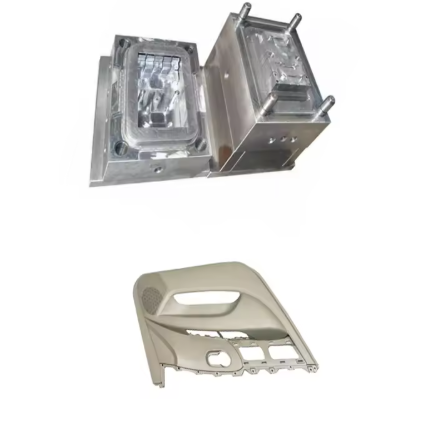
Surface Treatment Technologies for Automotive Door Panel Mold Enhancement
Surface treatment of door panel molds significantly impacts both tool performance and final part quality, with processes selected based on production requirements, resin type, and aesthetic demands.
Chrome Plating remains a popular surface treatment for door panel molds, offering:
- Enhanced wear resistance (hardness up to 1000 HV)
- Improved corrosion resistance, critical for PP and ABS molding
- Reduced friction, facilitating easier part ejection
- Mirror-like surface finish (Ra ≤ 0.02 μm) for Class A door panels
- Typical thickness of 5-15 μm, with precise control to maintain dimensional accuracy
The chrome plating process involves several stages: surface preparation (polishing to Ra ≤ 0.05 μm), nickel undercoating (5-10 μm), and chromium deposition. This treatment is particularly effective for high-volume production, extending mold life by 30-50% compared to uncoated steel.
Sandblasting provides controlled surface texturing for functional and aesthetic purposes:
- Creates uniform matte finishes (Ra 1.6-6.3 μm) that hide minor flow lines
- Improves adhesion for paint and adhesive applications on door panels
- Reduces light reflection in mold cavities, aiding visual inspection
- Available in various grit sizes (80-400 mesh) to achieve specific texture requirements
Aluminum oxide and glass bead media are commonly used, with process parameters (pressure, distance, duration) carefully controlled to ensure consistent texture across large door panel mold surfaces.
Nitriding offers a surface-hardening solution without dimensional distortion:
- Increases surface hardness (500-1000 HV depending on base material)
- Improves wear resistance for glass-filled PP door panels
- Typical case depth of 0.1-0.3 mm
- Can be applied to pre-hardened steels without compromising core toughness
Gas nitriding at 500-550°C for 20-40 hours creates a diffusion layer that enhances mold durability while maintaining the original surface finish.
PVD Coatings (Physical Vapor Deposition) provide advanced surface properties:
- TiN (Titanium Nitride) coatings for general-purpose wear resistance
- CrN (Chromium Nitride) for improved corrosion resistance in harsh environments
- DLC (Diamond-Like Carbon) coatings for ultra-low friction applications
- Thickness ranging from 2-5 μm, with minimal impact on dimensional accuracy
PVD coatings are particularly effective for molds producing door panels with complex geometries, where traditional plating may have coverage issues.
Surface Treatment Selection Criteria should consider:
- Production volume (chrome plating for >1,000,000 shots)
- Resin type (nitriding recommended for glass-filled materials)
- Surface finish requirements (polishing + chrome for Class A surfaces)
- Maintenance considerations (PVD coatings require specialized repair)
Proper surface treatment selection can increase mold life by 30-100%, reduce maintenance costs, and ensure consistent door panel quality throughout production runs.
Structural Design Considerations for Door Panel Molds
Effective structural design of automotive door panel molds balances functionality, durability, and production efficiency, with particular attention to cooling systems and ejection mechanisms.
Cooling System Design directly impacts cycle time, part quality, and mold longevity. For door panels, optimal cooling requires:
- Uniformly spaced cooling channels (8-15mm from cavity surface)
- Diameter selection based on panel thickness (8-12mm typical)
- Parallel flow design to maintain consistent temperature distribution
- Conformal cooling for complex geometries like armrests and storage pockets
- Beryllium copper inserts for thick sections to reduce cooling time by 20-30%
Simulation tools are essential for optimizing cooling channel layout, with mold flow analysis predicting temperature distribution and identifying potential hot spots. For large door panels, a combination of through-the-plate and bubbler cooling systems ensures uniform solidification.
Ejection System Engineering must accommodate the large surface area and potential distortion of door panels:
- Balanced ejection force distribution to prevent part warpage
- Ejector pin spacing optimized for panel rigidity (typically 80-120mm apart)
- Stripper plate systems for large flat areas to avoid surface damage
- Lifters for undercuts in handle recesses and storage compartments
- Ejector return pins with positive stops to prevent interference
The ejection stroke must be sufficient to clear the door panel from all mold features, typically 50-80mm depending on panel depth. For complex door panel designs, sequential ejection may be employed to release critical features first.
Mold Base Construction considerations include:
- Material selection (S50C or equivalent for mold bases)
- Support pillar placement to prevent deflection under injection pressure
- Guide pin and bushing selection for precise alignment (typically 4 guide sets for large door panels)
- Locating ring and sprue bushing alignment with injection machine
- Cavity and core plate thickness calculated for structural integrity under 100-150 MPa clamping pressure
Gate Design significantly impacts door panel quality:
- Hot runner systems preferred for large panels to reduce weld lines
- Valve gates for sequential filling of complex geometries
- Gate location selection to minimize visible flow lines on Class A surfaces
- Gate size calculated based on flow path length and resin viscosity
Ventilation Systems prevent gas traps and burn marks:
- Vent depth of 0.02-0.05mm in critical areas
- Vent width of 5-10mm along flow fronts
- Additional vents in deep ribs and corner features
- Vacuum venting systems for high-precision applications
Mold Maintenance Accessibility features include:
- Standardized fastener locations for easy disassembly
- Access panels for cooling line cleaning
- Ejector plate travel stops and safety interlocks
- Mold identification and part number marking
- Lifting lugs and handling points for safe transportation
Advanced door panel molds increasingly incorporate sensor technology to monitor temperature, pressure, and wear, enabling predictive maintenance and process optimization. These smart mold features provide real-time data to ensure consistent part quality throughout production runs.
By integrating these structural design elements, door panel molds can achieve production cycles of 45-60 seconds while maintaining dimensional stability and surface quality, even for complex door panel geometries with integrated features.
FAQs
- What materials are commonly used for the mold?
We typically use high-quality steel, selected based on production volume and surface requirements. - Can the mold support different plastics?
Yes, it’s suitable for FRP,PP, ABS, PVC, and other automotive-grade thermoplastics. - How do you ensure surface quality of the door panel?
Through precise CNC machining, polishing, texture control, and strict quality inspection. - Is customization available for different vehicle models?
Absolutely. We design molds according to specific drawings, dimensions, and OEM standards. - What is the typical mold lifespan?
With proper maintenance, the mold can achieve hundreds of thousands to over a million shots. - Do you provide mold testing and trial samples?
Yes, mold trials and sample approval are included before final delivery.
>>You may also like
Standards & References
The following industry standards are referenced in this article: