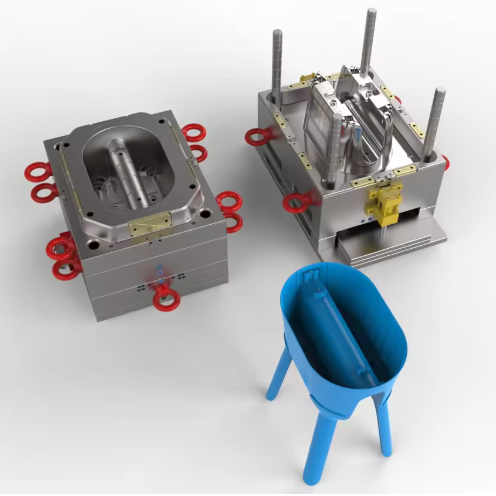
Material Selection for High Basin Molds
Selecting the right steel for high basin molds requires balancing durability, corrosion resistance, and cost-effectiveness. Three materials dominate the industry due to their proven performance in high-volume production environments: 718H, S136, and H13 tool steels. Each offers distinct advantages depending on the application requirements.
718H pre-hardened steel has become a staple in general-purpose basin mold applications. With a hardness of 33-37 HRC, it provides excellent machinability while maintaining sufficient wear resistance for production runs up to 500,000 cycles. The material’s uniform microstructure minimizes distortion during machining, making it ideal for complex basin geometries with tight tolerances. Its moderate price point positions it as a cost-effective solution for medium-volume production where extreme corrosion resistance isn’t required.
For applications demanding superior surface finish and corrosion resistance, S136 stainless steel stands out. This material maintains its integrity even when exposed to corrosive plastic resins and frequent cleaning cycles. The steel’s low carbon content (0.38%) combined with chromium (13.5%) and nickel (1.0%) additions creates a passive oxide layer that prevents rust formation. S136’s ability to achieve mirror-like抛光 (Ra ≤ 0.02 μm) makes it perfect for transparent or high-aesthetic basin components. While approximately 30% more expensive than 718H, its extended tool life (up to 1 million cycles) and reduced maintenance requirements often offset the initial investment.
H13 hot work tool steel addresses the most demanding basin molding challenges. With a hardness range of 42-48 HRC after heat treatment, it excels in high-temperature applications involving engineering plastics like PPS or PEI. H13’s exceptional thermal conductivity (42 W/m·K) ensures uniform cooling, reducing cycle times by up to 15% compared to conventional steels. The material’s resistance to thermal fatigue makes it indispensable for molds operating at temperatures exceeding 200°C. However, its higher hardness increases machining complexity, requiring specialized tooling and expertise.
Material selection should consider not only initial costs but also total cost of ownership. A 2023 study by the Society of Plastics Engineers found that while S136 commands a higher upfront price, its maintenance costs are 40% lower than 718H over a 3-year production cycle for corrosive applications. Similarly, H13 justifies its premium for high-temperature applications through increased productivity and reduced downtime.
Injection Molding Process Parameters
Optimizing injection molding parameters is critical for achieving consistent part quality and maximizing mold longevity. The interaction between temperature, pressure, and speed directly impacts dimensional accuracy, surface finish, and material distribution in high basin molds.
Temperature control forms the foundation of successful basin molding. Barrel temperatures typically range from 200-300°C depending on the resin type, with a general guideline of setting the rear zone 20-30°C lower than the front zone to prevent premature degradation. Mold temperatures should be maintained 10-20°C below the resin’s glass transition temperature to ensure proper crystallization while minimizing cycle time. For polypropylene basins, optimal mold temperatures range from 40-60°C, while engineering plastics like ABS benefit from higher temperatures (60-80°C) to reduce internal stresses.
Injection pressure settings must balance filling requirements with mold protection. First-stage pressure (holding pressure) typically ranges from 60-100 MPa, while second-stage pressure (packing pressure) should be set 10-20% lower to prevent flash formation. The pressure profile should gradually decrease as the cavity fills to avoid excessive shear stress on both the polymer and mold surfaces. A common industry practice is to use pressure decay curves that match the material’s viscosity characteristics throughout the filling phase.
Injection speed requires careful calibration to prevent flow marks and ensure uniform filling. Most basin applications utilize a multi-stage speed profile, starting with slow injection (20-30 mm/s) to establish a stable flow front, increasing to medium speed (50-80 mm/s) for main cavity filling, and reducing to 10-20 mm/s for the final packing phase. This approach minimizes air entrapment and weld line formation in critical areas.
Screw recovery parameters significantly impact process stability. Back pressure should be set between 5-15 MPa to ensure uniform melt temperature and proper degassing. Screw rotation speed typically ranges from 80-150 rpm, with the goal of completing recovery in 60-80% of the cooling time to maximize productivity.
The cooling phase represents the largest portion of the molding cycle, often accounting for 50-70% of total cycle time. Optimizing cooling channel design and water flow rates (1.5-2.5 m/s) can reduce cooling time by 20-30%. Conformal cooling channels, which follow the contour of the basin geometry, provide 30% more efficient heat transfer than conventional straight channels.
Process validation should include systematic testing of parameter combinations using design of experiments (DOE) methodology. This approach identifies optimal settings that balance part quality, cycle time, and mold longevity. A well-documented process window ensures consistent production and simplifies troubleshooting when variations occur.
Industry Standards and Compliance
High basin mold manufacturing operates within a framework of stringent industry standards that ensure product safety, performance, and interchangeability. These standards govern material selection, dimensional tolerances, and production processes, with specific requirements varying by application and geographic region.
The food contact sector represents one of the most regulated areas for basin molds. GB 4806.7-2016 establishes specific requirements for plastic materials in contact with food, including strict limits on migration of harmful substances. Molds producing food-grade basins must use materials that comply with these standards, particularly regarding heavy metal content (lead ≤ 10 mg/kg, cadmium ≤ 1 mg/kg) and organic volatile compounds. The standard also specifies cleaning protocols and durability requirements to ensure molds maintain their integrity throughout their service life.
European regulations take a more comprehensive approach through EU 10/2011, which sets migration limits for all plastics intended to contact food. This regulation includes a positive list of authorized monomers and additives, with specific migration limits for each substance (e.g., bisphenol A ≤ 0.05 mg/kg). Molds destined for the European market must demonstrate compliance through rigorous testing, including overall migration tests using food simulants (water, 3% acetic acid, 10% ethanol, and rectified olive oil) at various temperatures and contact times.
Automotive basin applications fall under ISO 16949, which specifies quality management system requirements for mold manufacturers. This standard emphasizes process control, measurement system analysis, and continuous improvement. Molds for automotive components must maintain dimensional stability within ±0.02 mm per 100 mm length and demonstrate capability indices (Cpk ≥ 1.33) for critical dimensions. The standard also mandates traceability of all materials used in mold construction, from raw steel through heat treatment processes.
Medical device basin molds face the most stringent regulatory requirements under ISO 13485. This standard incorporates all relevant aspects of ISO 9001 while adding specific requirements for risk management, process validation, and product traceability. Medical molds must be designed to prevent contamination, with smooth surfaces (Ra ≤ 0.8 μm) and minimal crevices where bacteria could accumulate. The standard also requires documented cleaning and maintenance procedures to ensure mold surfaces remain biologically inert.
Compliance with these standards requires careful documentation throughout the mold development process. Material certificates (including heat treatment records), dimensional inspection reports, and process validation data must be maintained for the lifetime of the mold. Many manufacturers implement document management systems specifically designed to track compliance-related information and facilitate audits by regulatory authorities.
Surface Treatment Technologies
The surface finish of high basin molds directly impacts both part quality and production efficiency. Modern surface treatment technologies offer solutions for aesthetic requirements, wear resistance, and release properties, enabling manufacturers to optimize molds for specific application demands.
Mechanical polishing remains the foundation of mold surface preparation, with progression through abrasive grit sizes (80-4000) achieving finishes ranging from functional (Ra 0.8 μm) to mirror-like (Ra 0.01 μm). The process typically begins with diamond grinding to establish uniform surface roughness, followed by progressively finer abrasive compounds applied with felt or foam tools. Automated robotic polishing systems have improved consistency, reducing variability by up to 40% compared to manual methods. For optical-quality surfaces, final polishing may involve colloidal silica suspensions applied with polyurethane pads, achieving the sub-micron finishes required for light-guide applications.
Chemical polishing offers an alternative for complex geometries where mechanical access is limited. This process uses acidic solutions (typically phosphoric, nitric, and hydrofluoric acid blends) to selectively dissolve surface irregularities. Chemical polishing can reduce Ra values by 50-70% in a single operation, though it cannot achieve the same high gloss as mechanical methods. The process is particularly effective for removing machining marks from deep ribs and undercuts in basin molds. Proper waste treatment is essential, as spent solutions contain heavy metals that require specialized disposal.
Physical Vapor Deposition (PVD) coatings provide durable surface enhancements for demanding molding applications. The process involves vaporizing solid materials (typically titanium, chromium, or aluminum) in a vacuum chamber and depositing them onto the mold surface as thin films (1-5 μm). TiN coatings (gold color) increase surface hardness to 2000-2500 HV, reducing wear in high-friction applications. CrN coatings (silver-gray) offer superior corrosion resistance, making them ideal for molds processing PVC or other corrosive resins. DLC (Diamond-Like Carbon) coatings provide the lowest friction coefficient (0.05-0.1) of any PVD option, significantly improving release properties for sticky materials like polypropylene. PVD coatings can extend mold life by 2-3 times while reducing maintenance requirements.
Laser texturing has revolutionized functional surface creation for basin molds. Using fiber lasers with wavelengths of 1064 nm, this process can generate precise microstructures (5-500 μm) that control friction, light diffusion, or hydrophobic properties. The non-contact nature of laser texturing eliminates tool wear and allows for intricate patterns that would be impossible with mechanical methods. Automotive basin applications often use laser-etched microchannels to manage fluid flow, while consumer product molds may incorporate textured surfaces that hide fingerprints. The technology’s digital nature enables quick design changes and pattern repeatability within ±2 μm.
The selection of surface treatment depends on multiple factors, including resin type, production volume, and aesthetic requirements. A 2024 industry survey found that 78% of mold manufacturers use combination approaches, typically mechanical polishing followed by PVD coating for high-performance applications. The trend toward more sustainable processes has led to developments in dry ice blasting and plasma etching as environmentally friendly alternatives to chemical treatments.
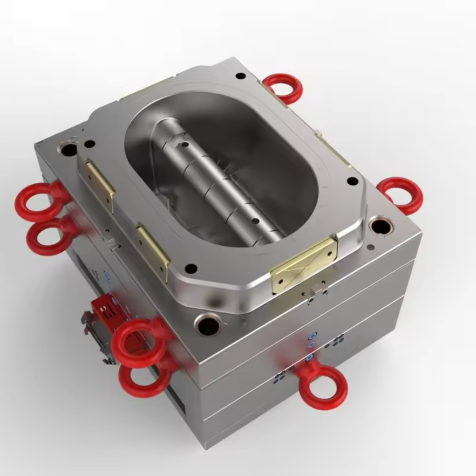
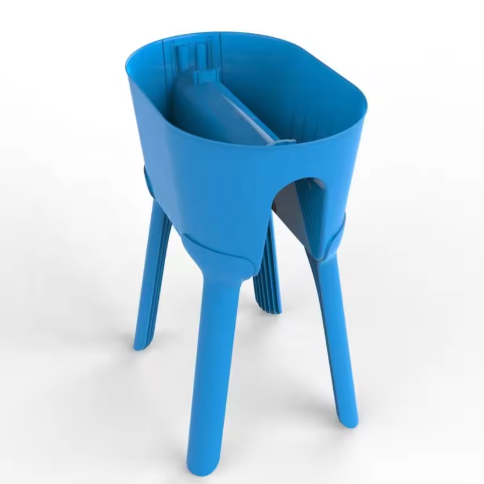
Structural Design Considerations
Effective structural design is essential for high-performance basin molds, influencing everything from production efficiency to part quality and mold longevity. Modern design approaches integrate advanced simulation tools with proven engineering principles to optimize cooling, ejection, and material flow.
Draft angles represent the most fundamental design consideration, with recommended values varying by material and surface finish. For standard thermoplastics like PP or PE, a minimum draft angle of 0.5° per side is sufficient for textured surfaces, increasing to 1.0° for smooth finishes. Engineering plastics with higher friction coefficients, such as POM or PC, require 1.5-2.0° draft to prevent part sticking and surface damage during ejection. The draft angle should increase by 0.25° for every 25 mm of cavity depth beyond 50 mm. These guidelines ensure easy part release while maintaining dimensional stability.
Cooling system design directly impacts cycle time and part quality. The ideal cooling circuit maintains a uniform mold temperature within ±2°C across all surfaces. Conventional cooling uses straight drilled channels (8-12 mm diameter) spaced 3-5 times the channel diameter apart. For complex basin geometries, conformal cooling—achieved through additive manufacturing or electrode discharge machining—can reduce cycle times by 20-30% compared to traditional methods. The cooling channels should be positioned 15-25 mm from the cavity surface, with water flow rates maintained at 1.5-3.0 m/s to ensure turbulent flow and maximum heat transfer. Simulation software like Moldflow can predict temperature distribution and optimize channel placement before mold construction begins.
Ejection system design must balance part protection with reliable operation. For large basin molds, a combination of ejector pins, sleeves, and stripper plates typically provides the most uniform ejection force. Ejector pins should be positioned to contact areas with sufficient structural support, avoiding thin walls or delicate features. The standard rule of thumb calls for one 12 mm diameter ejector pin for every 200 cm² of part surface area. For deep-drawn basins, lifter mechanisms may be necessary to address undercuts, with slide angles generally limited to 15-20° to prevent binding. Ejection stroke should exceed the part height by at least 5 mm to ensure complete part separation.
Gate design significantly influences material flow and part aesthetics. Edge gates work well for large basin components, typically positioned along the parting line to minimize visible gate marks. For thin-walled basins requiring uniform filling, hot runner systems with valve gates provide precise control over flow rate and pressure. The gate size should be calculated based on the material’s viscosity, with a general guideline of 50-70% of the part wall thickness. Fan gates distribute material evenly across wide surfaces, reducing weld line formation in large basins. Proper gate location prevents excessive shear stress that can cause molecular orientation and warpage in the final part.
Vent design prevents trapped air from causing burns or incomplete filling. Each cavity should have multiple vents (0.02-0.05 mm depth) positioned at the furthest points from the gate and in areas where air would naturally accumulate. Venting requirements increase with material viscosity; for highly filled resins, vent depth may need to increase to 0.08 mm to prevent premature clogging. The total vent area should be sufficient to allow air evacuation at a rate that matches the injection velocity, typically 150-300 mm² per cavity.
Modern mold design increasingly leverages digital tools to optimize these elements before physical construction. 3D CAD software with mold design modules automates many routine tasks, while CAE simulation predicts potential issues like weld lines, air traps, and warpage. This virtual validation reduces the need for costly design iterations, with industry data showing that upfront simulation reduces mold tryout time by an average of 40%.
FAQ – High Basin Mold
- What is a High Basin Mold used for?
A High Basin Mold is used to produce high-capacity basins or sinks, commonly for commercial or industrial applications. - Which materials can be used with a High Basin Mold?
It is suitable for materials such as plastic, fiberglass, and other composite materials, depending on design requirements. - Can the High Basin Mold be customized?
Yes, size, depth, shape, surface finish, and drainage design can all be customized according to customer drawings or samples. - What type of High Basin Mold steel is used?
Common mold steels include P20, 718, and H13, selected based on product volume and durability requirements. - Is the High Basin Mold suitable for mass production?
Yes, the High Basin Mold is designed for stable, high-efficiency mass production with consistent product quality. - What is the typical High Basin Mold lead time?
The lead time usually ranges from 30–45 days, depending on mold complexity and customization level. - Do you provide testing before shipment?
Yes, mold trials and sample testing are conducted to ensure proper structure, appearance, and functionality before delivery.
>>You may also like
Standards & References
The following industry standards are referenced in this article: