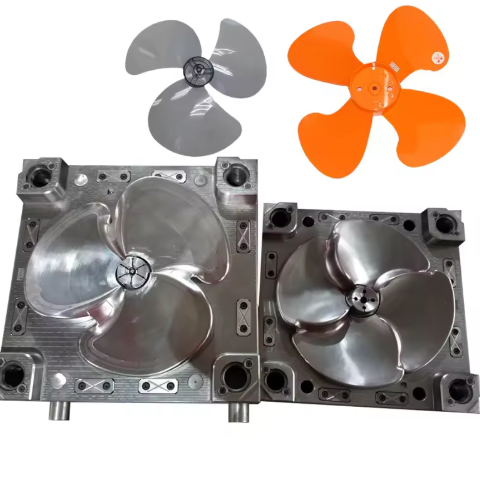
Material Selection for Fan Blade Molds
Selecting the right mold steel is critical for producing high-quality fan blades that meet performance and durability requirements. Three primary steel grades dominate the industry due to their unique properties tailored for plastic injection molding of fan components: 718H, S136, and H13.
718H pre-hardened steel stands out for its excellent polishability and dimensional stability, making it ideal for fan blades requiring smooth surfaces to minimize air resistance. With a hardness range of 33-37 HRC, it offers sufficient wear resistance for medium-volume production runs (up to 500,000 cycles). Its uniform microstructure ensures consistent cooling during molding, reducing the risk of warpage in thin-walled fan blade designs.
S136 stainless steel addresses the challenge of corrosion resistance, particularly valuable when molding plastic materials containing glass fibers or flame retardants that can accelerate mold degradation. This steel grade maintains its integrity even with aggressive cleaning agents, ensuring long-term surface finish retention. Its superior polishability (up to mirror finish) is essential for optical-grade fan blades used in precision cooling systems, where surface imperfections can disrupt airflow patterns.
H13 hot work tool steel excels in high-temperature applications, making it suitable for molding engineering plastics like PBT and PC that require elevated processing temperatures. With a hardness of 42-48 HRC after heat treatment, H13 offers exceptional thermal fatigue resistance, critical for maintaining dimensional accuracy during extended production runs. Its toughness properties reduce the risk of cracking when molding fan blades with complex geometries or thick-to-thin wall transitions.
Material selection should consider not only mechanical properties but also total cost of ownership. While S136 typically commands a 30-40% price premium over 718H, its extended lifespan in corrosive environments often justifies the investment for high-volume production. H13’s higher initial cost is offset by its performance in high-temperature applications, reducing downtime and maintenance costs.
Injection Molding Process Parameters
Optimizing injection molding parameters is essential for achieving consistent fan blade quality while maximizing production efficiency. The three critical parameters—temperature, pressure, and speed—must be precisely controlled to ensure proper material flow, packing, and cooling.
Injection temperature settings vary significantly based on the plastic material. For polypropylene (PP) fan blades, barrel temperatures typically range from 180-220°C, with nozzle temperatures 5-10°C higher to prevent premature solidification. Polycarbonate (PC) requires higher temperatures (260-300°C) to ensure complete melting of its crystalline structure. Maintaining consistent melt temperature is crucial; fluctuations greater than ±5°C can cause visible flow marks or dimensional variations in the final product.
Injection pressure directly impacts part density and dimensional accuracy. For thin-walled fan blades (0.8-2.0mm wall thickness), first-stage pressures of 80-120 MPa are common, followed by second-stage packing pressures of 60-90 MPa to compensate for volumetric shrinkage. Pressure holding time should be sufficient to allow gate freeze-off, typically 15-30 seconds depending on part thickness. Excessive pressure can lead to stress concentrations at the blade root, increasing the risk of fracture during operation.
Injection speed profiles follow a carefully designed ramp-up sequence to prevent jetting and air entrapment. A typical profile starts at 20-30% of maximum speed, increasing to 60-80% for the main fill phase, then reducing to 10-20% for packing. For fan blades with complex geometries or thin sections, multi-stage speed control prevents weld lines from forming at critical stress points. The total injection time should be balanced with cooling time to optimize cycle efficiency, generally ranging from 2-5 seconds for small to medium-sized fan blades.
Mold temperature control is equally important, with recommended settings of 40-60°C for PP and 80-120°C for PC. Uniform cooling is achieved through strategically placed water channels (typically 8-12mm diameter) positioned 15-20mm from the cavity surface. The cooling time, which constitutes 50-70% of the total cycle, must be sufficient to ensure the part reaches its glass transition temperature before ejection to prevent deformation.
Industry Standards and Quality Control
Fan blade mold manufacturing and performance must adhere to stringent industry standards to ensure safety, reliability, and interchangeability. Two primary standards govern plastic fan blade production: ASTM D4167 and ISO 1940.
ASTM D4167 establishes specifications for rigid plastic injection-molded parts, including fan blades. This standard covers dimensional tolerances, which are particularly critical for fan blades to ensure proper balance and airflow characteristics. For example, section 8.2 specifies a linear tolerance of ±0.25mm for parts with nominal dimensions between 50-150mm, which directly impacts the aerodynamic performance of the fan. The standard also outlines testing methods for determining mechanical properties such as flexural modulus and impact resistance, which are essential for evaluating fan blade durability under operating conditions.
ISO 1940 focuses on the determination of apparent density of plastic materials, a key parameter for ensuring consistent material performance in fan blade production. This standard provides procedures for measuring the density of moldings, which correlates with part strength and dimensional stability. For fan blades, maintaining consistent density across production batches prevents imbalances that could cause vibration, noise, or premature failure.
Quality control protocols extend beyond material and dimensional checks to include visual inspection criteria. Critical surface defects such as sink marks deeper than 0.1mm, flash exceeding 0.05mm, or visible weld lines in high-stress areas are typically rejected. Optical inspection using automated vision systems has become standard, with resolution capabilities down to 20μm for detecting surface imperfections that could affect airflow.
Performance testing of finished fan blades includes static balance testing, where imbalance greater than 1mg·mm/kg can cause excessive vibration. Dynamic testing evaluates airflow efficiency and noise levels, ensuring compliance with both industry standards and customer specifications. These tests often utilize anechoic chambers and laser Doppler anemometers to measure air velocity and turbulence characteristics.
Surface Treatment Technologies
The surface finish of fan blade molds directly impacts both the aesthetic appearance and functional performance of the molded parts. Two primary surface treatment techniques are employed in fan blade mold manufacturing: mechanical polishing and physical vapor deposition (PVD) coating.
Mechanical polishing progresses through a series of abrasive stages, starting with coarse grit (120-240) for removing machining marks, followed by progressively finer grits (400-1200) to achieve the desired finish. For fan blades requiring optimal aerodynamic performance, a mirror polish (Ra 0.02-0.05μm) is often specified to minimize air resistance. This level of polish requires specialized techniques including diamond compound polishing and ultrasonic finishing, which can increase mold production time by 15-25% compared to standard finishes.
PVD coating has emerged as a critical technology for extending mold life and improving release properties. Titanium nitride (TiN) coatings, applied at temperatures below 500°C to avoid affecting mold hardness, provide a surface hardness of 2000-2500 HV and reduce friction coefficients by 30-40%. This significantly reduces wear in high-volume production and improves part release, particularly when molding materials with high glass fiber content. For fan blades molded from polycarbonate or other high-temperature plastics, chromium nitride (CrN) coatings offer superior thermal stability and chemical resistance.
The selection between polishing and coating depends on production volume and material characteristics. For low-volume runs (less than 100,000 parts), mechanical polishing alone may be sufficient. For high-volume production or abrasive materials, PVD coatings can extend mold life by 200-300%. The combination of mirror polishing followed by PVD coating creates an optimal surface that enhances both part aesthetics and mold durability.
Surface treatment also plays a role in reducing cycle time. A properly finished mold surface with Ra values below 0.1μm can reduce cooling time by 5-10% by promoting uniform heat transfer. This is particularly beneficial for fan blades with complex geometries where uneven cooling can lead to warpage or dimensional inconsistencies.

Structural Design Considerations
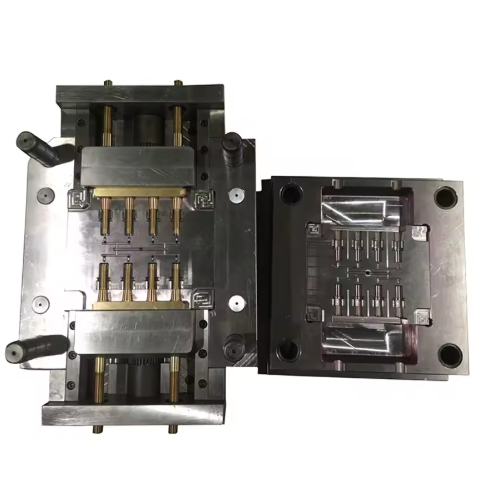
The structural design of fan blade molds directly influences production efficiency, part quality, and tooling cost. Two critical aspects of mold design are cavity layout and cooling system configuration.
Cavity layout optimization balances production efficiency with part quality. For small to medium-sized fan blades, multi-cavity molds (typically 2-8 cavities) are common, with cavity spacing of 2.5-3 times the part height to ensure uniform cooling. The choice between inline and circular cavity arrangements depends on part geometry and injection molding machine specifications. Hot runner systems are increasingly preferred for fan blade molds, as they eliminate runner waste (which can account for 15-30% of material usage) and reduce cycle time by 10-15%. Valve gate systems offer precise control over the filling process, minimizing weld lines in critical areas of the fan blade.
Cooling system design is paramount for ensuring consistent part quality and minimizing cycle time. Conventional cooling channels, typically 8-12mm in diameter, are strategically positioned to maintain a maximum distance of 2.5 times the channel diameter from any point on the cavity surface. For complex fan blade geometries, conformal cooling—achieved through 3D printing or electrode discharge machining (EDM)—can reduce cooling time by 20-30% compared to conventional straight channels. This technology allows cooling channels to follow the contours of the fan blade, maintaining uniform temperature distribution and reducing warpage.
The ejection system must be carefully designed to prevent part deformation during demolding. For thin-walled fan blades, sequential ejection with multiple ejection pins (spaced 25-40mm apart) ensures uniform force distribution. Ejector pin diameter is typically 3-6mm, with depth penetration of 0.5-1.0mm to avoid visible marks on the finished part. For parts with deep ribs or complex undercuts, lifter mechanisms or slider systems may be required, adding complexity and cost to the mold design.
Mold base selection considers both structural integrity and thermal management. Standard mold bases (such as LKM or DME) are often modified with additional support plates for large fan blade molds to prevent deflection under injection pressure. The mold material selection for structural components typically includes P20 or 718H steel for the mold base, with cavity and core inserts made from the specialized steels discussed earlier. This combination balances cost and performance, ensuring the mold maintains dimensional stability throughout its production life.
Emerging Trends and Future Developments
The fan blade mold industry is evolving to meet the demands of advanced applications in electric vehicles, HVAC systems, and consumer electronics. Three key trends are shaping mold design and manufacturing: material innovation, process automation, and additive manufacturing integration.
Advanced high-strength steels with improved thermal conductivity are entering the market, allowing for more efficient heat transfer and reduced cycle times. New variants of H13 steel with vanadium additions offer 15-20% better wear resistance than conventional grades, extending mold life in high-volume production environments. These materials come with higher price points (10-15% more than standard H13) but provide significant total cost of ownership benefits through reduced maintenance and downtime.
Process automation is transforming mold production and operation. Computer numerical control (CNC) machining centers with 5-axis capabilities now achieve tolerances of ±0.005mm, essential for the intricate geometries of modern fan blade designs. In-mold sensors are becoming standard, providing real-time data on temperature, pressure, and cooling rates. This data feeds into machine learning algorithms that optimize process parameters, reducing defect rates by up to 30% in some applications.
Additive manufacturing is revolutionizing mold design, particularly for conformal cooling systems. Direct metal laser sintering (DMLS) allows for the production of cooling channels that precisely follow the contours of complex fan blade geometries. This technology reduces cooling time by 25-40% compared to conventional drilling methods and enables the production of molds with internal features that would be impossible with traditional machining. While the initial cost of additive manufacturing is higher, the technology is becoming economically viable for medium-volume production runs (50,000-200,000 parts).
Sustainability considerations are also influencing mold design and material selection. Water-based release agents and biodegradable lubricants are replacing solvent-based products, reducing environmental impact. Mold designs that minimize material usage through lightweighting and optimized gating systems are becoming standard, aligning with the broader industry trend toward sustainability.
The integration of these technologies is leading to the development of “smart molds” that can self-monitor performance and predict maintenance needs. Embedded sensors track cavity pressure, temperature variations, and wear patterns, providing early warning of potential issues before they affect production quality. This predictive maintenance approach can reduce unplanned downtime by 20-30%, significantly improving overall equipment effectiveness (OEE) in fan blade manufacturing operations.
As fan blade designs continue to evolve with more complex geometries and higher performance requirements, mold technology must keep pace. The convergence of advanced materials, precision manufacturing, and intelligent process control is setting new standards for quality, efficiency, and sustainability in fan blade production. Manufacturers that embrace these emerging technologies will gain a competitive edge in an increasingly demanding market.
Fan Blade Mold – FAQs
1. What materials are used for Fan Blade Mold?
Fan Blade Molds are usually made from high-quality steel such as P20, 718, H13, or aluminum, depending on the required durability, production volume, and blade material.
2. What types of fan blades can this mold produce?
The mold can be designed for ceiling fan blades, industrial fan blades, cooling fan blades, and ventilation fan blades in various sizes and profiles.
3. Can the Fan Blade Mold be customized?
Yes. Fan Blade Molds can be fully customized according to blade drawings, samples, 3D files, material requirements, and balance or airflow design needs.
4. What molding processes are suitable for Fan Blade Mold?
Fan Blade Molds are commonly used for injection molding, compression molding, or resin transfer molding (RTM), depending on the blade material.
5. How is blade balance ensured in the mold design?
The mold design focuses on uniform wall thickness, precise cavity machining, and optimized gate location to ensure blade balance and stable rotation performance.
6. What materials can be used to produce fan blades?
Typical materials include ABS, PP, PA, fiberglass-reinforced plastic, and composite materials.
7. How long is the mold service life?
With proper steel selection and maintenance, a Fan Blade Mold can support hundreds of thousands to millions of production cycles.
8. Can samples be provided before mass production?
Yes. Trial samples can be produced for dimensional, balance, and performance verification before mass production.
9. How is surface finish handled for fan blade molds?
Surface finishes such as polishing, texture, or matte treatment can be applied according to aerodynamic and appearance requirements.
10. What quality control is applied to Fan Blade Mold?
Each Fan Blade Mold undergoes dimensional inspection, trial molding, balance evaluation, and performance testing before delivery.
>>You may also like
Standards & References
The following industry standards are referenced in this article: