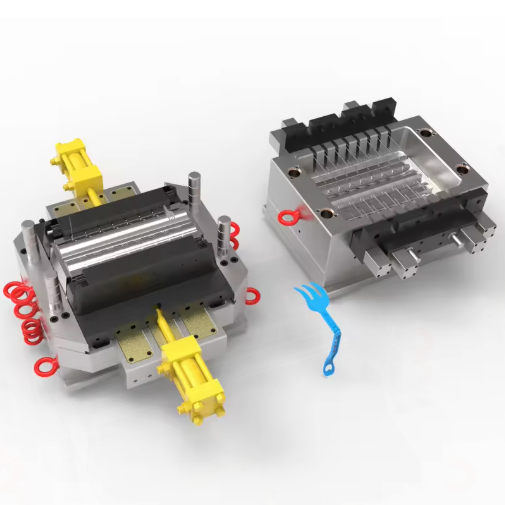
Material Selection for Fork Molds
Selecting the right steel for fork molds requires balancing wear resistance, corrosion resistance, and polishability—critical factors for producing food-grade utensils with consistent quality. Pre-hardened steel grades like 718H and NAK80 are industry standards, offering hardness levels between 30-45 HRC and excellent machinability. These materials minimize deformation during high-volume production runs, ensuring dimensional stability for fork tines and handles.
Technical parameters of common fork mold steels include: 1.2311 with chemical composition (C 0.35-0.45, Cr 1.8-2.1, Mn 1.3-1.6, Mo 0.15-0.25, S ≤0.03) and mechanical properties (hardness 30-35 HRC, tensile strength 1000-1100 MPa, good polishability); 1.2312 featuring higher sulfur content (S 0.05-0.1), hardness 28-32 HRC, and excellent polishability; 1.2738 containing nickel and molybdenum (Mo 0.2-0.4), with hardness 30-34 HRC and superior polishability.
For applications requiring enhanced corrosion resistance—especially for forks intended for acidic or salty foods—stainless steel grades such as S136 (420 stainless steel) are preferred. Their chromium content forms a protective oxide layer, preventing rust and maintaining surface integrity even after repeated cleaning cycles. When prioritizing cost-effectiveness for low-to-medium production volumes, P20 steel provides a balance of durability and affordability, though it may require additional surface treatments for food contact compliance.
Molding Process Parameters
Precision in injection molding parameters directly impacts fork quality. Melt temperature should be controlled between 220-250°C for polypropylene (PP) and 240-280°C for polystyrene (PS), ensuring uniform material flow without degradation. Injection pressure typically ranges from 600-900 bar, with holding pressures set at 70-80% of injection pressure to prevent sink marks in fork handles and thin-walled tines.
A case study from a Zhejiang factory demonstrates high-efficiency production using a 36-cavity mold with an EM 260-SVP/2 injection molding machine. The process utilizes PP material with MFI >40, producing forks with 2.5g single-cavity weight and 1mm thickness. Key parameters include injection pressure 600-900 bar and an ultra-short cycle time of 12 seconds, enabling fully automated production with consistent part quality.
Cooling time is critical—too short, and warpage occurs; too long, and production efficiency drops. For standard fork designs, 15-25 seconds of cooling time is optimal, with water channel temperatures maintained at 20-25°C to ensure rapid and uniform solidification. Cycle time averaging 45-60 seconds balances productivity with part quality, though complex fork geometries with intricate tines may require extended cycles to avoid defects like short shots or flash.
Food Contact Industry Standards
Compliance with food safety regulations is non-negotiable. Fork molds must adhere to FDA 21 CFR 177.2600 for plastic materials, ensuring no harmful substances migrate into food. This requires mold steels free from heavy metals and additives that could leach during use. Additionally, EU 10/2011 standards mandate migration limits for substances like bisphenol A (BPA) and phthalates, necessitating rigorous material testing and certification.
Surface finish is equally regulated—molds must achieve a Ra 0.8-1.6 μm polish to prevent bacterial adhesion and facilitate easy cleaning. Textured surfaces, while sometimes used for ergonomic grip, must not create crevices that trap food particles. Regular mold maintenance, including ultrasonic cleaning and passivation treatments for stainless steel, is essential to maintain compliance over time.
Surface Treatment Techniques
Surface treatments enhance mold performance and part quality. Nitriding increases surface hardness (up to 65 HRC) and wear resistance, extending mold life by 30-50% in high-volume production. For stainless steel molds, electropolishing removes micro-imperfections, creating a smooth, non-porous surface that resists staining and simplifies cleaning.
PVD (Physical Vapor Deposition) coatings, such as TiN or CrN, offer superior release properties, reducing the need for mold release agents that could contaminate food contact surfaces. These coatings also minimize friction between the mold and molten plastic, reducing cycle times and improving part consistency. Rose gold PVD coating has emerged as a premium option, boasting hardness of HV3000 and surface finish Ra ≤0.05μm. This treatment extends mold cleaning intervals from once every 2 hours to once daily, resulting in a 15% increase in production efficiency.
For critical applications, mirror polishing (Ra < 0.05 μm) is employed to achieve the high-gloss finishes required for premium cutlery brands.
Structural Design Key points
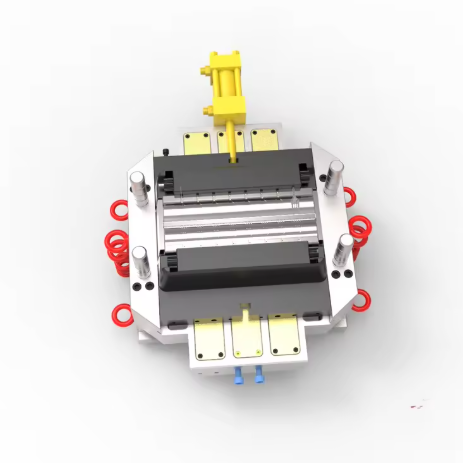
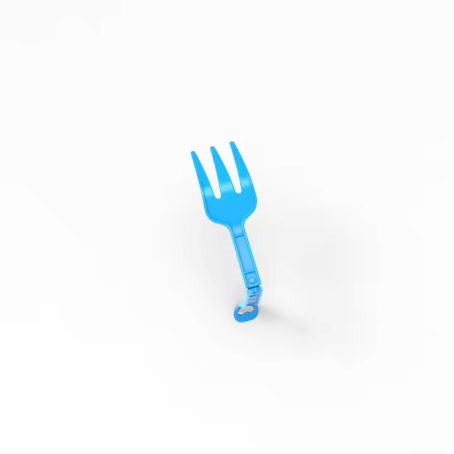
Fork mold design must address both functional and manufacturing challenges. Tine geometry demands precise draft angles (1-2° per side) to ensure easy ejection without damaging thin sections. Gate placement is critical—submarine or edge gates are preferred to avoid visible gate marks on fork tines, while hot runner systems with valve gates provide uniform filling for multi-cavity molds.
A 48-cavity hot runner mold example features SSG full hot runner design with mold dimensions 800x750x590mm and weight 2780kg. The mold utilizes P20 mold base steel (HRC28-32) with cavity steel options of SKD61 or Stavax 420 (HRC48-50). Integration of conformal cooling channels aligned with fork contours reduces cooling time by 15-20% compared to traditional cooling systems.
Cooling channel design directly impacts part quality. Conformal cooling channels, aligned with the fork’s curved handle and tines, reduce cycle times by 15-20% compared to conventional straight channels. For multi-cavity molds, balanced flow distribution ensures consistent wall thickness, preventing warpage in fork handles. Ejection systems should use ejector pins on non-visible surfaces (e.g., fork undersides) to maintain aesthetic appeal, with lifters employed for undercuts in ergonomic handle designs.
By integrating these material, process, and design considerations, manufacturers can produce high-quality fork molds that meet stringent food safety standards, optimize production efficiency, and deliver durable, visually appealing cutlery for consumer and commercial markets.
FAQ
Q1: What materials are used for the fork mold?
A: The fork mold is made from high-quality steel or aluminum, depending on product requirements, production volume, and surface finish expectations.
Q2: What is the fork mold lead time?
A: Typical mold lead time is 30–45 days, subject to design confirmation and mold complexity.
Q3: Is the fork mold cost refundable?
A: No. The fork cost is a one-time, non-refundable charge and remains the property of the customer after full payment.
Q4: How many samples will be provided for approval?
A: Normally 1–2 samples will be provided for customer approval before mass production.
Q5: Can the mold be modified after sampling?
A: Minor adjustments are possible. Any major design changes may result in additional mold modification costs and extended lead time.
Q6: What is the expected mold lifespan?
A: The mold is designed for stable mass production. Actual mold life depends on product structure, material, and operating conditions.
>>You may also like
Standards & References
The following industry standards are referenced in this article: