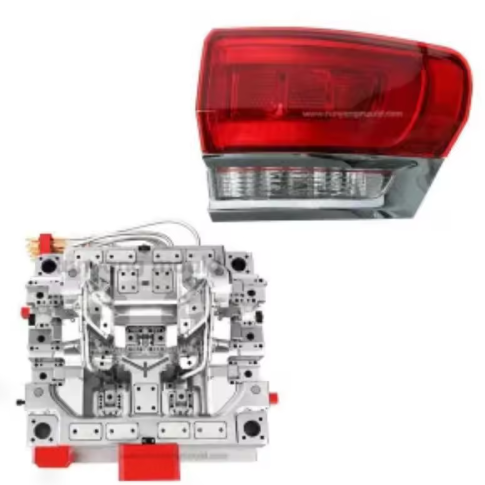
Automotive Tail Light Mold Material Selection: Balancing Durability and Optical Precision
The foundation of any high-quality automotive tail light molds lies in its steel selection, where durability must coexist with optical precision. Tool steel remains the industry standard, with grades like 718H and S136H dominating production due to their exceptional polishability and corrosion resistance—critical properties for achieving the mirror-like finishes required for light transmission. For high-volume production runs exceeding 500,000 cycles, premium options such as NAK80 offer superior hardness (42-48 HRC) and wear resistance, while H13 steel provides optimal thermal stability for handling the high temperatures of PC and PMMA molding.
Material selection directly impacts the automotive tail light mold’s ability to reproduce intricate optical patterns. When manufacturing multi-color lenses or complex light guides, the automotive tail light molds steel must maintain dimensional stability under repeated thermal cycling. This becomes particularly important when working with PMMA, which requires precise temperature control to prevent warpage. Leading manufacturers report that using properly heat-treated 2344 steel can extend automotive tail light molds lifespan by up to 40% compared to standard P20 steel, justifying the higher initial investment for long-term production efficiency.
Molding Process Parameters for Consistent Optical Performance
Achieving consistent light diffusion and color uniformity in automotive tail light molds production demands meticulous control over injection parameters. The typical process window for PC lenses involves melt temperatures between 280-300°C and mold temperatures maintained at 80-100°C to balance flow characteristics with dimensional stability. Injection pressure settings of 800-1200 bar are common, but must be precisely calibrated to avoid weld lines that would disrupt light transmission.
Cycle time optimization presents a unique challenge for automotive tail light molds operators. While faster cycles improve productivity, cooling times under 30 seconds often lead to residual stress in PC components. Advanced automotive tail light molds designs incorporate conformal cooling channels that reduce cycle times by 15-20% while maintaining part quality. For bi-color applications, sequential injection timing becomes critical—manufacturers recommend a 2-3 second delay between material shots to ensure proper bonding without flash formation.
ECE R112 Compliance: Safety Standards Shaping Mold Design
The ECE R112 standard governs automotive lighting performance, imposing strict requirements that directly influence automotive tail light molds engineering. The standard mandates specific luminous intensity levels (minimum 400 cd for brake lights) and color uniformity (±5 nm wavelength tolerance for red lenses), necessitating precision molding of optical features. Automotive tail light molds designers must incorporate micro-structured surfaces that diffuse light evenly while maintaining the required intensity distribution.
Durability testing under ECE R112 includes thermal cycling (-40°C to +85°C) and vibration resistance, which translates to specific automotive tail light molds steel requirements. Automotive tail light molds cores and cavities must withstand these environmental stresses without deforming, which is why many manufacturers specify through-hardened steel with homogeneous microstructure. Additionally, the standard’s photobiological safety provisions require automotive tail light mold surfaces to prevent glare-inducing imperfections, driving the adoption of ultra-fine polishing (Ra ≤ 0.02 μm) for critical optical surfaces.
Surface Treatment Processes for Enhanced Light Management
The automotive tail light mold’s surface finish directly impacts the final product’s optical performance and aesthetic appeal. A1-level polishing (equivalent to SPI A-3) is standard for lens-forming surfaces, achieved through progressive grit sequences from 400# to 4000# diamond compounds. For decorative elements like chrome-plated bezels, automotive tail light mold cavities require specialized texturing (typically MT11010 to MT11030) that must be precisely replicated across production runs.
Innovative surface treatments are expanding automotive tail light mold capabilities. Plasma nitriding creates a 5-15 μm hardened layer that increases wear resistance without affecting dimensional accuracy, extending maintenance intervals for high-volume automotive tail light mold production. For LED-specific applications, some manufacturers apply diamond-like carbon (DLC) coatings to mold surfaces, reducing friction and improving release properties for complex geometries. These treatments not only enhance part quality but also contribute to a 10-15% reduction in scrap rates for critical automotive tail light mold components.
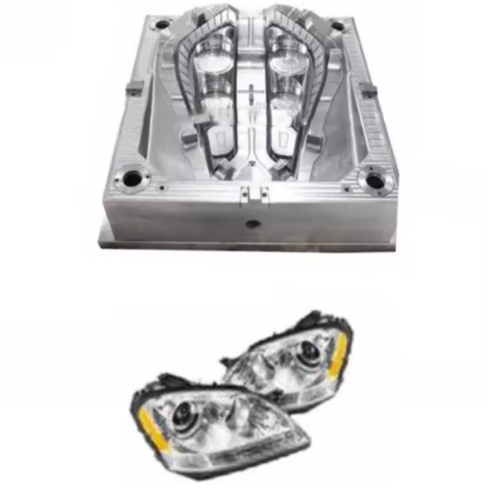
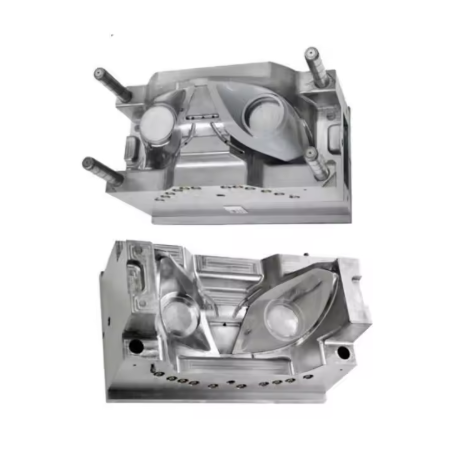
Advanced Cooling System Design for Quality and Efficiency
Effective thermal management is paramount in automotive tail light mold design, with cooling system efficiency directly impacting both part quality and production costs. Modern automotive tail light mold designs feature 3D-printed conformal cooling channels that follow the part’s contours, reducing temperature variation across the molding surface to ±2°C. This precision eliminates sink marks in thick-walled sections and ensures consistent crystallization in semi-crystalline polymers like PA66.
The automotive tail light mold cooling system must address specific material characteristics. For PMMA lenses, engineers recommend a cooling rate of 3-5°C per second to prevent yellowing, achieved through high-flow channel designs with turbulent flow (Reynolds number > 4000). Water temperature control units with ±0.5°C precision are standard, while some high-end automotive tail light mold installations incorporate thermoelectric cooling for critical areas. Computational fluid dynamics (CFD) simulation has become indispensable, with studies showing optimized cooling layouts can reduce cycle times by up to 25% compared to conventional straight-channel designs in complex automotive tail light mold geometries.
Future Trends Reshaping Automotive Tail Light Mold Technology
The automotive industry’s shift toward OLED and laser lighting technologies is driving significant innovations in automotive tail light mold design. OLED applications require automotive tail light mold surfaces with absolute flatness (≤ 5 μm deviation) to ensure uniform light emission, while laser-based systems demand micro-precision features (±10 μm tolerance) for light guidance. These advancements are pushing moldmaking capabilities to new limits, with 5-axis machining centers now achieving positional accuracies of 3 μm for critical automotive tail light mold components.
Sustainability is also influencing automotive tail light mold development, with lightweighting trends leading to thinner wall sections (down to 1.2 mm for PC lenses) that require specialized molding techniques. The adoption of bio-based polymers like PLA blends is introducing new challenges for automotive tail light mold designers, who must adjust cooling profiles and release agents to accommodate these materials’ different flow characteristics. As the industry moves toward more integrated lighting systems, the automotive tail light mold of the future will increasingly incorporate multi-material capabilities, with some manufacturers already developing hybrid molds that combine injection molding with in-mold assembly processes to reduce post-processing steps.
The evolution of automotive tail light mold technology reflects the broader transformation of automotive manufacturing—where precision, efficiency, and compliance intersect to create safer, more sustainable vehicles. As lighting systems become more integrated with vehicle communication and autonomy features, the automotive tail light mold will continue to be a critical enabler of innovation, requiring ongoing collaboration between material scientists, mold engineers, and lighting specialists to push performance boundaries while meeting the stringent requirements of global safety standards.
>>You may also like
Standards & References
The following industry standards are referenced in this article: