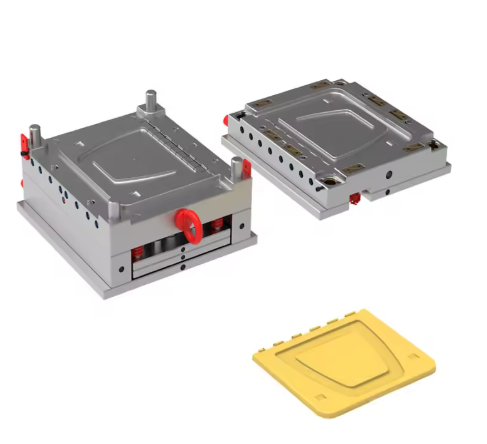
The plastic box lid mold plays a critical role in manufacturing container closures with precise dimensional accuracy and surface quality. A high-performance plastic box lid mold must achieve tight tolerances (typically ±0.05mm for critical dimensions), consistent part weight, and excellent surface finish while maintaining production efficiency. This comprehensive guide covers material selection, design considerations, manufacturing processes, and quality control standards specific to plastic box lid mold applications. Special attention will be given to integrating fishing lure mold technology where applicable, as the precision requirements for fishing lure mold components share similarities with high-end plastic box lid manufacturing.
Material Selection for Plastic Box Lid Molds
Pre-hardened Steel P20
P20 steel serves as the workhorse material for medium-volume plastic box lid mold production. This pre-hardened steel (28-32 HRC) offers excellent machinability and dimensional stability, making it ideal for standard plastic box lid applications. Its uniform carbide distribution ensures consistent wear resistance when processing common polymers like PP and PE. P20 plastic box lid molds typically achieve 500,000-800,000 cycles before requiring maintenance, balancing performance and cost-effectiveness.
Enhanced Pre-hardened Steel 718H
For plastic box lid molds demanding higher precision, 718H provides superior mechanical properties compared to standard P20. With a hardness range of 36-40 HRC and improved polishability (Ra≤0.4μm), this material excels in producing plastic box lids with Class A surfaces. The nickel-enriched composition enhances corrosion resistance, making it suitable for food-grade plastic box lid applications. 718H plastic box lid molds maintain tighter tolerances (±0.03mm) during prolonged production runs, similar to the precision required in fishing lure mold manufacturing.
Corrosion-Resistant Stainless Steel S136
Food and medical packaging plastic box lid molds require specialized materials like S136 stainless steel. This material offers exceptional resistance to chemical cleaning agents and meets FDA 21 CFR 177.2600 standards for food contact applications. S136 plastic box lid molds demonstrate 500-hour salt spray resistance (per ASTM B117) and maintain Ra≤0.2μm surface finish after 1 million cycles. The material’s low thermal conductivity (16 W/(m·K)) requires optimized cooling system design, a technique also critical in fishing lure mold temperature management.
High-Strength Alloy Steel H13
For plastic box lid molds processing glass-filled materials, H13 hot work steel provides superior abrasion resistance. With a working temperature up to 600°C and hardness of 44-48 HRC, H13 withstands the erosive effects of reinforced polymers containing up to 30% glass fiber. This material’s toughness (impact energy 45 J/cm²) prevents premature cracking in plastic box lid molds with complex geometries, similar to the durability requirements in fishing lure mold components subjected to repeated mechanical stress.
Design Considerations for Plastic Box Lid Molds
Dimensional Precision Control
The plastic box lid mold must maintain critical dimensional parameters:
- Overall lid dimensions: ±0.1mm tolerance for length/width, ±0.05mm for height
- Wall thickness uniformity: 0.8-2.0mm with ±0.1mm variation across the part
- Warpage control: ≤0.5mm/m for flat lids, ≤1.0mm for complex shapes
- Seal lip dimensions: ±0.03mm to ensure container tightness
These precision requirements mirror the exacting standards in fishing lure mold manufacturing, where small dimensional variations can significantly affect performance.
Gating and Runner System
Optimal plastic box lid mold gating design includes:
- Gate type: Edge gate or submarine gate for minimal witness mark
- Gate size: 0.8-1.2mm diameter based on lid weight (typically 5-20g)
- Runner configuration: Balanced tree layout for multi-cavity molds (2-8 cavities common)
- Pressure drop: ≤15% from sprue to gate to ensure uniform filling
Proper gating prevents weld lines in critical seal areas, a consideration equally important in fishing lure mold design where surface defects can impact hydrodynamic performance.
Cooling System Optimization
Efficient cooling is essential for plastic box lid mold productivity:
- Channel diameter: 6-8mm with 3-5mm distance from cavity surface
- Cooling layout: Conformal design following lid contour with 15-20mm spacing
- Temperature control: ±1°C variation across mold surface
- Cooling time: 15-25 seconds (60-70% of total cycle time)
Advanced plastic box lid molds incorporate beryllium copper (BeCu) inserts in thick sections, leveraging its high thermal conductivity (200 W/(m·K)) to reduce cycle time by 20-30%, a technique also employed in high-performance fishing lure mold components.
Ejection System Design
Plastic box lid mold ejection systems require careful engineering:
- Ejector type: Stripper plate or sleeve ejection for large surface area contact
- Ejector placement: 8-12 points evenly distributed to prevent deformation
- Ejection speed: 50-100mm/s with velocity profiling to avoid part damage
- Return mechanism: Positive stops with 0.05mm clearance to ensure mold closure
Proper ejection system design prevents cosmetic defects, ensuring the plastic box lid maintains its aesthetic appeal, just as fishing lure mold ejection systems preserve intricate surface details.
Manufacturing Processes for Plastic Box Lid Molds
Precision Machining
Modern plastic box lid mold manufacturing employs advanced machining techniques:
- CNC milling: 5-axis machining centers with ±0.005mm positioning accuracy
- EDM sinking: For complex cavity details with Ra≤1.6μm surface finish
- Wire EDM: For precision parting lines and core features with ±0.003mm tolerance
- Micro-machining: For vent channels (0.03-0.05mm width) and gate details
These processes ensure the plastic box lid mold accurately reproduces critical features like hinge lines and snap-fit mechanisms, comparable to the precision required for fishing lure mold texture reproduction.
Surface Treatment
Plastic box lid mold surface finishing follows industry standards:
- SPI B-2 finish (Ra 0.1-0.15μm) for standard lids
- SPI A-3 finish (Ra 0.05-0.10μm) for transparent or high-gloss applications
- Texturing options: Laser etching for grip patterns or brand identification
- Hard coating: TiN or CrN coatings (3-5μm thickness) for extended tool life
Surface treatment directly impacts plastic box lid release properties and aesthetic quality, similar to how fishing lure mold finishes influence both functionality and visual appeal.
Assembly and Validation
Rigorous assembly procedures ensure plastic box lid mold performance:
- Guide pillar installation: 0.01mm runout tolerance with H7/g6 Fit clearance
- Plate parallelism: ≤0.02mm/m across parting surfaces
- Leak testing: 10 bar pressure for 30 minutes with no pressure decay
- Trial molding: 50-100 sample production with dimensional inspection at 23±2°C
Validation protocols confirm the plastic box lid mold meets all specifications before full production, a critical step also emphasized in fishing lure mold manufacturing to ensure consistent quality.
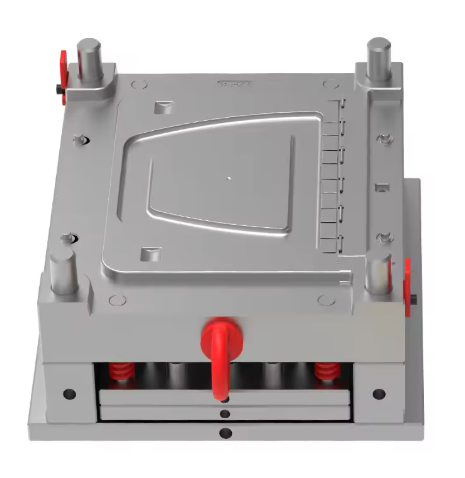
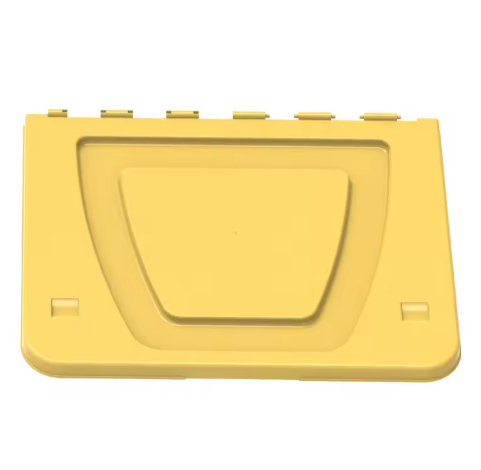
Process Parameters for Plastic Box Lid Molds
Polypropylene (PP) Processing
For PP plastic box lids, optimal parameters include:
- Barrel temperature profile: 180-200°C (rear), 200-220°C (front)
- Mold temperature: 40-60°C (regulated via proportional control valves)
- Injection pressure: 70-90MPa with 3-stage pressure profile
- Injection speed: 60-80mm/s (faster for thin-walled sections)
- Hold pressure: 60-70% of injection pressure for 5-8 seconds
These parameters balance production efficiency with part quality, similar to the precise process control required in fishing lure mold injection molding.
High-Density Polyethylene (HDPE) Processing
When molding HDPE plastic box lids:
- Melt temperature: 210-230°C
- Mold temperature: 30-50°C
- Injection pressure: 60-80MPa
- Cooling time: 18-25 seconds (depending on wall thickness)
- Screw recovery speed: 70-90rpm (to minimize shear heating)
HDPE’s lower melt viscosity requires careful venting to prevent burn marks, a consideration shared with fishing lure mold processing of low-viscosity materials.
Process Monitoring and Control
Advanced plastic box lid mold systems incorporate real-time monitoring:
- In-cavity pressure sensors (±0.5% accuracy)
- Mold temperature mapping (12-16 point measurement)
- Part weight control (±0.1g precision)
- Cycle time variation: ≤±0.5 seconds
Statistical process control (SPC) reduces plastic box lid variation by 40-50% compared to manual setup, ensuring consistent quality similar to the standards maintained in fishing lure mold production.
Quality Control Standards
Dimensional Inspection
Plastic box lid mold quality control follows rigorous standards:
- CMM inspection: 3D scanning with ±0.005mm accuracy
- Optical comparator analysis for critical features
- Surface finish verification: Profilometer measurements at 5 standard locations
- Assembly check: Parting surface flatness ≤0.02mm/m
These inspections ensure the plastic box lid mold produces parts meeting GB/T 14486-2008 MT3 grade tolerance requirements, comparable to the precision standards in fishing lure mold manufacturing.
Performance Testing
Plastic box lid mold validation includes:
- Pressure testing: 1.5× working pressure for 1 hour with no leakage
- Thermal cycling: -40°C to 80°C for 100 cycles (for lids used in extreme environments)
- Impact resistance: 1m drop test onto concrete surface (for rigid plastic box lids)
- Fatigue testing: 10,000 opening/closing cycles for hinged designs
These tests validate the plastic box lid mold’s ability to produce durable products, reflecting the performance validation protocols used in fishing lure mold manufacturing.
Conclusion
The plastic box lid mold represents a critical component in modern packaging manufacturing, demanding precise material selection, engineering design, and process control. By implementing the guidelines presented in this guide, manufacturers can produce plastic box lid molds that meet the stringent requirements of today’s packaging industry. The plastic box lid mold’s performance directly impacts production efficiency, product quality, and end-user satisfaction, making it a cornerstone of container manufacturing.
Continuous innovation in plastic box lid mold technology—including advanced materials, conformal cooling, and in-mold sensing—will drive future advancements in packaging production. As sustainability concerns grow, the plastic box lid mold industry must also adapt to produce lighter-weight designs using recycled materials, while maintaining the precision and durability standards that define modern manufacturing excellence, much like the ongoing innovations in fishing lure mold technology that balance performance, sustainability, and production efficiency.