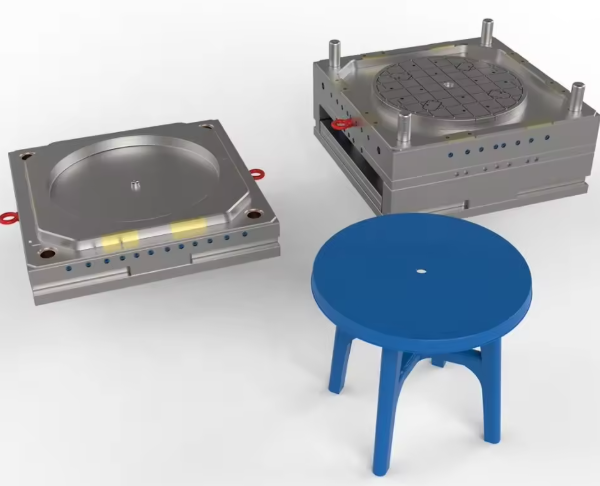
Round stool molds represent a specialized category of plastic injection molds requiring precise balance between structural integrity, material efficiency, and manufacturing economy. This technical guide outlines mold steel selection criteria, design considerations, and production parameters specifically optimized for round stool manufacturing. With global demand for commercial furniture molds growing at 4.7% CAGR, the need for application-specific steel solutions has become increasingly critical.
Material Selection and Performance Parameters
Pre-hardened Steel 718H
Application Scenario: Main cavity and core for general-purpose round stools
Performance Parameters:
- Hardness: 32-36 HRC (pre-hardened)
- Dimensional Stability: ±0.002 mm/m
- Machinability: Excellent for complex rib structures
- Mold Life: 500,000+ cycles for PP/PE processing
Advantages:
- No post-machining heat treatment required
- Superior polishability (SPI #3 finish achievable)
- Cost-effective solution for medium-volume production (100,000-500,000 units)
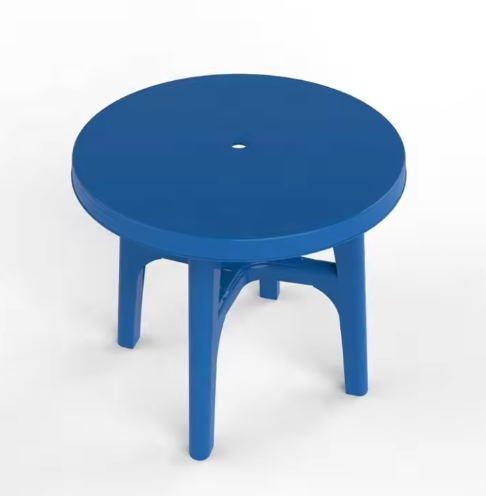
- Ideal balance of strength and toughness for I-shaped support structures
Stainless Steel 2316
Application Scenario: Sliders, guide grooves, and wear-resistant inserts
Performance Parameters:
- Hardness: 48-50 HRC after heat treatment
- Corrosion Resistance: Passes ISO 9227 salt spray test (500 hours)
- Surface Finish: Ra ≤ 0.2 μm after polishing
- Wear Resistance: 15% higher than conventional 420 steel
Advantages:
- Excellent resistance to mold fouling during long production runs
- Maintains dimensional stability in high-temperature environments (up to 180°C)
- Optimal choice for molds requiring frequent cleaning cycles
- Compatible with all common plastic materials including glass-filled grades
Mirror-Ready Steel Nak80
Application Scenario: Visible surfaces and high-aesthetic requirements
Performance Parameters:
- Hardness: 37-43 HRC (pre-hardened)
- Polishing Capability: Ra ≤ 0.05 μm (SPI #1 finish)
- Machinability: 20% better than traditional martensitic stainless steels
- Yield Strength: 950 MPa
Advantages:
- Eliminates the need for secondary polishing operations
- Ideal for stools with textured or patterned surfaces
- Reduces cycle time by 15% through improved heat transfer
- Excellent for high-gloss visible components without paint applications
Hot Work Steel H13
Application Scenario: Hot runner systems and gate inserts
Performance Parameters:
- Hardness: 44-48 HRC after heat treatment
- Thermal Conductivity: 26 W/(m·K)
- Hot Hardness: 40 HRC at 500°C
- Impact Toughness: 28 J/cm² (Charpy V-notch)
Advantages:
- Withstands cyclic thermal stresses in hot runner applications
- Resists cracking in areas with extreme temperature gradients
- Extends hot runner service life by 300% compared to standard tool steels
- Maintains dimensional stability during prolonged heating cycles
Design and Manufacturing Considerations
Structural Design Fundamentals
Load-Bearing Requirements:
- Primary support structure: I-shaped reinforcement layout with 3-5mm wall thickness
- Cross-sectional design: Optimized for 150kg static load capacity (deflection ≤ 2mm)
- Rib configuration: Height limited to 3× wall thickness, width 0.8× wall thickness
- Corner radius: Minimum 2mm to reduce stress concentration and improve flow
Dimensional Specifications:
- Overall tolerance: IT8 grade (±0.05mm for critical dimensions)
- Flatness: ≤ 0.1mm/m for seating surface
- Concentricity: ≤ 0.03mm for leg alignment features
- Draft angles: 1° for vertical surfaces, 3° for textured areas
Mold Component Design
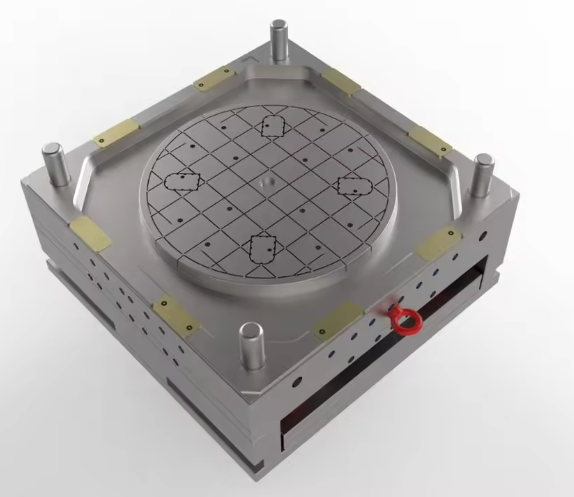
Cavity and Core Design:
- Single-cavity configuration recommended for dimensional consistency
- Cooling channel layout: Equally spaced (30-40mm pitch) with 8mm diameter
- Water flow rate: Minimum 6 L/min per circuit to ensure uniform cooling
- Venting: Perimeter vents (0.015mm depth × 5mm width) at flow fronts
Ejection System:
- Balanced ejector pin arrangement: 1 pin per 100cm² of projected area
- Ejector pin diameter: Minimum 3mm to prevent bending
- Return spring force: 15N per spring to ensure positive return
- Stripper plate design for large flat surfaces to prevent distortion
Guidance System:
- Guide pillar diameter: Minimum 20mm with 100mm length
- Guide sleeve clearance: 0.02-0.04mm for precise alignment
- Locating pins: 2 per mold half (diameter 12mm, tolerance H7/g6)
- Wear plates: 50mm width along all sliding interfaces
Surface Treatment Specifications
Functional Finishes:
- Seating surface: SPI #3 finish (Ra 0.4μm) with micro-texture for slip resistance
- Leg surfaces: SPI #4 finish (Ra 0.8μm) to hide flow lines
- Decorative features: Laser engraving compatible with 2316 steel
- Threaded inserts: Knurled surface with 0.5mm pitch for secure bonding
Special Treatments:
- Nitriding: 0.1-0.2mm case depth for wear surfaces (50-55 HRC surface hardness)
- PVD coating: TiN (2μm thickness) for gate inserts to reduce wear
- Electropolishing: For visible surfaces requiring maximum corrosion resistance
- Laser surface alloying: For localized reinforcement of high-stress areas
Production Process Parameters
Material-Specific Processing
Polypropylene (PP):
- Melt temperature: 200-230°C (zone 3-4)
- Mold temperature: 40-60°C
- Injection pressure: 70-90 MPa
- Hold pressure: 60-70% of injection pressure
- Injection speed: 50-80 mm/s
- Cooling time: 15-25 seconds
High-Density Polyethylene (HDPE):
- Melt temperature: 180-210°C
- Mold temperature: 30-50°C
- Injection pressure: 60-80 MPa
- Hold pressure: 50-60% of injection pressure
- Injection speed: 60-90 mm/s
- Cooling time: 18-28 seconds
Acrylonitrile Butadiene Styrene (ABS):
- Melt temperature: 220-250°C
- Mold temperature: 60-80°C
- Injection pressure: 80-100 MPa
- Hold pressure: 65-75% of injection pressure
- Injection speed: 40-70 mm/s
- Cooling time: 20-30 seconds
Glass-Filled Polypropylene (30% GF):
- Melt temperature: 210-240°C
- Mold temperature: 50-70°C
- Injection pressure: 90-110 MPa
- Hold pressure: 70-80% of injection pressure
- Injection speed: 30-60 mm/s
- Cooling time: 25-35 seconds
Cycle Optimization
Key Cycle Parameters:
- Total cycle time: 35-40 seconds (target: 38 seconds)
- Injection phase: 4-6 seconds
- Hold phase: 5-8 seconds
- Cooling phase: 20-25 seconds
- Mold open/close: 6-7 seconds
- Ejection time: 1-2 seconds
Optimization Strategies:
- Conformal cooling channels: Reduce cooling time by 20-30%
- Sequential valve gating: Eliminate weld lines in critical areas
- Mold temperature control: ±1°C precision to ensure dimensional stability
- Rapid heat cycle molding: For Class A surface requirements
Quality Control Measures
In-Process Inspection:
- Dimensional verification: CMM inspection of 5 samples per production run
- Weight control: ±2g tolerance for process stability monitoring
- Visual inspection: 100% inspection under 1000 lux illumination
- Defect classification: Critical (safety-related), Major (functional), Minor (aesthetic)
Material Verification:
- Melt flow rate: Test every production lot (±10% of nominal value)
- Density: Verification using Archimedes method
- Tensile properties: Monthly coupon testing (tensile strength, elongation)
- Impact resistance: Instrumented impact testing at 23°C and -30°C
Assembly and Secondary Operations
Insert Molding Considerations
Metal Insert Design:
- Knurled surface with 0.5mm pitch for mechanical bonding
- Insert preheating: 150-200°C to prevent cold spots
- Insert placement tolerance: ±0.1mm for proper alignment
- Retention force: Minimum 200N per insert (per ISO 10299)
Insert Materials:
- Carbon steel: For standard load applications (electroplated for corrosion resistance)
- Stainless steel: For outdoor or moisture-exposed applications
- Aluminum: For weight reduction (with thread reinforcement)
- Brass: For electrical conductivity requirements
Joining Methods
Welding Processes:
- Ultrasonic welding: 20-30kHz frequency, 0.3-0.5mm amplitude
- Vibration welding: 120-240Hz frequency, 1.5mm amplitude
- Hot plate welding: 220-260°C plate temperature, 300N force
- Spin welding: 2000-3000 RPM, 2-5 seconds weld time
Mechanical Fastening:
- Threaded fasteners: M4-M6 size with 0.7mm pitch
- Snap fit design: 1.5mm interference, 45° lead-in angle
- Riveting: Semi-tubular rivets with 1.5× diameter grip range
- Adhesive bonding: Acrylic-based structural adhesives (shear strength ≥ 15 MPa)
Maintenance and Troubleshooting of Round Stool Mold
Preventive Maintenance Program
Daily Maintenance:
- Visual inspection of mold surfaces for wear or damage
- Cleaning of cooling channels to prevent scale buildup
- Lubrication of guide pillars and slide mechanisms (food-grade lubricant)
- Verification of temperature control settings
Weekly Maintenance:
- Measurement of critical dimensions (wear monitoring)
- Inspection of ejector pins for bending or wear
- Verification of cooling circuit flow rates and pressures
- Checking of hot runner system for leaks or degradation
Scheduled Overhaul (Every 50,000 Cycles):
- Complete disassembly and cleaning
- Replacement of wear components (ejector pins, bushings)
- Re-polishing of cavity and core surfaces
- Verification of all dimensional parameters
Safety and Regulatory Compliance
Material Safety Requirements
Food Contact Compliance:
- FDA 21 CFR 177.1520 (for PP, PE, ABS)
- EU 10/2011 (plastic materials and articles)
- GB 4806.7 (national standard for China)
- Migration limits: Overall migration ≤ 10 mg/dm² (simulant A, B, C, D)
Flammability Requirements:
- UL 94 V-2 rating minimum for indoor applications
- Oxygen Index ≥ 24% (ASTM D2863)
- Heat release rate ≤ 65 kW/m² (ASTM E1354)
Mechanical Safety Standards
Load Testing:
- Static load: 150kg applied for 1 hour (deflection ≤ 2mm, permanent set ≤ 0.5mm)
- Dynamic load: 75kg applied at 5Hz for 100,000 cycles
- Impact resistance: 10J impact at 23°C (no cracking or permanent deformation)
- Fatigue testing: 100,000 cycles at 75kg load (no visible damage)
Chemical Resistance:
- Resistance to common cleaning agents (per ISO 10243)
- UV stability: ≤ 20% loss of tensile strength after 1000 hours exposure
- Water absorption: ≤ 0.5% after 24-hour immersion (ASTM D570)
- Stain resistance: No visible staining after 24-hour contact with common foodstuffs
Conclusion
Round stool mold design requires careful balancing of structural performance, manufacturing efficiency, and material selection to meet the demanding requirements of commercial and residential furniture applications. By implementing the guidelines outlined in this technical guide, manufacturers can achieve optimal mold performance, extended service life, and consistent part quality.
The selection of appropriate mold materials—718H for general applications, 2316 for wear components, Nak80 for high-aesthetic requirements, and H13 for hot runner systems—provides a comprehensive solution for various production scenarios. When combined with proper design principles, optimized processing parameters, and rigorous quality control, these materials can deliver mold performance exceeding 500,000 cycles with minimal maintenance requirements.
FAQ for Round Stool Mold
1. What materials can be used with the Round Stool Mold?
The Round Stool Mold supports fiberglass, plastic, PU, and other composite materials.
2. Can the Round Stool Mold be customized in size?
Yes, we can customize the diameter, height, and thickness based on your design requirements.
3. How long does it take to produce a Round Stool Mold?
Usually 15–25 days, depending on the mold’s complexity and surface finish.
4. Do you provide sample production using the Round Stool Mold?
Yes, we can make a sample to confirm the shape and quality before mass production.
5. What is the lifespan of a Round Stool Mold?
With proper maintenance, it can deliver thousands of molding cycles.
6. Can the Round Stool Mold support different surface textures?
Yes, glossy, matte, leather texture, and custom surface effects are available.