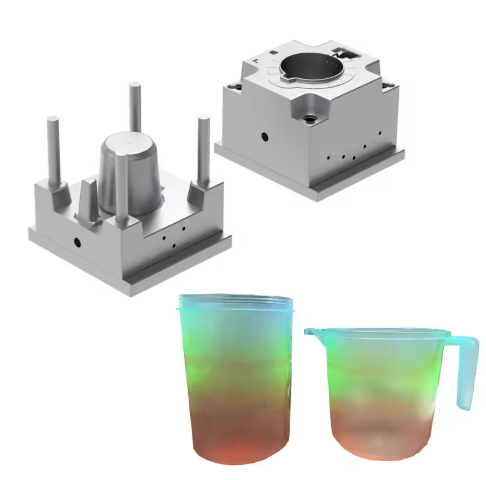
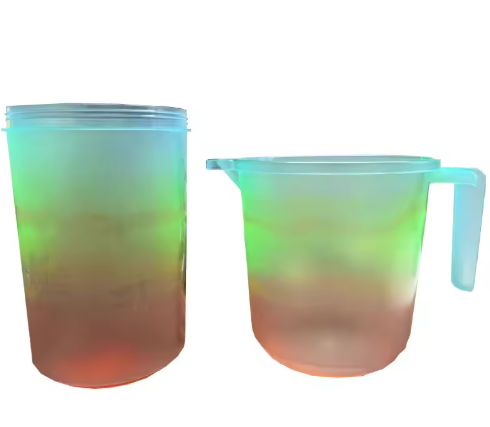
Mixing cups are critical components in food processing and household appliances, requiring strict compliance with food safety standards and excellent mechanical performance. This guide focuses on mold steel selection, design considerations, manufacturing processes, and quality control for mixing cup molds, providing technical insights for producing high-quality mixing cup components.
Material Selection and Performance Parameters
Stainless Steel S136
Application Scenario: Inner cavity and food-contact surfaces
Performance Parameters:
- Hardness: 48-50 HRC
- Surface Roughness: Ra ≤ 0.4 μm after mirror polishing
- Corrosion Resistance: Passes FDA 21 CFR 177.2600 standards
- Mold Life: 500,000 cycles for PP/PE materials
Advantages:
- Excellent polishability for smooth inner surfaces that minimize residue buildup
- Superior corrosion resistance suitable for acidic food contact
- Low maintenance requirements for continuous production runs
Pre-hardened Steel 718H (P20+Ni)
Application Scenario: Structural components, lids, and handles
Performance Parameters:
- Hardness: 28-34 HRC
- Surface Roughness: Ra ≤ 0.8 μm
- Dimensional Stability: ±0.002 mm/m
- Mold Life: 300,000 cycles
Advantages:
- No post-heat treatment required, reducing production time
- Excellent machinability for complex geometries
- Cost-effective solution for non-food contact components
Stainless Steel 316L
Application Scenario: Special food-grade requirements
Performance Parameters:
- Hardness: 20-25 HRC (annealed)
- Corrosion Resistance: 5x higher chloride resistance than carbon steel
- Surface Finish: Ra ≤ 0.8 μm
Advantages:
- Meets strict FDA requirements for food contact
- Ideal for mixing cups used with salt-containing or acidic foods
- Excellent weldability for complex mold structures
Design and Manufacturing Considerations of Mixing Cup Mold
Precision Requirements
Dimensional Tolerances:
- Critical dimensions: IT7级 (±0.015 mm)
- Wall thickness uniformity: ±0.1 mm
- Concentricity error for rotating parts: ≤ 0.03 mm
Surface Requirements:
- Inner cavity: SPI #3 finish (Ra ≤ 0.4 μm)
- Outer surfaces: SPI #4 finish (Ra ≤ 0.8 μm)
- Sealing surfaces: Ra ≤ 0.2 μm to ensure leak-proof performance
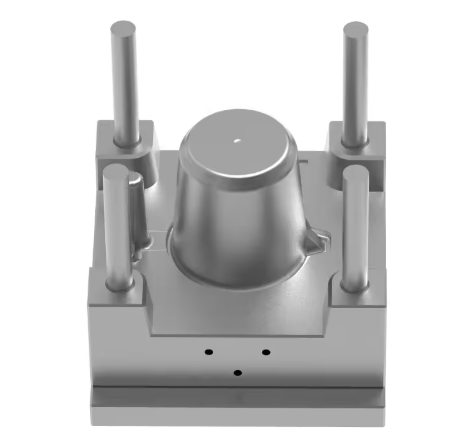
mixing cup mold Structure Design
Cooling System:
- Conformal cooling channels with 8 mm diameter
- Channel spacing: 5x diameter (40 mm)
- Distance from cavity surface: 8 mm
- Temperature control accuracy: ±1°C
Gating System:
- Hot runner design recommended for uniform filling
- Gate location:keep away functional areas to avoid flow marks
- Gate size: 1.2-2.0 mm depending on part thickness
Ejection System:
- Balanced ejector pin layout (minimum 2 mm diameter)
- Ejection stroke: 1.5x part height
- Draft angle: 1.5° for PP materials, 2° for PE materials
Manufacturing Processes of mixing cup mold
Machining Sequence:
- Rough milling: Remove excess material (Ra 6.3 μm)
- Semi-finishing: CNC milling (Ra 1.6 μm)
- Heat treatment: For S136 – 1050°C quenching + triple tempering
- Finish grinding: Achieve dimensional accuracy (Ra 0.8 μm)
- Polishing: Progressive diamond paste polishing up to 0.4 μm
Special Processes:
- Chemical etching for texture patterns (if required)
- Laser welding for repair of complex features
- Electropolishing for critical food contact surfaces
Quality Control Standards
Material Inspection
- Chemical composition analysis (spectroscopy)
- Hardness testing (every 50 mm on mold surface)
- Ultrasonicflaw detection (100% coverage for critical areas)
- Metallographic examination for microstructure verification
dimensional Inspection
- Coordinate measuring machine (CMM) for critical dimensions
- Optical comparator for profile measurements
- Surface roughness testing (at 5 locations per cavity)
- Mold flow simulation validation before production
Performance Testing
- 500-shot production run validation
- Dimensional stability check after 10,000 cycles
- Corrosion resistance testing (salt spray test: 500 hours)
- Food contact compliance testing (migration test per FDA 21 CFR 177)
Application and Maintenance Guidelines of Mixing Cup Mold
Recommended Processing Parameters
Injection Molding Parameters for PP:
- Barrel temperature: 200-230°C (nozzle: 210°C)
- mixing cup mold temperature: 60-80°C
- Injection pressure: 70-90 MPa
- Hold pressure: 50-70 MPa (50% of injection pressure)
- Cooling time: 20-30 seconds (depending on wall thickness)
Maintenance Schedule
Preventive Maintenance:
- Daily: Clean mixing cup mold surfaces and check for debris
- Weekly: Lubricate guide pins and slides
- Monthly: Check cooling channel flow rates
- Every 50,000 cycles:
- Ultrasonic cleaning of cooling channels
- Polishing of cavity surfaces
- Verification of critical dimensions
| Issue | Cause | Solution |
| Flash | Insufficient clamping force | Increase clamp force by 10% |
| Sink marks | Inadequate packing | Extend hold time by 2 seconds |
| Burn marks | Poor ventilation | Add 0.015 mm deep venting |
| Surface defects | Mold contamination | Implement ultrasonic cleaning |
mixing cup mold Storage
- Store in climate-controlled environment (40-60% humidity)
- Apply rust inhibitor to all steel surfaces
- Maintain mold in closed position with cavity protectors
- Document maintenance history and cycle counts
Frequently Asked Questions
Q1: What is the optimal steel choice for a mixing cup mold producing 1 million parts?
A1: For high-volume production (1M+ cycles), consider S136 stainless steel with PVD coating (TiN) to extend mold life and maintain surface finish.
Q2: How can I reduce cycle time for mixing cup production?
A2: Optimize cooling with conformal cooling channels and increase mixing cup mold temperature to 80°C while maintaining proper cooling time to prevent warpage.
Q3: What surface finish is required for mixing cups used with viscous materials?
A3: For viscous materials, a mirror finish (Ra ≤ 0.2 μm) is recommended to minimize material adhesion and facilitate cleaning.
Q4: How to address corrosion issues with acidic food contact?
A4: Use 316L stainless steel with electropolishing and ensure proper passivation after machining to enhance corrosion resistance.
Conclusion
The selection of mold steel for mixing cups must balance food safety requirements, mechanical performance, and production economics. S136 stainless steel offers the best overall performance for food contact applications, while 718H provides a cost-effective solution for structural components. By following the design guidelines, manufacturing processes, and maintenance procedures outlined in this guide, manufacturers can produce high-quality mixing cups with consistent performance and extended mold life.
Key considerations include maintaining strict dimensional control, implementing proper cooling systems, and adhering to food safety standards throughout the production process. Regular maintenance and proactive quality control are essential to ensuring long-term mold performance and product quality.
>>You may also like
Standards & References
The following industry standards are referenced in this article: