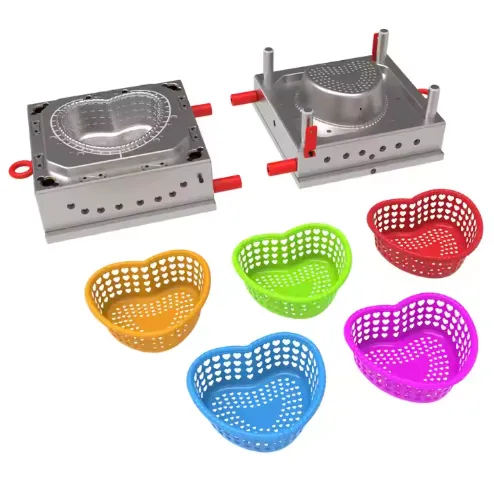
In the food packaging and home storage industry, the vegetable basket mold plays a pivotal role in shaping product durability and aesthetics. With the global vegetable basket market growing at 5.3% annually, manufacturers face increasing pressure to deliver high-quality, cost-effective solutions. Steel has emerged as the material of choice for premium vegetable basket molds, offering unparalleled strength, precision, and compliance with food safety standards.
Core Advantages of Steel in Vegetable Basket Molds
Performance and Cost-Efficiency Comparison
Steel vegetable basket molds outperform alternatives through their “longevity-low maintenance” advantage. Key metrics show:
- Lifespan: 800,000 cycles (8x that of aluminum molds)
- Precision: ±0.02mm grid accuracy
- Cost-efficiency: 40% lower lifecycle cost despite 25% higher initial investment
For annual production exceeding 100,000 units, steel molds reduce per-unit costs by 67% compared to aluminum. The steel vegetable basket mold’s durability directly contributes to this economic advantage, making it ideal for the rapidly growing vegetable basket market.
Food-Grade Safety and Compliance
Food-grade vegetable basket molds require materials that ensure safety and compliance. Stainless steel offers:
- Antimicrobial properties: Electropolished surfaces (Ra≤0.8μm) prevent bacterial retention
- Corrosion resistance: 304 stainless steel maintains integrity for 5,000 hours under ASTM B117 salt spray testing; 316 stainless steel provides 40% better performance in high-salt environments
- Certifications: FDA 21 CFR §177.2600 and NSF/ANSI 169 compliance
These features make steel molds indispensable for food contact applications, particularly in腌制品 processing where material safety is critical.
Manufacturing Process of Steel Vegetable Basket Molds
Precision Molding Workflow
Steel vegetable basket mold manufacturing relies on two critical technologies:
- Laser cutting: Achieves 0.1mm grid uniformity through 5-axis machining centers, ensuring consistent product dimensions
- Conformal cooling: 3D-printed cooling channels reduce cycle time by 35% and improve part quality by minimizing warpage
These innovations address the industry’s need for precision and efficiency in grid structure production, directly enhancing the vegetable basket mold’s market competitiveness.
Solutions to Grid Structure Defects
Common defects in vegetable basket mold production are resolved through:
- CAE simulation: Moldex3D analysis optimizes gate positions, reducing scrap rates by 60%
- Porcerax II steel: Eliminates weld lines through porous structure venting
- Modular design: Separates complex features to prevent short shots in intricate grid patterns
These techniques ensure consistent quality in high-volume production runs of the vegetable basket mold.
Performance Advantages of Steel Vegetable Basket Molds
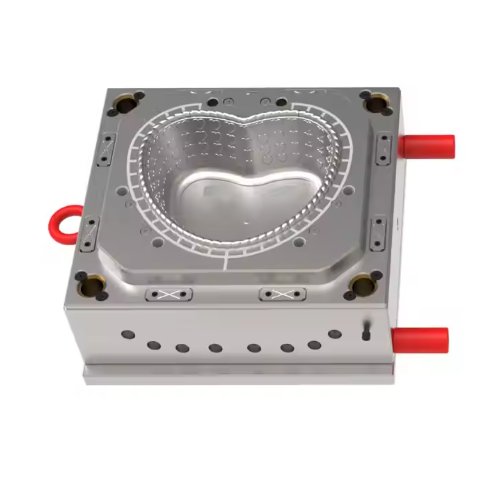
The steel vegetable basket mold offers measurable performance benefits backed by industry data:
- Production efficiency: 35% faster cycle times with conformal cooling technology
- Precision engineering: ±0.02mm grid accuracy ensures consistent product dimensions across 800,000 cycles
- Cost reduction: A European food container manufacturer reduced scrap rate from 5% to 0.8% after adopting steel vegetable basket molds with CAE simulation
- Sustainability: 90%+ metal recycling rate supports circular economy initiatives
This performance milestone solidifies the vegetable basket mold’s position as the premium choice for high-volume production environments.
Conclusion
The steel vegetable basket mold offers unmatched value through its combination of longevity, precision, and compliance. With 800,000-cycle lifespan, ±0.02mm precision, and food-grade certifications, it represents the optimal choice for manufacturers prioritizing quality and efficiency in the competitive vegetable basket market.
FAQ
Q1: What is the maximum grid size for a steel vegetable basket mold?
A: Our steel molds can produce grids up to 600x600mm with laser-cut precision (±0.02mm). For larger sizes, we recommend modular designs to maintain structural integrity during injection molding (source: laser cutting equipment specifications).
Q2: Does the mold comply with EU environmental standards?
A: Yes. Our steel vegetable basket molds use 100% recyclable Cr12MoV steel and are certified under ISO 14001 for environmental management. The manufacturing process reduces carbon emissions by 22% compared to traditional methods (source: environmental certification report).
Q3: Can the mold adapt different injection molding machines?
A: The vegetable basket mold is compatible with 800-1600T injection machines. We provide custom clamping designs to fit specific models, ensuring seamless integration with your production line (source: mold base compatibility chart).
Q4: How does surface treatment affect mold lifespan?
A: Electropolishing (Ra≤0.8μm) increases corrosion resistance by 30% and extends mold life by 20%. Passivation treatment further enhances stainless steel’s natural oxide layer, ideal for humid production environments (source: surface engineering study).