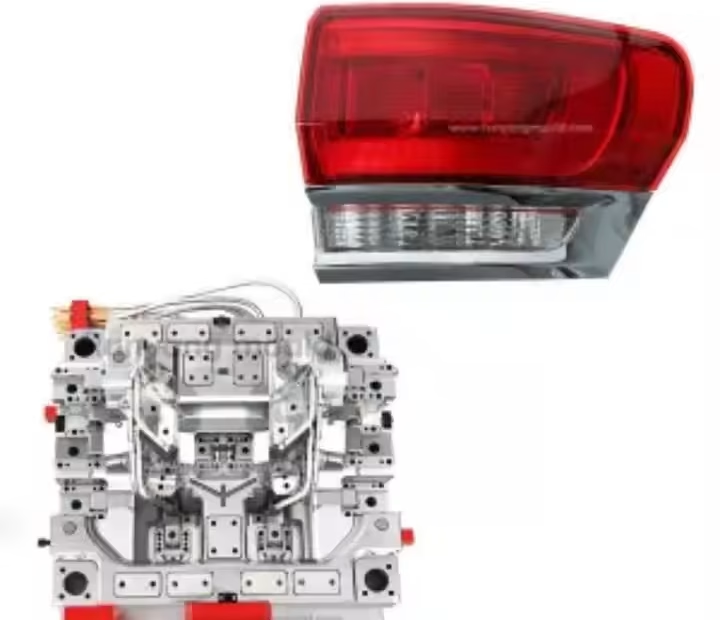
Introduction: The Backbone of Automotive Lighting Innovation
The global automotive mold market is projected to reach USD 79.4 billion by 2033, growing at a CAGR of 6.11% from 2025 to 2033 (IMARC Group). Within this rapidly expanding industry, tail light molds represent a critical segment driving innovation in vehicle safety, aesthetics, and energy efficiency. As LED and OLED technologies become standard across vehicle models, the precision of mold manufacturing directly impacts lighting performance, durability, and design flexibility.
This comprehensive guide explores the technological advancements, material science, and manufacturing processes that define modern automotive tail light molds production. We’ll examine case studies from industry leaders, analyze emerging trends like AI integration and sustainable manufacturing, and provide actionable insights for manufacturers and buyers navigating this complex market.
Material Science: The Foundation of High-Performance Molds
Mold Steel Selection: Balancing Durability and Precision
Automotive tail light molds demand exceptional material performance to withstand the rigors of high-volume production while maintaining optical precision. The most commonly used materials include:
| Steel Grade | Hardness (HRC) | Typical Applications | Key Advantages |
| P20 | 28-32 | General purpose molds | Excellent polishability, cost-effective |
| 718H | 32-36 | High-gloss surfaces | Superior wear resistance, reduced maintenance |
| S136H | 48-52 | Optical components | Corrosion resistance, exceptional surface finish |
| H13 | 44-48 | High-temperature applications | Thermal stability, long service life |
Optical Materials: Transparency Meets Durability
The performance of tail light lenses depends on advanced polymeric materials engineered for optical clarity and mechanical strength:
Polycarbonate (PC) dominates the market, offering:
- 90% light transmission
- Impact resistance (10x greater than glass)
- Heat resistance up to 120°C
- UV stability with appropriate coatings
Polymethyl Methacrylate (PMMA) remains popular for:
- Superior scratch resistance
- Higher light transmission (92%)
- Enhanced color stability
- Lower cost for non-critical applications
Recent innovations include hybrid PC/PMMA blends that combine the best properties of both materials, enabling complex light guides and multi-color designs without compromising durability.
Manufacturing Processes: Precision Engineering in Action
5-Axis CNC Machining: Complex Geometries Made Possible
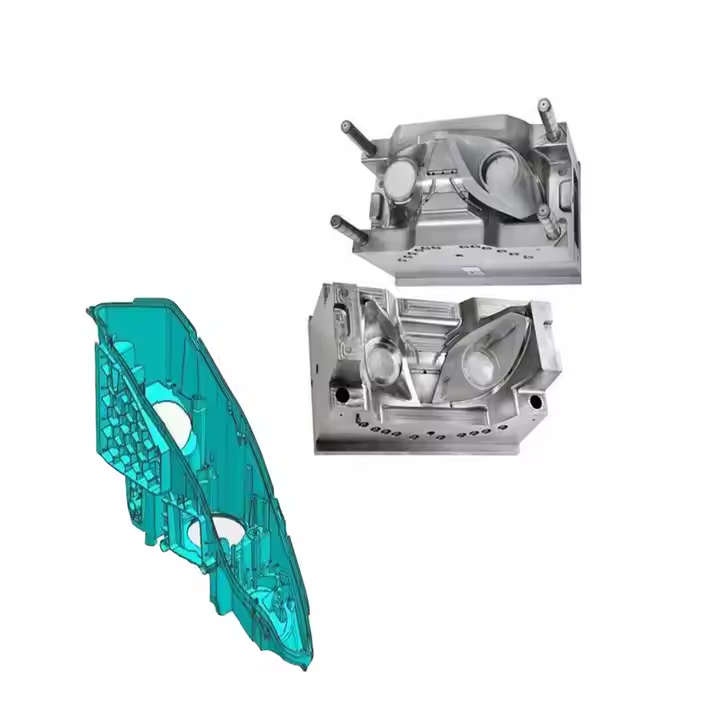
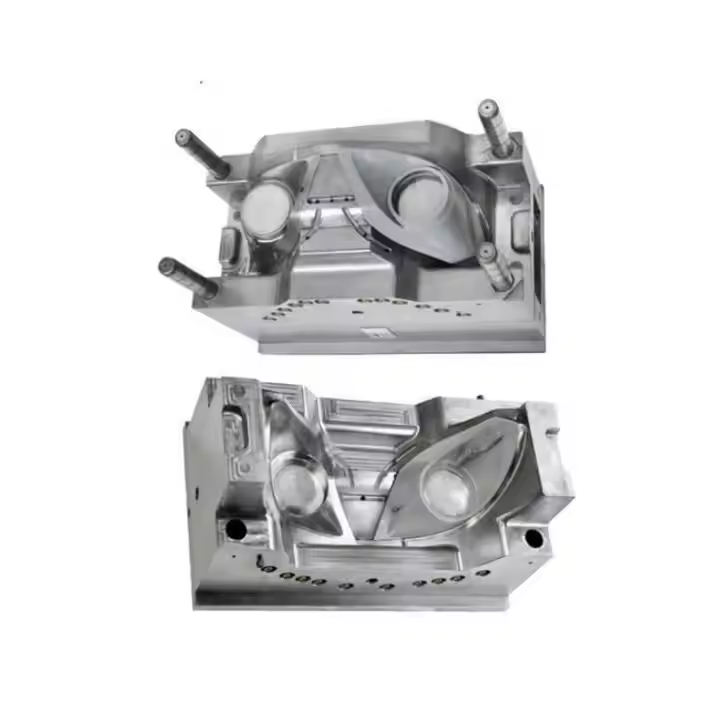
Modern tail light molds feature intricate optical patterns and undercuts that require advanced machining capabilities:
- Roughing Operations: High-speed steel cutters remove 80-90% of excess material
- Semi-Finishing: Carbide end mills achieve dimensional accuracy of ±0.02mm
- Finishing: Ball nose cutters create the optical surfaces with Ra 0.4μm finish
- EDM Operations: Wire electrical discharge machining for complex undercuts
Suntime Mould’s production of Audi tail light molds demonstrates the precision possible with 5-axis machining, achieving positional accuracy of ±0.005mm across mold cavities up to 1.2 meters in length.
Injection Molding Process Parameters
Optimal molding of tail light components requires tight control of:
- Temperature: Barrel zones set to 240-280°C for PC materials
- Injection Pressure: 800-1200 bar for complex geometries
- Cycle Time: Typically 45-60 seconds for single-cavity molds
- Cooling Time: 25-35 seconds to prevent warpage
Moldflow simulation software plays a critical role in predicting and preventing defects like sink marks and weld lines, reducing first-article qualification time by up to 40%.
Quality Control: Ensuring Perfection in Every Detail
Advanced Metrology Systems
Precision measurement technologies ensure mold accuracy:
- Coordinate Measuring Machines (CMM): 3D scanning with 0.001mm resolution
- Optical Comparators: For 2D profile inspection
- Surface Roughness Testers: Verify Ra values on optical surfaces
- Laser Scanners: Full-field analysis of complex geometries
Statistical Process Control
Manufacturers implement SPC systems to monitor:
- Cavity pressure curves
- Temperature profiles
- Cycle time variations
- Dimension stability
This data-driven approach reduces scrap rates to less than 0.5% in high-volume production environments like those used by Toyota and Volkswagen suppliers.
Industry Trends Reshaping the Market
AI-Driven Design and Manufacturing
Artificial intelligence is transforming mold development:
- Generative Design: AI algorithms create optimal mold geometries based on performance requirements
- Predictive Maintenance: Machine learning models analyze sensor data to predict mold wear
- Quality Inspection: Computer vision systems detect defects with 99.98% accuracy
Pioneer Plastech reports that AI integration has reduced design cycles by 35% while improving mold performance by 20% in their automotive lighting applications.
Lightweighting and Material Innovation
The shift to electric vehicles drives demand for:
- Multi-material molds: Combining PC, ABS, and elastomers in single tools
- Gas-assisted injection molding: Reducing material usage by 15-20%
- Microcellular foaming: Creating lightweight structures with uniform density
These technologies contribute to vehicle weight reduction, directly improving EV range by 5-8% depending on application.
Sustainability in Mold Manufacturing
Environmental considerations are driving significant changes:
- Water-based release agents: Reducing VOC emissions by 90%
- Energy-efficient molding: Servo-hydraulic machines cutting energy use by 50%
- Mold recycling programs: Recovering and reusing high-value steel components
Case Studies: Innovation in Action
Case Study 1: Zhejiang Saihao’s Tri-Color Lens Mold
Saihao Industrial developed a 12-cavity mold for complex taillight lenses that:
- Reduced production time by 50% compared to conventional methods
- Achieved dimensional stability of ±0.05mm across all cavities
- Enabled simultaneous molding of red, amber, and clear sections
- Produced 1.93m-long lenses for electric vehicle models
This innovation earned Saihao supplier status with Mercedes-Benz and BMW, demonstrating China’s leadership in advanced mold technology.
Case Study 2: Taizhou Renxin’s Patent Innovation
Renxin Mould’s 2025 patent (CN222742056U) introduces:
- Inclined bottom inserts for integrated bulb mounting slots
- Rear core-pulling mechanism eliminating secondary operations
- Modular design reducing changeover time by 40%
- Enhanced cooling channels cutting cycle time to 45 seconds
This design exemplifies how mold innovation directly contributes to manufacturing efficiency and product quality.
Market Analysis: Growth Drivers and Challenges
Market Size and Forecast
The automotive tail light molds segment is projected to grow at 7.2% CAGR through 2030, outpacing the broader automotive mold market. Key drivers include:
- Increasing vehicle production in Asia-Pacific (54% of global output)
- Rising adoption of OLED technology in premium vehicles
- Stringent safety regulations requiring advanced lighting systems
- Growth in electric vehicle production (30% CAGR through 2028)
Regional Dynamics
Asia-Pacific dominates with 46.5% market share, led by:
- China’s manufacturing ecosystem (60% of global mold production)
- Japan’s precision engineering capabilities
- South Korea’s focus on OLED and advanced materials
Europe maintains leadership in premium segments:
- Germany’s automotive excellence (BMW, Audi, Mercedes)
- Italy’s design innovation
- Strict quality standards driving technological advancement
North America is experiencing reshoring trends:
- Proximity to automotive assembly plants
- Investment in 3D printing for mold components
- Focus on lightweighting technologies for EVs
Conclusion
The automotive tail light molds industry stands at the intersection of optical engineering, advanced materials science, and precision manufacturing. As vehicles become more connected, autonomous, and electric, molds will play an increasingly critical role in enabling innovative lighting solutions that enhance safety, efficiency, and brand differentiation.
Key developments to watch include:
- Further integration of AI and machine learning throughout the mold lifecycle
- Adoption of 3D printing for mold inserts and conformal cooling channels
- Development of bio-based polymer materials for sustainable production
- Advancements in multi-material molding enabling smarter, more integrated lighting systems
For manufacturers and suppliers, success will depend on balancing technological innovation with cost efficiency, while maintaining the precision and reliability that automotive OEMs demand. Those who can navigate these challenges will be well-positioned to capitalize on the industry’s projected growth in the coming decade.tail light moldStail light moldS
FAQ
What is the typical mold life for a tail light moldS?
Mold life ranges from 300,000 to over 1 million shots depending on the steel and maintenance.
Can the tail light moldS support multi-color injection?
Yes, multi-color (co-injection or rotary system) is possible for aesthetics and function.
Do you offer hot runner systems for tail light molds?
Yes, hot runners improve efficiency and reduce waste for complex parts.
How is mold cooling optimized for large tail light molds?
With conformal cooling channels and efficient layout to reduce cycle time.
What surface finishes can be applied to the tail light moldS cavity?
High-polish mirror finish, texture (VDI/SPI), and EDM surfaces are available.