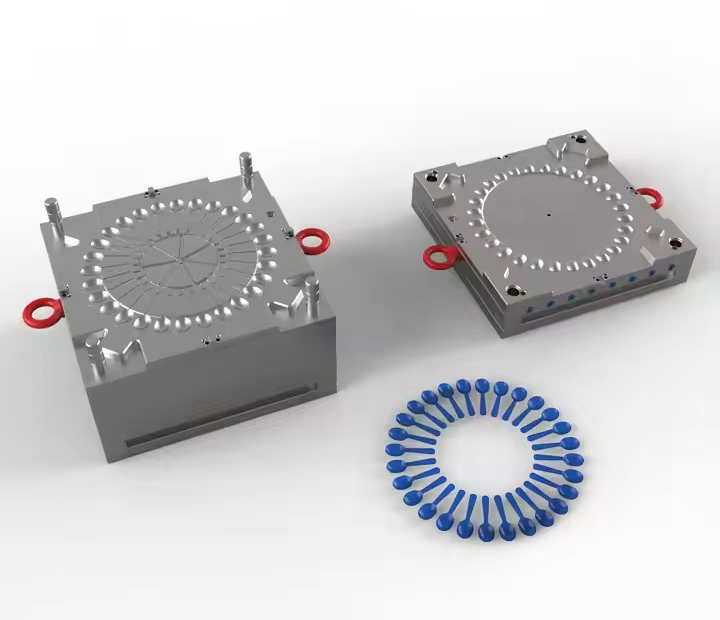
Plastic spoons, as high-volume consumable items, rely entirely on precision injection molds for their efficient, stable, and high-quality production. These molds are the critical conversion tools that transform spoon designs from drawings into mass-produced items.
Core Design Elements of the Spoon Molds
- Product Structure Decomposition: Mold design begins with the precise decomposition of the spoon’s 3D model. The design must accurately define independent regions such as the bowl, neck, handle, and any reinforcing ribs, ensuring precise geometric dimensions for each functional area.
- Parting Surface Definition: Based on the spoon’s shape complexity, the separation interface between the moving and fixed mold halves (parting line) is scientifically planned. This interface selection directly impacts the spoon’s visual quality (flash location) and smooth ejection.
- Cavity Layout: Determined by injection machine tonnage and production efficiency targets, this defines the number of spoons formed per cycle (number of cavities). Requires precise calculation of the runner system to ensure balanced filling across all cavities.
- Ejection System Design: Tailored to the spoon’s specific structure (e.g., recessed bowl, slender handle), designs incorporate combinations of ejector pins, ejector plates, or pneumatic systems to ensure undamaged ejection.
- Cooling System Optimization: Precision-calculated cooling channel networks embedded within the mold enable efficient temperature control of cavity surfaces, directly determining injection cycle time and spoon dimensional stability.
- Gating System Planning: Designs the flow path for molten plastic from the injection machine nozzle to each cavity (sprue, runners, gate). Gate location and size critically influence spoon appearance and internal stress distribution. Hot runner technology significantly reduces material waste.
- Venting Structure: Precision venting slots or gas-permeable inserts are placed at cavity ends and potential air trap areas to ensure air escapes during filling, preventing defects like short shots or burn marks.
Core Spoon Molds Manufacturing Process
- Material Preparation & Rough Machining: Metal materials possessing specific properties are selected. Standard blanks are processed via milling, turning, etc., to near-final dimensions of mold components, leaving allowance for finishing.
- Heat Treatment Strengthening: Key forming components (cores, cavities) undergo quenching and tempering to achieve the required surface hardness combined with internal toughness, enabling them to withstand long-term injection pressure and plastic abrasion.
- Precision Forming Machining:
- CNC Finishing: Computer Numerical Control (CNC) machines perform high-precision milling and engraving on core and cavity surfaces, replicating spoon design details to micrometer-level accuracy.
- Electrical Discharge Machining (EDM): Used for complex geometries difficult for CNC (e.g., deep slots, sharp corners, fine textures), employing electrical discharge erosion for precision shaping.
- Surface Treatment & Finish: Molded surfaces undergo progressive polishing to achieve specified finish grades (e.g., mirror, satin, texture). Food-grade applications demand surfaces completely free of pores and easy to clean. Anti-corrosion coatings (e.g., chrome plating, PVD coating) are applied when necessary.
- Standard Component Assembly & Testing: Machined cores, cavities, plates, and purchased standard components (guide pins/bushes, ejector pins, hot runners if used, cooling connectors) are assembled precisely. Mold actions (opening/closing, ejection), and cooling circuit integrity are tested on dedicated mold testing equipment.
- Trial Run & Validation: The mold is mounted on an injection machine for trial production. Process parameters (temperature, pressure, speed, time) are adjusted to optimize spoon quality. Mold performance (output, stability, lifespan) is validated before final acceptance.
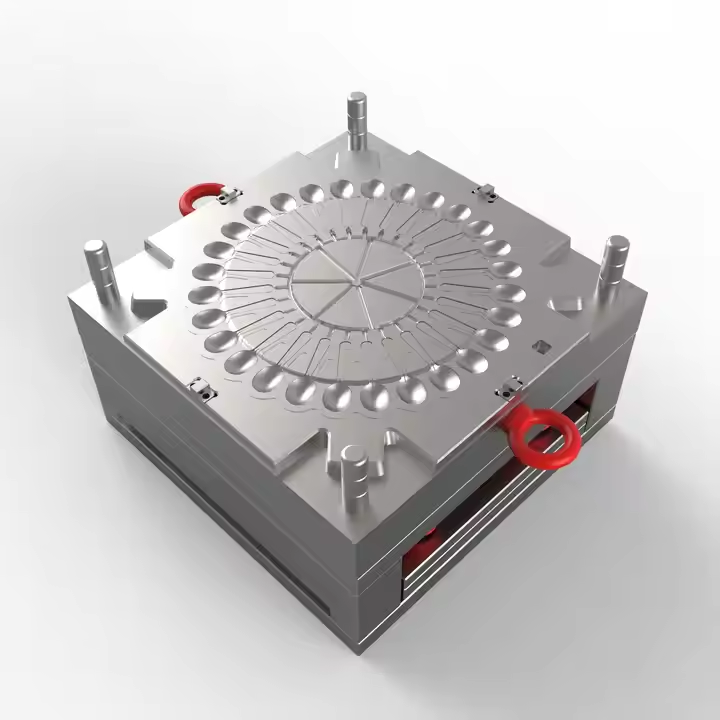

Mold Usage & Maintenance Protocol
- Standardized Operation: Strict adherence to mold installation, setup, and production operating procedures. Clamping force must be controlled within specified limits to prevent overload damage.
- Periodic Cleaning & Maintenance: Regular professional cleaning of parting lines, cavity surfaces, ejection systems, and guide pins/bushes to remove plastic residue, oil, and dust. Specialized cleaning agents and tools are used.
- Lubrication Management: Specified high-temperature lubricants are applied to sliding components (ejector plates, guide pins/bushes, return pins) at defined intervals and quantities.
- Condition Monitoring & Repair: A mold history log is maintained, continuously tracking spoon quality changes. Regular professional inspections assess key mold areas (cavity surfaces, vents, cooling efficiency, structural integrity). Wear, scratches, or minor damage are promptly repaired (polishing, welding, replacement of wear parts).
- Scientific Storage: Molds taken out of service require thorough cleaning, drying, and application of anti-corrosion oil to critical surfaces. Storage must be in a dry, dust-free, temperature/humidity-controlled environment to prevent deformation and rust.
Conclusion
Precise, reliable, and efficient plastic spoon molds are the cornerstone of modern mass production. Their design and manufacturing integrate multidisciplinary technologies from materials science, precision machining, and thermodynamics. Rigorous maintenance and the adoption of cutting-edge technologies are essential to ensure their continuous output of high-quality products, meeting market demands.
FAQ
What are the key structural design points for a plastic Spoon Molds?
Plastic spoon injection molds typically adopt a two-plate structure. The parting line follows the spoon contour to avoid undercuts and side-core-pulling mechanisms. A hot-to-cold runner system ensures balanced filling, while ejector pins (Ø1.5–2.5 mm) and a draft angle (0.5°–1°) facilitate demolding.
How to optimize the cooling system in a plastic Spoon Molds?
Cooling channels (Ø8–12 mm) must maintain a uniform distance (12–15 mm) from the cavity surface. Beryllium copper inserts at the spoon-handle junction enhance thermal conductivity, reducing cooling time by 30%.
What are the venting requirements for a plastic Spoon Molds?
Vent slots (depth: 0.02–0.03 mm) on the parting line prevent gas traps and burn marks. Multi-cavity molds require evenly distributed vents.
How to resolve short shots in plastic Spoon Molds production?
Optimize gate location (minimize flow length), increase melt temperature (80–100°C for PS), and raise injection pressure (80–100 MPa). Expand venting capacity.
How to prevent flash in plastic Spoon Molds?
Ensure parting line fit accuracy ≤0.02 mm, reduce injection pressure (≤100 MPa for PS), and regularly repair mold wear gaps.