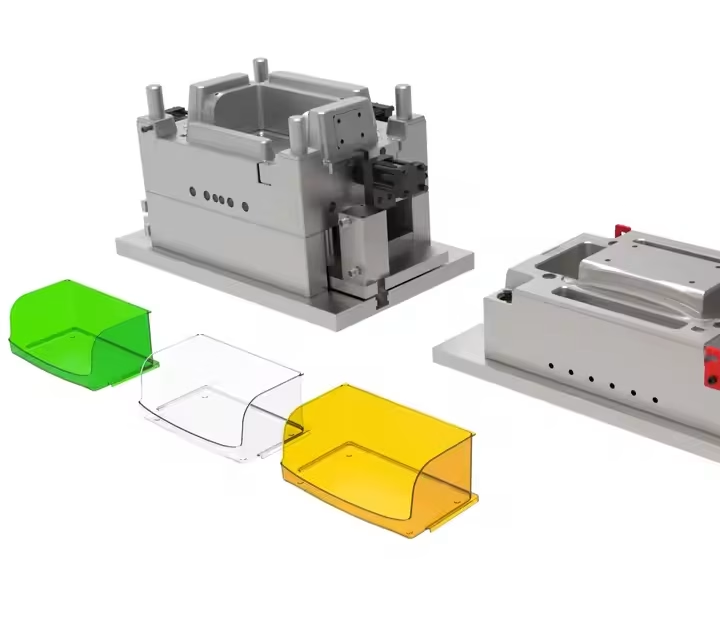
As a core functional component of modern appliances, the manufacturing technology of refrigerator storage bin molds directly determines product precision, lifespan, and production efficiency. Injection molds made of steel have become the industry mainstream due to their exceptional mechanical properties and process adaptability. This article comprehensively analyzes the technological essence of refrigerator storage bin molds—from material characteristics to design, manufacturing, and innovation trends.
Product Core: Precision Manufacturing Enabled by Steel
Refrigerator storage bin molds are typical large thin-walled injection molds, requiring a balance of structural strength and detailed molding capabilities. Key technical features include:
- Material Selection: Primarily uses pre-hardened tool steels such as:
- 718 Steel (Hardness: 41~47 HRC),
- P20 Steel (Hardness: 30~36 HRC),
- 2316 Steel (16% chromium content, strong corrosion resistance).
These steels undergo pre-hardening during production, eliminating post-heat-treatment deformation and ensuring dimensional stability.
- Structural Design:
- Hot Runner Systems minimize material waste and enhance injection efficiency (especially for PP, ABS—common refrigerator plastics).
- 1×2 or 1×4 Cavity Layouts balance productivity and mold complexity.
- Draft Angles strictly controlled at 1°~3° to prevent thin-wall deformation.
- Cooling System:
Conformal Cooling Channels enable precise temperature control (error ≤ ±2°C) via circulating water, reducing cooling time by 30% and minimizing warpage caused by internal stress.
Material Advantages: How Steel Solves Industry Pain Points
1. Revolutionary Balance of Lifespan and Cost
- Extended Service Life: Premium steels (e.g., S136, NAK80) endure 3 million injection cycles—3× longer than standard steel—reducing per-part cost by 40%.
- Optimized Maintenance: Pre-hardened steel skips heat treatment, streamlining processing. Nitriding further resists plastic abrasion, doubling maintenance intervals.
2. Dual Assurance of Precision and Stability
- Micron-Level Machining: CNC milling (±0.1 mm) and engraving ensure parting line gaps ≤0.02 mm, eliminating flash.
- Deformation Resistance: High-chromium steel (e.g., 2316) has a thermal expansion coefficient of 11.2×10⁻⁶/℃ at 80°C, guaranteeing batch-to-batch consistency.
3. Breakthrough Compatibility with Complex Processes
- Cryogenic Treatment: At -130°C, >90% retained austenite transforms, increasing hardness by 1.5 HRC and wear resistance by 30%.
- Surface Enhancement: TD coating (vanadium carbide) on sliding parts reduces friction coefficient to 0.05, extending lifespan by 50%.
Manufacturing Process OF Refrigerator Storage Bin MoldS
1. Design Phase: Digital Simulation First
- Software (UG, PROE) analyzes plastic flow, shrinkage (PP: 1.8~2.5%), and optimizes gate positions/cooling channels.
- Stress simulation predicts deformation risks, guiding insert design (length-thickness ratio ≤8) to avoid fragile L/U shapes.
2. Machining Phase: High-Precision Equipment Synergy
- Rough Machining: Large milling machines (±0.1 mm).
- Finish Machining: High-speed CNC + EDM (cavity surface: Ra 0.8 μm).
- Detail Processing: Taper engraving for undercuts (draft angle error ≤0.05°).
- Assembly & Debugging: Hot runner seal test + mold parallelism calibration (gap uniformity ≤0.03 mm).

Application and Maintenance: Key Strategies for Longevity
- Production Adaptability
Steel molds are compatible with various engineering plastics:- Transparent Materials: PC, PPS (require mold temperature above 80°C to prevent cold flow marks).
- Food-Grade Materials: PP, ABS (cold-resistant and impact-resistant).
- Standardized Maintenance
- Daily Maintenance: Clean parting line residue, lubricate ejector mechanisms.
- Periodic Inspection: Check gear wear every 50,000 cycles, replace aged sealing rings.
- Anti-Corrosion Treatment: Apply anti-rust coatings in environments with humidity >60%.
Industry Trends: Smart Manufacturing and Sustainability
- Integrated Real-Time Sensor Monitoring
Embedding pressure/temperature sensors within molds allows dynamic adjustment of injection parameters, reducing defect rates below 0.3%. - Circular Design
Modular steel molds (e.g., replaceable core-pulling units) enable rapid product changeovers, reducing new mold development costs. - Parallel Advancement of Lightweighting and High Strength
Developing thin-wall steel molds (wall thickness reduced by 15%), combined with topology-optimized ribs, achieves dual goals of reduced energy consumption and enhanced rigidity.
Conclusion
Refrigerator storage bin molds represent the deep integration of precision manufacturing and materials science. From the pressure and wear resistance of 1900-series steels, to functional innovations like arc core-pulling mechanisms, and the construction of intelligent operational systems, each step drives upgrades in space utilization and freshness performance for refrigerator storage. Moving forward, with growing demands for sustainable manufacturing and flexible production, steel molds will continue to achieve breakthroughs in high precision, longevity, and low energy consumption, providing foundational support for advanced home storage solutions.
>>You may also like
Standards & References
The following industry standards are referenced in this article: