
Amidst the tides of energy transition and industrial advancement, fan blades—as core carriers of fluid dynamics—directly impact the efficiency and reliability of wind turbines, aircraft engines, and advanced thermal management systems. The critical element determining blade aerodynamic precision and structural integrity is the fan blade molds, which endures thousands of tons of pressure and extreme heat. It is not only a masterpiece of industrial machinery but also the pinnacle crystallization of materials science, thermodynamics, and precision engineering—forging humanity’s future wings to harness wind energy with the resilience of steel.
I. Industry Landscape: The Strategic Value and Technological Pinnacle of Steel Molds
The global fan blade molds market follows a dual-track development of “application-driven growth and material breakthroughs.” Industrial clusters centered in Kunshan, Jiangsu, and Dongguan, Guangdong, are rapidly ascending into high-value sectors.
- Material Performance Defines Industrial Sophistication:
The comprehensive properties of mold steel directly dictate blade quality and lifespan. Current mainstream choices focus on three directions:- Pre-hardened Workhorse: P20 (1.2738): Delivers 28-32 HRC hardness out-of-the-box, balancing machinability and polishability. Ideal for household appliances and medium/low-speed turbine blades (<60m blade length), offering optimal cost-effectiveness.
- Thermal Strength Leader: H13 (1.2344): Maintains >45 HRC hardness at 500°C, with exceptional thermal fatigue resistance. The core choice for aircraft engine blades and gas turbine blades (operating >700°C). Vanadium/molybdenum additions increase lifespan by 30%.
- Giant Mold Specialist: 718HH (Enhanced 1.2738): Vacuum melting + ESR (Electroslag Remelting) ensures purity. Hardness variation <2 HRC across sections, guaranteeing stability under 10,000-ton clamping force for 80m+ wind fan blade molds.
- Breaking Through Technical Barriers:
- Ultra-Long Mold Joining Technology: 80m-class fan blade molds use segmented designs with interface flatness <0.02mm/m and thermal alignment accuracy ±0.1mm (ISO 2768).
- Intelligent Temperature Control: Distributed heating/cooling channels enable zonal temperature control within ±1.5°C, eliminating profile deviation from thermal distortion.
II. Materials Science: The Performance Evolution of Specialty Steels
Fan blade molds steels must maintain micron-level stability under extreme conditions, relying on sophisticated synergy between metallurgy and heat treatment.
- Metallurgical Excellence:
- Vacuum Degassing (VD/VOD): Reduces oxygen ≤15ppm, sulfur ≤0.001%, minimizing inclusions at the source.
- Electroslag Remelting (ESR): Directional solidification creates uniform fine equiaxed grains, increasing transverse impact toughness to 90% of longitudinal values (vs. 60% with conventional methods).
- The Art of Heat Treatment:
- Multi-Stage Quenching: Pre-cooling (600°C) → Austenitizing (1020°C) → Interrupted quenching (salt bath 400°C) → Cryogenic treatment (-196°C × 8h). Achieves retained austenite <3% and hardness uniformity ±1 HRC.
- Surface Enhancement:
- Plasma Nitriding: Surface hardness 1100 HV, wear-resistant layer depth 0.3mm, tripling lifespan.
- PVD Coating (AlCrN): Lowers friction coefficient to 0.35, preventing glass fiber adhesion (GFRP blades).
III. Manufacturing Process of fan blade molds
Modern fan blade molds manufacturing is a symphony of digital precision, where error control enters the “micron era.”
- Design Phase: Fusion of Aerodynamics and Structural Mechanics
- Parametric Modeling (UG NX/CATIA): Generates variable-section airfoils from NACA libraries with twist angle error <0.05° from root to tip.
- Multi-Physics Simulation (ANSYS):
- Thermo-Mechanical Analysis: Predicts mold deformation under clamping force for tolerance pre-compensation.
- Resin Flow Simulation: Optimizes resin injection gates to eliminate dry spots and voids.
- Machining Phase: Balancing Heavy Cuts and Micro-Finishing
- Roughing: Heavy-Duty Gantry Milling:
Uses φ250mm corncob cutters at 15mm depth, achieving 800 cm³/min material removal rate—boosting base shaping efficiency by 50%. - Finishing: Five-Axis Precision Sculpting:
- Pressure/Suction Surfaces: R6 ball-nose cutters at 0.3mm stepover, scallop height ≤5μm (VDI 3400).
- Leading Edge Radii: EDM finishing to Ra 0.4μm, contour accuracy ±0.03mm.
- Inspection Loop: Full Surface Digitization:
Laser trackers + white-light scanners create 3D point clouds, comparing to design models with profile error ≤0.1mm/2m.
- Roughing: Heavy-Duty Gantry Milling:
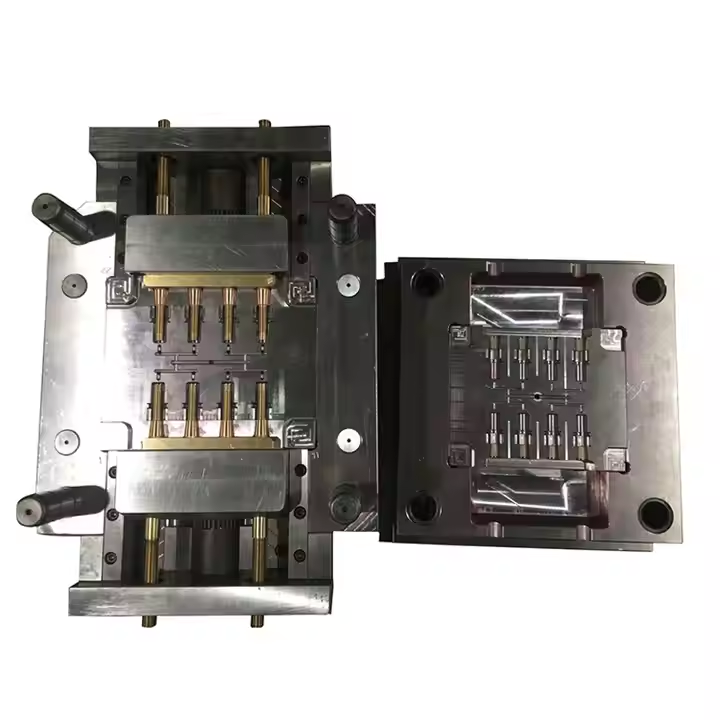

IV. Technological Frontiers: Breakthroughs in Intelligence and Extreme Performance
Steel molds are undergoing dual evolution: “sensory awakening” and “efficiency revolution.”
- Industry 4.0 Smart Molds:
- Embedded Sensor Networks: Fiber optic strain gauges and thermocouples at critical points monitor clamping stress and thermal gradients in real-time, enabling data-driven process optimization.
- Digital Twin Systems: Virtual replicas predict fatigue life after 100,000 cycles, allowing maintenance planning 90 days in advance.
- Additive Manufacturing Redefines Cooling:
- Conformal Cooling Revolution: Selective Laser Melting (SLM) prints 316L stainless steel 3D cooling channels following cavity contours. Cooling efficiency +40%, cycle time -25%.
- Local Reinforcement Inserts: 3D-printed tool steel inserts (e.g., HOTVAR®) in high-wear zones (blade root fir-tree slots) achieve 62 HRC hardness, extending life 5x.
- Ultra-Large Mold Structural Innovation:
- Topology-Optimized Lightweighting: AI-generated bionic rib structures reduce 80-ton mold weight by 15% while increasing stiffness 20%.
- Intelligent Leveling Systems: Hydraulic servo legs auto-compensate for foundation settlement, maintaining clamping parallelism at 0.1mm/10m.
V. Application of fan blade molds
Extreme application diversity drives continuous evolution in steel performance and processes.
- Wind Energy: Dual Challenge of Scale and Precision
- Ultra-Long Blades (80m+): Segmented welded 718HH steel molds for Vacuum Assisted Resin Infusion (VARI). Root flange flatness ≤0.1mm/m.
- Typhoon-Resistant Design: Molds incorporate aerodynamic brake grooves; blade trailing edges thickened 3% for enhanced shear resistance.
- Aerospace: Reliability and Lightweighting Under Extremes
- Titanium Investment Casting Molds: H13 steel with Al-Si diffusion coating withstands 1600°C molten titanium erosion. Blade wall tolerance ±0.15mm.
- Hollow Cooled Blades: Ceramic core positioning accuracy ±0.05mm enables 400-micron cooling channels.
- High-End Electronics Cooling: Micro-Scale Precision
- Ultra-Thin Aluminum Blades (0.3mm): S136 mirror-polish steel molds (Ra 0.025μm) with 0.25° draft angles ensure high aspect ratio structural integrity.
Conclusion
Fan blade molds—these precision fortresses forged from specialty steel—embody humanity’s relentless pursuit of energy efficiency and power frontiers. From quenching steel billets under 10,000-ton presses to micron-level sculpting on five-axis machines, each mold crystallizes the ingenuity of materials scientists, mechanical engineers, and fluid dynamicists.
As additive cooling channels course like veins within the mold, as sensor data builds digital twins in the cloud, the “cold hardness” of steel now pulses with the heartbeat of intelligent manufacturing. With future iterations in superalloys and composite matrices, fan blade molds will push performance limits under ever harsher conditions—whether capturing every wisp of wind crossing the Gobi or propelling silver wings through 10,000-meter skies. The cavities shaped by precision steel will ultimately define the direction and force of the wind. Forged in steel, driven by precision—within the mold, a thousand wings ride the same wind.
FAQ
Why is steel the preferred material for fan blade molds?
Steel offers high hardness (HRC 48–62), wear resistance (lifespan: 500,000–800,000 cycles), and deformation resistance (yield strength ≥1,600 MPa), enabling it to withstand high-pressure injection and long-term wear.
What are the special requirements for the gating system in fan blade molds?
A balanced multi-point gate or hot runner system is essential to prevent uneven filling of multiple blades, which could cause density variations and affect dynamic balance.
How is exhaust handled in fan blade molds?
Exhaust grooves (0.02–0.03 mm deep) are cut along the parting line, and vacuum exhaust valves are added at blade tips to prevent gas trapping-induced burn marks or incomplete filling.
How are demolding challenges resolved?
Pneumatic-assisted ejection or pre-deformed ejector pin mechanisms are designed for blade release force, with stroke tolerance ±0.01 mm to prevent fracture.
>>You may also like
Standards & References
The following industry standards are referenced in this article: