
Automotive component molds are indispensable core process equipment within the modern automotive industry manufacturing system. Their performance directly determines the quality, production efficiency, and final cost of automotive parts. These high-precision, high-complexity specialized tools play a decisive role in key processes such as stamping forming of metal sheets, melt injection molding of plastic pellets, and solidification die casting of alloy materials. Without the support of mold technology, the large-scale, high-efficiency, high-precision production model of the automotive manufacturing industry would be unattainable.
Core Mold Classifications and Functional Implementation
Automotive component molds are primarily categorized into several key types based on their processing objects and process principles:
- Stamping Dies: Applied to metal sheet forming. Utilizing powerful mechanical force provided by presses, metal sheets undergo plastic deformation or separation through the precise coordination of punches and dies, producing body panels (e.g., doors, hoods), structural components (e.g., longitudinal beams, cross members), and various chassis parts. These dies require extremely high strength and wear resistance to withstand repeated significant impact loads.
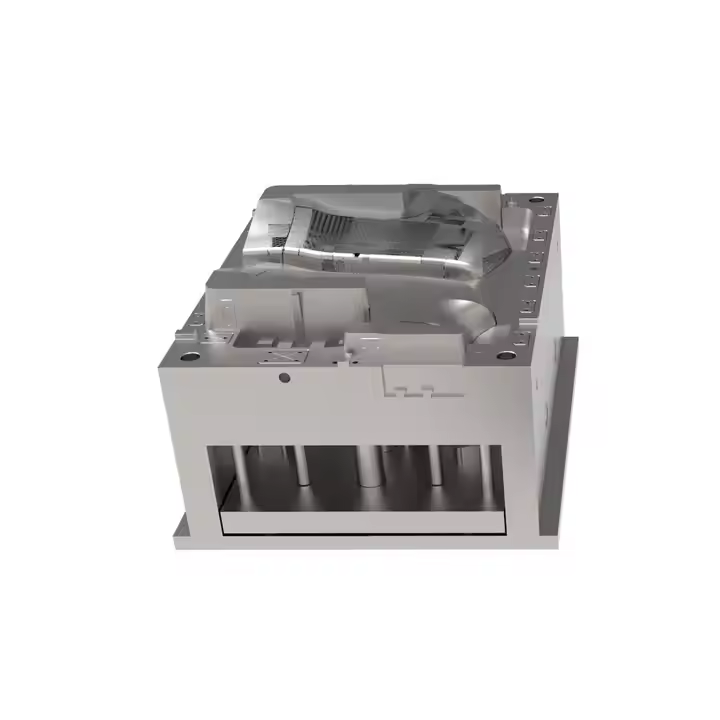
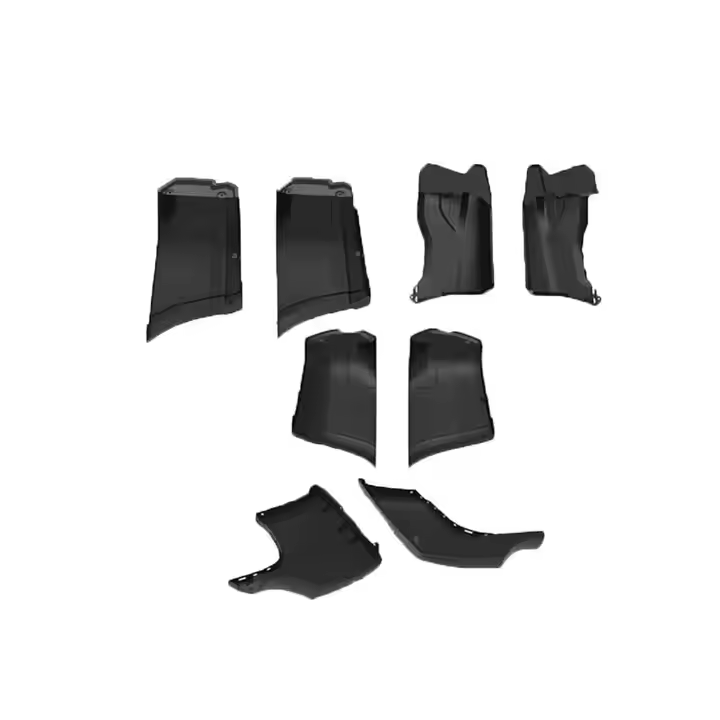
- Plastic Injection Molds: Used for producing thermoplastic or thermosetting plastic parts. Molds are mounted on injection molding machines. Molten plastic is injected under high pressure into the sealed mold cavity, cooled and solidified before mold opening and ejection, forming interior parts (e.g., instrument panels, door panels), exterior parts (e.g., bumpers, grilles), and functional parts (e.g., switches, wire harness connectors). The mold’s temperature control system is critical for cycle time and part quality.
- Die Casting Molds: Employed for producing low-melting-point alloy parts such as aluminum or magnesium alloys. Molten metal is injected at high speed under high pressure into the metal mold cavity, rapidly cooling and solidifying. Commonly used for high-strength components like engine blocks, transmission housings, and structural brackets. Die casting molds require excellent thermal fatigue resistance, high thermal conductivity, and resistance to molten metal erosion.
- Other Molds: Rubber molds for seal production, forging dies for high-strength structural component blanks, glass molds for headlight manufacturing, etc.
Automotive Component Molds Design: Precision Calculation and Simulation Verification
Mold design is the primary stage of the manufacturing process. Its core lies in translating part geometry, material properties, and process requirements into a manufacturable mold structure solution.
- Structural Design: Determines the overall mold frame, cavity and core structure, parting line location, gating/runner systems (for plastic, die casting), ejection mechanisms, cooling/heating circuits, guiding and positioning systems, and selection of standard mold bases. Designs must ensure mold strength, rigidity, and lifespan meet production demands, while guaranteeing operational safety and maintenance convenience.
- Forming Process Simulation: Computer-aided engineering software is widely used for simulation analysis before physical manufacturing. Stamping simulation predicts material flow, thinning, wrinkling, and springback; injection/die casting simulation predicts melt filling, packing, cooling, warpage, air traps, and weld line positions. Simulation results guide design optimization, reducing trial runs, development risk, and cost.
- Tolerance and Precision Design: Strictly allocates machining and assembly tolerances for key mold components based on part functional requirements. Mold manufacturing precision typically needs to be an order of magnitude higher than part precision (e.g., part tolerance ±0.1mm requires mold working area tolerance within ±0.01mm) to ensure batch production stability.
- Material Selection: Suitable mold steels (e.g., pre-hardened plastic mold steel P20, 718; high-hardness quenched steel H13 for die casting/stamping; carbide for high-wear areas) and surface treatment technologies (nitriding, PVD, CVD coatings) are selected based on mold type, production volume, part material, and budget. These enhance wear resistance, corrosion resistance, anti-adhesion properties, and service life.
Automotive Component Molds Manufacturing: Precision Machining and Rigorous Inspection
Automotive Component Molds manufacturing transforms design into physical reality, demanding extremely high equipment accuracy, process expertise, and inspection methods.
- Machining Process Chain: Main processes include:
- Rough Machining: Large-scale milling and turning remove the bulk of material.
- Semi-Finishing: Further approaches the final shape, leaving uniform stock for finishing.
- Heat Treatment: Hardening and tempering applied to components requiring high hardness to ensure base material properties.
- Finishing: High-speed milling, precision grinding, Electrical Discharge Machining (EDM), Wire Electrical Discharge Machining (WEDM) achieve final dimensional accuracy and surface finish. Five-axis machining centers efficiently handle complex surface machining. Mirror EDM and Slow Wire EDM achieve micron-level precision.
- Bench Work Assembly and Polishing: Manual fitting, assembly of components, and fine grinding/polishing of forming surfaces achieve the required finish (e.g., mirror finish Ra<0.1μm). Polishing quality directly affects plastic part appearance and metal part demolding.
- Precision Inspection and Quality Control: High-precision measuring equipment is used throughout: Coordinate Measuring Machines (CMMs) inspect critical dimensions and geometric tolerances; laser scanning and optical comparators inspect complex surfaces; roughness testers measure surface finish; hardness testers verify heat treatment results. All inspection data is rigorously compared against the design model to ensure manufacturing errors fall within allowable limits.
Automotive Component Molds Use and Maintenance: Key to Ensuring Stable Production
Once a Automotive Component Molds enters production, its usage and maintenance level directly determine production efficiency, part quality, and mold lifespan.
- Trial Runs and Debugging: New molds undergo trial runs before mass production. Process parameters (pressure, temperature, speed, time) are adjusted, gate/runner/vent designs are optimized, and the mold is locally modified to resolve issues encountered during trial production (e.g., short shots, flash, sink marks, warpage, sticking). This continues until qualified parts are produced consistently.
- Standardized Operation and Maintenance: Strict mold operating procedures are established, covering correct installation, clamp height setting, ejection stroke adjustment, and mold release agent usage. Preventive maintenance plans are executed regularly: cleaning cavities, lubricating moving parts, checking fastener status, ensuring cooling channel patency, and inspecting wear on consumables (ejector pins, inserts, guide pillars/bushes) for timely replacement.
- Repair Management: Professional repair is conducted for molds damaged during production (e.g., chipping, scoring, corrosion, excessive wear). Repair processes are documented, and molds must pass re-inspection before returning to production. Mold history records track usage status and repair history.
Synergistic Evolution of Automotive Component Molds Technology and Automotive Industry Development
Automotive industry demands are the core driver of mold technology advancement:
- New Material Applications: High-strength steel, aluminum, magnesium alloys, carbon fiber composites, and new engineering plastics impose higher requirements on mold material selection, structural design, and surface treatment. Hot stamping molds must withstand the forming and quenching of ultra-high-strength steel sheets at high temperatures.
- Part Integration and Lightweighting: Large, complex structural parts (e.g., one-piece door inner panels, instrument panel carriers) demand larger molds, more complex structures, and higher precision. Processes like microcellular foam molding and thin-wall injection molding require more precise mold temperature control and venting design.
- High Precision and Efficiency: Increasing part precision requirements driven by automotive electrification and intelligence. Technologies like stack molds, multi-material co-injection molds, and high-speed progressive stamping dies aim to increase the number of parts per cycle and production rates.
- Intelligence and Digitalization: Integration of sensors within molds monitors pressure, temperature, and wear status; combined with IoT technology enables remote mold condition monitoring and predictive maintenance; digital management (CAD/CAE/CAM/CAPP/PLM) of the entire mold design and manufacturing process enhances collaboration efficiency and quality traceability.
conclusion
As an “efficiency multiplier” in modern manufacturing, the value of a mold extends far beyond the tool itself. A well-designed, precisely manufactured, and properly maintained mold can stably and efficiently produce hundreds of thousands or even millions of high-quality parts, distributing the high initial investment cost over each part, thereby significantly reducing unit cost. In the fiercely competitive automotive market, the advancement, reliability, and economy of mold technology are critical factors determining product success and manufacturing cost advantages.
From a metal sheet to the streamlined curves of a car body, from plastic pellets to intricate interior structures, automotive component molds, through rigorous engineering logic and precise physical forms, silently underpin the creation of every vehicle, continuously driving automotive manufacturing towards greater efficiency, precision, and intelligence.
FAQ
What are automotive component molds?
Automotive component molds are specialized tooling used for mass-producing auto parts. They are precision instruments that process raw materials into specific shapes through stamping, injection molding, die casting, etc.
What are the main types of automotive component molds?
Core types include stamping dies (for body panels), plastic injection molds (for interior/exterior trim), die casting molds (for engine components), and rubber/forging molds.
What are key considerations in designing automotive component molds?
Design requires comprehensive optimization of part geometry complexity, material properties, production volume, precision requirements (±0.01mm level), and cost control.
Why is CAE simulation essential for automotive component molds?
It simulates stamping, plastic filling, etc., predicting material deformation and defect risks, reducing trial runs by over 30% and shortening development cycles.
What equipment is critical for manufacturing high-precision automotive component molds?
Five-axis machining centers, precision EDM, Slow Wire EDM (WEDM), and CMMs are required to ensure micron-level accuracy.
>>You may also like
Standards & References
The following industry standards are referenced in this article: