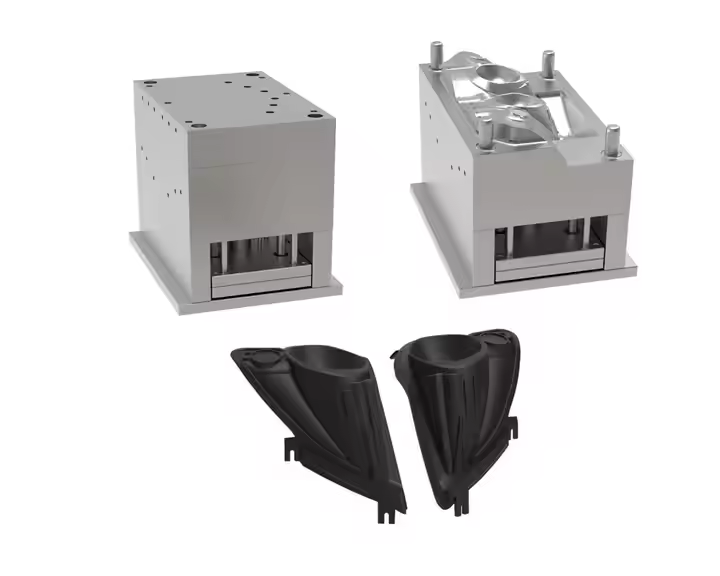
As night falls, cars transform into shimmering spirits of light, their most striking feature—the headlights—transcending mere illumination. They define body contours, embody brand aesthetics, and even serve as visual signatures on the road. The origin of this brilliance lies not solely in LED bulbs but in a sophisticated core: plastic headlamp shell molds. These molds are the “Soul of Light Sculpting,” translating visionary design blueprints into millions of radiant realities on vehicles.
From Blueprint to Reality: Defying Design Limits
Every innovation in headlight design challenges mold engineering to its extremes:
- Shape Revolution: Flowing curves, sharp edges, intricate 3D surfaces—designers’ bold strokes demand precise geometric replication to ensure every ray follows its intended path.
- Optical Maze: Modern headlights house intricate light-guides, reflectors, and microstructures. Plastic headlamp shell molds must replicate micron-level features (depth tolerance: ±0.002mm) to achieve uniform light diffusion, eliminating dark spots or glare.
- Harsh Environment: Facing rain, debris, UV radiation, and thermal shocks, molds must ensure housings resist impact, weathering, and deformation while meeting ±0.015mm positional accuracy for assembly integrity.
Sculpting the Micrometer Realm: The Zenith of Precision
Plastic headlamp shell molds represent the pinnacle of advanced manufacturing:
- Precision as Priority: Cavity/core surface accuracy often demands ≤±0.01mm tolerances—equivalent to controlling a grain of rice on a football field. Deviations cause optical distortion or structural flaws.
- Process Symphony: Achieving this requires masterful collaboration:
- High-Precision CNC: For structural and complex surface machining.
- WEDM (Wire EDM): Delivers sharp corners and fine structures (accuracy: ±0.005mm).
- Sinking EDM: Crafts textures and deep features with ≤0.02μm surface roughness.
- Foundation of Strength: Mold bases require 34–36 HRC hardness and 1,050 MPa yield strength to endure high-pressure cycles, alongside corrosion resistance. Surface polishability (Ra≤0.015μm) underpins optical clarity.
Taming “Liquid Light”: Material-Process Synergy
Plastic headlamp shell molds unlock the potential of engineering plastics (PC, PMMA):
- Material Science:
- Polycarbonate (PC): Chosen for impact resistance (>20 kJ/m²) and heat tolerance (HDT: 160°C).
- Polymethyl Methacrylate (PMMA): Preferred for optics (≥92% light transmission) and UV stability.
- Process Intelligence: Molds counteract material behavior with precision:
- Flow Prediction: Advanced CAE (e.g., Moldflow) simulates filling to eliminate air traps.
- Shrinkage Compensation: Pre-compensated designs offset material contraction (PC: 0.6–0.9%).
- Thermal Equilibrium: Efficient cooling is critical:
- Conformal Channels: Positioned 8±0.3mm from surfaces with turbulence flow (Re>4,000).
- Target Outcome: Minimized stress, warpage <0.1mm/m, and cycle times ≤45 seconds.
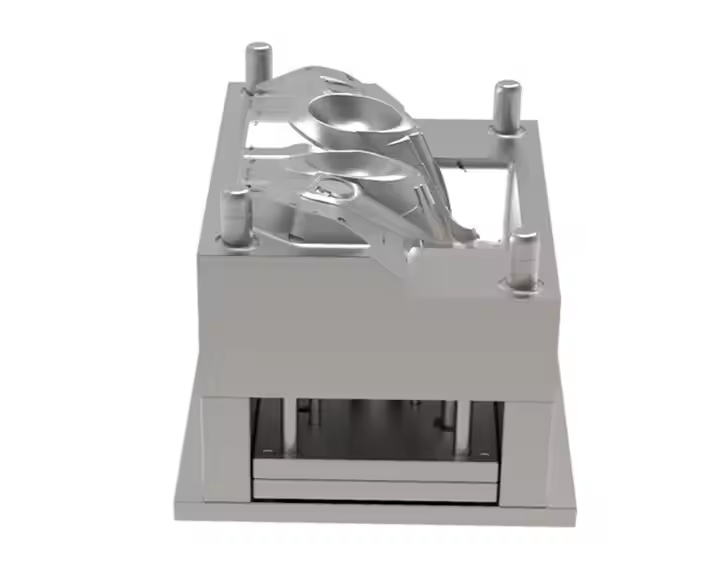
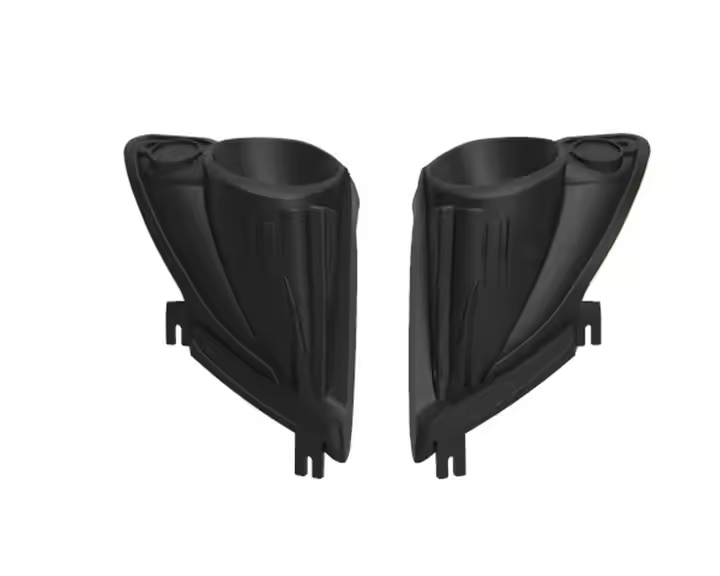
Textures of Light: The plastic headlamp shell molds Surface Alchemy
Micro-textures define luminous signatures:
- Optical Engineering: Purpose-engineered textures include:
- Prism Arrays: For uniform light guides (e.g., DRLs).
- Microlens Dots: Eliminate hotspots in lens surfaces.
- 3D Surface Patterns: Enable dynamic effects like scrolling turn signals.
- Precision Execution: Techniques ensure fidelity:
- Laser Texturing: Achieves ±0.8μm depth control for nanostructures.
- Photochemical Etching: Creates matte finishes (VDI #15–35).
- Consistency Imperative: Textures must endure >500,000 cycles with under 0.5μm wear.
Longevity Assurance System for plastic headlamp shell molds
To ensure stability in high-volume production, a systematic maintenance program must be established:
Material Durability Standards
- Primary Templates: Pre-hardened tool steel (P20/718) hardness 32-36 HRC
- Critical Inserts: Carbide (hardness ≥60 HRC) or powder steel (hardness 58-62 HRC)
- Service Life: ≥500,000 cycles (under proper maintenance)
Wear Protection Measures
- Cavity Surface: PVD coating (TiAlN/AlCrN) thickness 3-5μm
- Ejection System: Nitriding depth 0.15-0.25mm
- Slide Mechanism: Self-lubricating bearings
Thermal Management Optimization
- Cooling Efficiency Standard: Mold temperature control ±1.5℃
- Conformal Cooling Channels: 8-12mm from molding surface (geometry-dependent)
- Zoning Control: 6-12 independent temperature circuits
Maintenance Management Protocol
- Preventive Maintenance Cycle: Full overhaul every 50,000 cycles
- Critical Component Replacement:
• Ejector pins/Reset pins: Every 150,000 cycles
• Guide pillars/Bushings: Every 300,000 cycles - Dimensional Monitoring: 3D cavity scan every 10,000 cycles (0.02mm accuracy)
Intelligence & Innovation: The Future of plastic headlamp shell molds Technology
Evolution continues through automation and integration:
- Hot Runner Systems: Multi-zone temperature control (±0.5°C), 48+ nozzles per mold, reducing waste to ≤2.7%.
- Smart Molds: Embedded sensors (pressure: ±0.3%, temperature: ±0.2°C) enable predictive maintenance and real-time parameter optimization.
- Future-Forward Design:
- Full-Width Units: Molds for 1.5m+ lamp housings demand nano-scale flatness (±0.02mm/m).
- Sensor Integration: Accommodate radar/lidar windows with <0.5% signal attenuation.
- Material Advancements: Bio-based resins with modified processing needs.
Conclusion
Plastic headlamp shell molds epitomize the fusion of precision mechanics and optical design. Hidden from view yet fundamental, these engineering marvels translate micro-accuracy into automotive artistry. They are the silent backbone, giving form to light, ensuring durability across millions of cycles, and pushing boundaries with smarter, sustainable solutions. In every precise beam and signature glow, these molds silently empower the evolving language of automotive light—bringing brilliance to motion and vision to the road ahead.