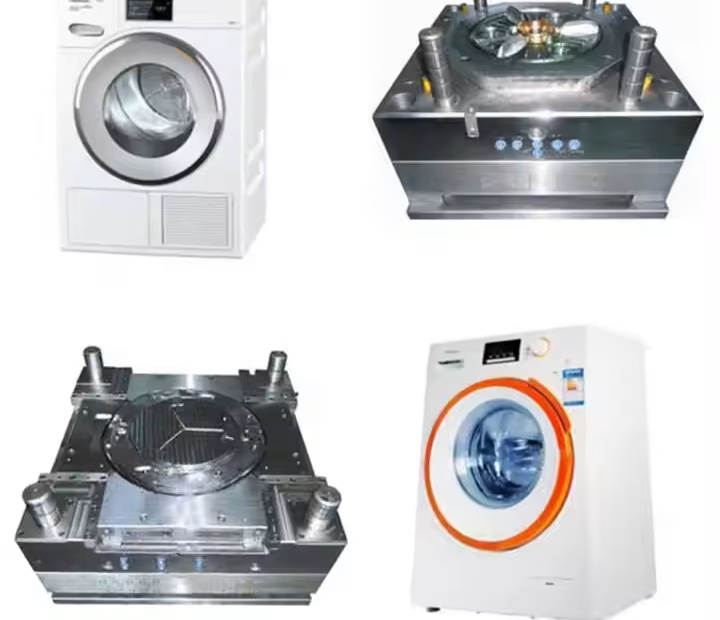
As essential household appliances, the reliability, efficiency, and quality of modern washing machines critically depend on the precise manufacturing of internal components. Washing machine molds, serving as pivotal engineering carriers for mass production, fundamentally determine the geometric accuracy, functional realization, production efficiency, and overall quality of washing machine parts through their design sophistication, machining precision, and manufacturing processes.
I. Core Functions of Washing machine molds Manufacturing Systems
- Foundation for Mass Production and Consistency: Washing machines incorporate numerous structurally complex plastic components (inner tubs, outer tubs, pulsators/agitators, control panels, base assemblies, etc.) with high precision requirements. Molds represent the sole viable means for the efficient, stable, and geometrically consistent replication of these parts.
- Realization of Complex Geometries and Functional Structures: Modern washing machine performance requirements (high washing efficiency, low fabric wear, efficient dewatering, low noise/vibration) directly translate to demands for precise molding of complex features such as inner tub lifter profiles, dewatering hole array distributions, balancer ring internal flow channels, shock absorber interfaces, and fluid-guiding surfaces. Molds serve as the physical realization tools for these engineering designs.
- Guarantee of Dimensional Accuracy and Assembly Reliability: The machining accuracy of mold cavities (typically controlled within 0.02mm – 0.05mm) directly determines part dimensional tolerances, geometric tolerances, and the quality of critical mating surfaces. This forms the basis for smooth final assembly, stable operation of moving parts, and effective dynamic/static sealing.


II. Technical Analysis of Core Component of Washing Machine Molds
- Inner Tub Mold:
- Core Challenges:
- High-Density Hole Array Molding: Thousands of dewatering holes require uniform distribution, strict aperture tolerances, and burr-free edges without stress concentration. Relies on high-precision arrayed core pins and stable ejection systems.
- Complex Lifter Structure: Lifter height, angle, cross-sectional shape, and spatial distribution directly impact fabric dynamics and fluid flow energy. Mold flow analysis (CAE) is essential to optimize melt flow paths, packing pressure, and cooling rates, preventing short shots, weak weld lines, and deformation.
- Deep-Cavity Thin-Wall Uniformity Control: Ensures uniform melt filling over long flow paths, sufficient packing compensation, and rapid yet balanced cooling. Places extremely high demands on cooling system design, especially conformal cooling technology.
- Mold Structural Features: Widespread use of hot runner systems to reduce scrap and improve fill balance; complex sliders and lifters for side-action features; multi-stage ejection systems to ensure damage-free demolding of deep-cavity parts.
- Core Challenges:
- Outer Tub/Water Tank Mold:
- Functional Requirements: Structural pressure-bearing, fluid sealing, shock absorber integration, internal component support.
- Technical Difficulties: Large molds face challenges in clamp force distribution over large projected areas, wall thickness uniformity control, reinforcement rib layout optimization, and precise assembly interface molding (e.g., flanges, shock absorber mounts). Strict requirements for overall mold rigidity, cooling uniformity, and venting efficiency to minimize warpage.
- Pulsator/Agitator Mold:
- Performance Core: Drives water flow patterns to achieve specific washing actions (tumbling, rolling, scrubbing).
- Key Technologies: High-fidelity replication of complex 3D surfaces (blade angles, flow channels, surface curvature); ensuring dense filling in blade regions for strength requirements; high cavity surface finish (reducing fluid resistance and wear); molded parts require good dynamic balance to suppress vibration and noise.
- Control Panel/Housing Mold:
- Dual Requirements: Functional integration and aesthetic quality.
- Precision Technology Embodiment:
- Surface Texture Engineering: Direct transfer of surface finish from mold cavity (mirror polish for gloss, chemical etching/laser texturing for matte/special textures).
- Precise Hole Positioning and Windows: Button holes, display windows, interface ports rely on high-precision sliders, inserts, and ejector pins.
- Multi-Material Integrated Molding: Two-shot/multi-shot molding requires complex rotating or shuttle mold structures; In-Mold Decoration/In-Mold Labeling (IMD/INS) technology demands extremely high mold positioning accuracy and process control.
- Balancer Ring Mold:
- Core Function: Dynamic balance compensation during high-speed spinning.
- Peak Mold Complexity: Molding internal, enclosed, multi-loop high-precision saltwater channel systems. Poses severe challenges for mold parting line design, core structural strength, reliability of multi-directional core-pulling mechanisms, and cavity sealing. Must guarantee unimpeded flow channels and zero potential leakage points.
III. Washing Machine Molds Engineering
- Digital Design and Simulation (CAD/CAE):
- 3D Modeling and Virtual Assembly: Accurately constructs washing Machine Molds structure, performs interference checks and motion simulation.
- Mold Flow Analysis (e.g., Moldflow): Core process. Simulates plastic melt flow (filling), pressure maintenance (packing), heat transfer (cooling), and final deformation (warpage). Used to predict and eliminate weld lines, air traps, voids, sink marks, and warpage; optimizes gating systems, cooling layouts, and process parameters. Indispensable for large complex parts (inner/outer tubs).
- Structural Mechanics Analysis (FEA): Verifies mold deformation and stress distribution under high injection pressure, ensuring structural rigidity and longevity.
- Ultra-High Precision Machining Technology Group:
- CNC Machining (Milling/Turning): Washing machine molds bases, plates, and foundational surfaces.
- Electrical Discharge Machining (EDM): Key precision machining method, excels at deep/narrow slots, sharp corners, micro-textures, and complex surfaces (e.g., lifters), achieving mirror finishes (Ra<0.1μm).
- Wire EDM (WEDM): Precisely machines shaped inserts, ejector pin holes, and precision through-holes.
- Deep Hole Drilling: Enables long-distance, spatially precise straight or angled cooling channel machining.
- High-Speed Milling (HSM): Efficiently finishes complex surfaces, reducing manual polishing and improving efficiency/consistency.
- Additive Manufacturing (Metal 3D Printing): Revolutionary technology for manufacturing washing Machine Molds inserts integrated with conformal cooling channels. Channels can be topologically optimized to conform tightly to cavity surfaces, significantly improving cooling efficiency (30%+), shortening cycle times, reducing part warpage, and increasing yield. Offers significant advantages for washing Machine Molds producing ultra-complex internal flow parts like balancer rings.
- Surface Treatment and Enhancement Technologies:
- Precision Polishing: Achieves A0-A1 level mirror finishes for high-gloss appearance requirements.
- Surface Texturing (Etching/Laser Engraving): Chemical etching or laser engraving techniques create diverse surface textures (leather grain, geometric patterns, matte finishes).
- Surface Modification and Strengthening: Application of Physical Vapor Deposition (PVD), Chemical Vapor Deposition (CVD), ion nitriding, hard chrome plating, etc., to drastically increase mold working surface hardness (HV 1000+), wear resistance, corrosion resistance, and release properties, significantly extending service life.
- Integration of Precision washing machine molds Subsystems:
- Hot Runner Systems: Reduce cold runner scrap, improve multi-cavity fill balance, shorten cycles, enhance surface quality.
- High-Rigidity Guiding Systems: Ensure precise mold closure and smooth movement.
- Efficient Thermal Management (Cooling) Systems: Optimize channel design (baffled bubblers, fountain tubes, conformal channels), use turbulence promoters to enhance heat transfer.
- Multi-Stage/Compound Ejection Mechanisms: Solve demolding challenges for deep-cavity parts and undercuts.
- Complex Side-Action Core-Pulling Mechanisms: Combined use of lifters, hydraulic/pneumatic sliders, gear racks, etc., for multi-directional core pulling.
Conclusion
Washing machine molds represent the pinnacle of modern precision manufacturing engineering. They are inherently complex systems integrating advanced mechanical design, material science, thermodynamics, fluid dynamics, computational simulation, and ultra-precision machining. The design decisions, manufacturing accuracy, material properties, and maintenance standards of washing machine molds constitute the underlying logic defining the performance thresholds, quality stability, production efficiency, and ultimate market competitiveness of washing machine products.
Facing the washing machine industry’s continuous evolution towards larger capacities, higher efficiency, enhanced intelligence, and greater sustainability, washing machine molds technology will inevitably push existing boundaries. With higher precision, greater efficiency, stronger adaptability, and superior cost-effectiveness, molds will provide a solid manufacturing foundation for the next generation of washing machines. Continuous investment in mold technology R&D and innovation remains the strategic core for the washing machine industry to maintain technological leadership and market advantage.