
In the intricate production system of the automotive industry, engine hood molds play a pivotal role. As critical carriers of vehicle exterior design and cornerstones of mass production, these molds must meet stringent technical requirements such as aerodynamic performance and pedestrian protection while achieving millimeter-level precision control in high-efficiency manufacturing. From conceptual design to mass production, this precision tool epitomizes the evolution of modern manufacturing from experience-driven to digitally intelligent paradigms. This article delves into the technical essence, core advantages, and multifaceted applications of engine hood molds in the automotive sector.
Product Overview: The Engineering Code of Engine Hood Molds
1. Definition and Functional Role
Automotive engine hood molds (Hood Molds) are core tooling equipment used to stamp-form the outer and inner panels of engine hoods, classified under automotive body panel molds. Their primary functions include:
- Design Realization: Translating designers’ curved concepts into mass-producible physical forms;
- Material Shaping: Processing steel/aluminum sheets into complex 3D structures through multi-step stamping (drawing, trimming, flanging, etc.);
- Quality Assurance: Ensuring dimensional accuracy (±0.2 mm), surface finish (Ra ≤0.8 μm), and assembly compatibility.
2. Structural Breakdown
A typical engine hood molds system comprises four key modules:
- Upper and Lower Molds: Cast from high-hardness alloy steels like Cr12MoV, CNC-machined to create cavities;
- Blank Holder: Controls material flow to prevent wrinkling or cracking (gap precision ≤0.05 mm);
- Ejection Mechanism: Hydraulic or pneumatic systems for automatic part release;
- Guidance System: Precision guide pillars/bushings ensure engine hood molds alignment (error ≤0.01 mm).
Depending on vehicle requirements, molds can be designed as single-stage, compound, or progressive molds, with integrated progressive molds boosting productivity by 40%.
3. Material and Process Evolution
- Base Materials: Transition from traditional cast iron to forged SKD11 steel and lightweight aluminum-bronze alloys (30% weight reduction);
- Surface Treatments: TD coating (vanadium carbide, 8–15 μm thickness, HV3000 hardness), laser cladding (5x wear resistance);
- Manufacturing Processes: 5-axis machining centers (positioning accuracy 0.005 mm) + EDM precision finishing (Ra 0.4 μm surface polishing).
- Product Advantages: Six Core Competitiveness Factors
1. Millimeter-Level Precision Control
Finite element analysis (FEA) optimizes mold surface compensation, while laser trackers enable in-process inspection, eliminating springback (compensation accuracy: 0.1 mm/m). For example, a German luxury brand’s adaptive compensation algorithm reduced panel gaps from 1.5 mm to 0.8 mm, enhancing vehicle airtightness.
2. High Efficiency and Cost Optimization
- Quick Mold Change Systems: Hydraulic clamping + QR code recognition cut changeover time from 2 hours to 15 minutes;
- Modular Design: Universal blank holders and ejectors reduce development costs by 25% across vehicle platforms;
- Extended Lifespan: Hard alloy inserts push mold longevity beyond 1 million cycles (vs. 500k for traditional molds), lowering per-part costs by 40%.
3. Complex Curvature Forming
NURBS surface modeling enables replication of 0.1 mm-radius sharp edges (e.g., Cadillac’s diamond-cut design) or gradient curvatures (e.g., Porsche Taycan’s flyline styling). Variable pressure drawing (VPD) addresses cracking in high-strength steel (980 MPa) via zone-specific forming.
4. Lightweighting and Material Adaptability
- Multi-Material Compatibility: Interchangeable inserts process steel (0.7–1.2 mm), aluminum (6016-T4), and carbon fiber prepreg;
- Thinning Design: Local reinforcement supports 0.6 mm ultra-thin sheets (40% lighter than 1.0 mm sheets), meeting EV lightweight demands.
5. Smart Manufacturing and Digital Twins
- Embedded Sensors: Real-time pressure/temperature monitoring (1 kHz sampling);
- Virtual Debugging: DELMIA-based digital twins reduce trial runs by 70% through pre-optimized stamping parameters.
6. Sustainability and Eco-Friendliness
- Energy Efficiency: Servo motors cut energy use by 60% vs. hydraulic systems;
- Circular Economy: 95% base material recyclability; coatings regenerated via electrolytic stripping.
Applications Of engine hood molds

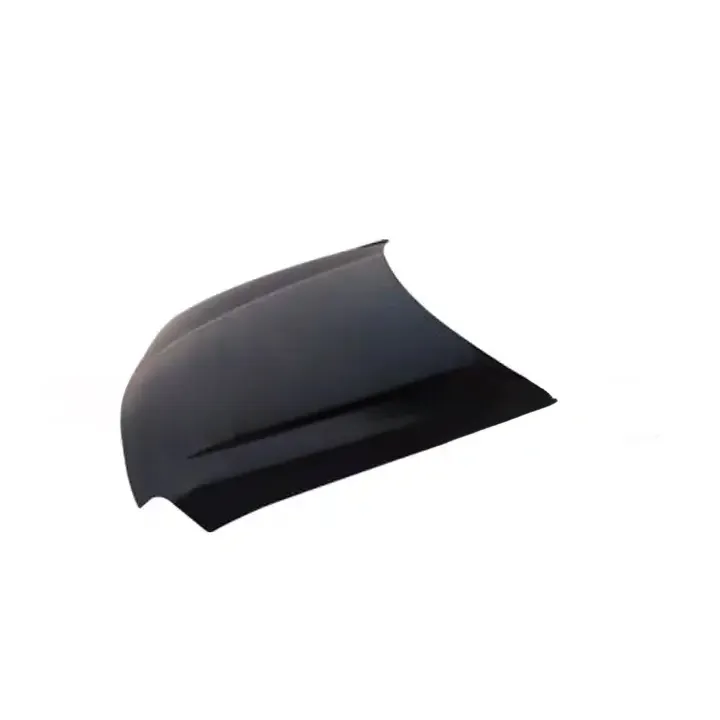
1. Traditional Internal Combustion Vehicles
- Economy Cars: Progressive molds achieve 12 parts/minute with DC06 deep-draw steel, yielding 500k parts/year;
- Luxury Models: Modular molds enable dual-tone hoods (e.g., Mercedes S-Class chrome trim) with Class-A surface finish.
2. New Energy Vehicle Innovations
- Lightweight Solutions: Tesla Model Y’s 7000-series aluminum molds + hot stamping (400°C) form complex rib structures;
- Integrated Design: NIO ET5’s hood-LiDAR housing integration reduces 20 assembly interfaces.
3. Specialty Vehicles and Aftermarket
- Carbon Fiber Customization: Matched-mold compression molds produce Lamborghini Aventador prepreg hoods (cured at 130°C);
- Functional Upgrades: Off-road vehicle molds with precision-cooling grilles (±0.3 mm accuracy) enhance engine cooling.
4. Aftermarket and Remanufacturing
- Rapid Repair Molds: 3D-printed nickel alloy molds (0.1 mm accuracy) for low-volume replacements;
- Mold Regeneration: Laser-clad repairs (0.2–0.5 mm thickness) extend lifespan by 30%.
Conclusion
From steam-powered hammering to 5-axis machining, the evolution of engine hood molds mirrors modern manufacturing’s journey. Amidst the automotive industry’s century-long transformation, this craft—melding materials science, mechanical engineering, and digital intelligence—will continue redefining physical limits, endowing vehicles with elegance and efficiency. Each mold born from the factory’s roar echoes humanity’s relentless pursuit of perfection.