
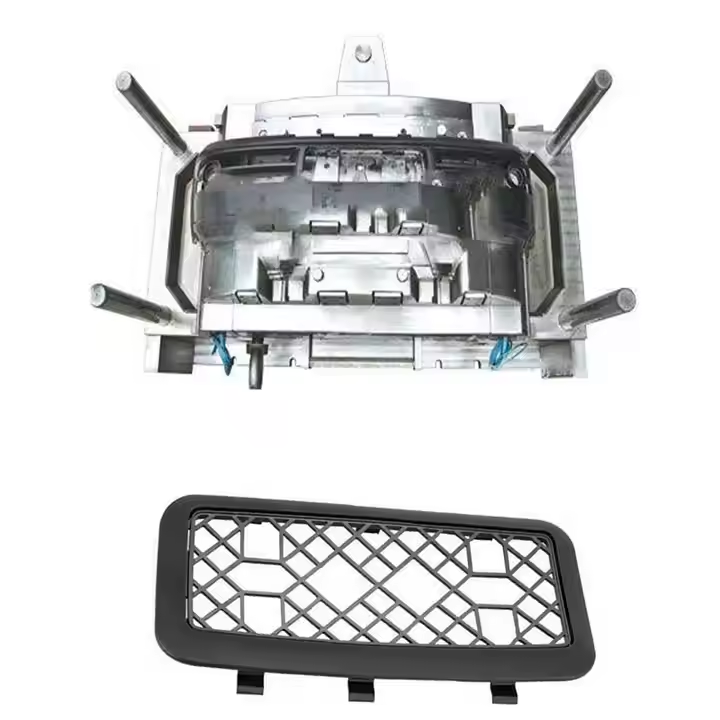
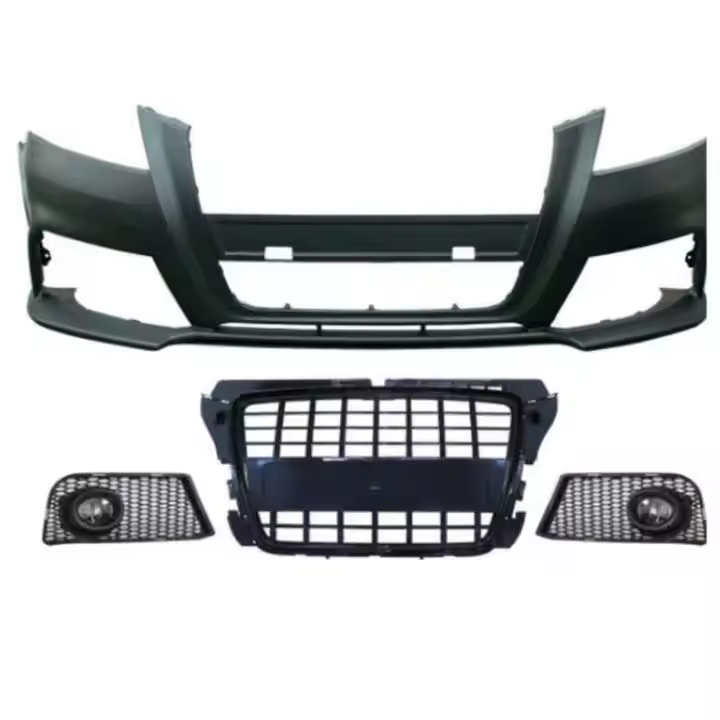
Automotive grilles, as a core component of a vehicle’s front fascia, serve not only as a critical element in aerodynamic design but also as a canvas for brand aesthetics. As the formative carrier of these critical components, automotive grille molds manufacturing technology directly determines product precision, efficiency, and aesthetic performance.With the rise of electric vehicles (EVs) and the proliferation of autonomous driving technologies, the functionality of grilles has expanded beyond traditional ventilation and heat dissipation to include sensor integration, active aerodynamic adjustments, and more. This evolution demands higher standards for mold manufacturing—balancing complex aesthetics, precise structural design, and efficient production. This article delves into the design principles, material selection, manufacturing processes, and industry trends shaping automotive grille molds.
Core Design Logic of automotive grille molds
Automotive grille molds design must harmonize functionality, manufacturability, and cost-effectiveness. While traditional grilles for internal combustion engine (ICE) vehicles featured horizontal or vertical slats, modern designs increasingly adopt parametric patterns, 3D honeycomb structures, and intricate geometries. These innovations challenge mold design in terms of parting line placement, draft angles, and demolding efficiency.
- Topology Optimization and Parting Line Design
The positioning of parting lines directly impacts product aesthetics and demolding efficiency. Finite Element Analysis (FEA) is used to simulate resin flow during injection molding, preventing issues like incomplete filling or stress concentration. For instance, a German automaker employs hidden parting line technology, placing parting surfaces on the grille’s rear side to achieve seamless surfaces and reduce post-processing costs. - Innovative Cooling Systems
Cooling efficiency dictates production cycle times. Conformal cooling channels, enabled by 3D printing, align with the product’s geometry to reduce cooling time by over 30%. Tesla’s Model Y integrated grille mold utilizes this technology, achieving a production rate of 2.8 parts per minute. - Precision Ejection Mechanisms
Thin-walled and deep-cavity grille designs require multi-stage ejection systems. Japanese manufacturers have developed gas-assisted ejection technology, embedding micro-pneumatic valves in ejector pins to minimize deformation, boosting yield rates to 99.2%.
Design Innovations and Key Technologies in automotive grille molds
Steel molds continue to advance in parting design, cooling systems, and surface treatments to address complex grille structures.
1. Invisible Parting Lines and Multi-Slider Systems
- Hidden Parting Design: Placing main parting lines on the grille’s rear side with hydraulic sliders ensures seamless front surfaces. Volkswagen’s ID. series grille mold uses seven synchronized hydraulic sliders to achieve 0.05 mm alignment precision and 6-second demolding.
- Micro-Hook Solutions: Tungsten carbide inserts (HRA 90) combined with pneumatic ejectors prevent thin-wall damage in 0.8 mm radar apertures. Toyota’s bZ4X grille mold reduced defect rates from 5% to 0.3% using this approach.
2. Gradient Cooling System Optimization
- Hybrid Cooling Channels: Beryllium copper inserts (thermal conductivity: 210 W/m·K) and 3D-printed conformal cooling boost efficiency by 40%. Tesla’s Cybertruck grille mold cut cycle times from 55s to 32s with this method.
- Smart Temperature Control: Embedded sensors and PID algorithms regulate coolant flow, maintaining cavity temperature within ±2°C to eliminate weld lines.
3. Surface Enhancement Breakthroughs
- Nano-Composite Coating (NCC): TiAlN+CrN multilayer coatings (8–10 μm thick, 3500 HV hardness) on S7 tool steel reduce demolding force by 28% for mineral-filled PP. BMW’s i7 Automotive Grille Molds leverages this technology.
- Micro-Arc Oxidation (MAO): A 20–30 μm ceramic layer on H13 steel via MAO improves corrosion resistance 5-fold, ideal for high-humidity markets like Southeast Asia.
Smart Manufacturing Empowers automotive grille molds Production
Digitalization and intelligence are reshaping steel mold fabrication:
- AI-Driven Process Planning:
Machine learning optimizes cutting parameters, boosting deep-cavity machining efficiency by 25% and reducing tool wear by 18% (Makino’s AI system). - Five-Axis Precision Machining:
Rotary five-axis machines (e.g., DMG MORI HSC 75) with ball-nose cutter compensation achieve ±0.005 mm contour accuracy for diamond-faceted grilles, as seen in XPeng’s G9 mold. - Real-Time Inspection and Correction:
Hexagon’s blue-light scanners compare machined surfaces with CAD models, enabling automatic compensations. A leading mold manufacturer reduced trial runs from 4 to 1 and slashed development cycles by 30%.
Conclusion
In the automotive industry’s transformative era, automotive grille molds remain irreplaceable, driven by precision machining, smart cooling, and surface innovations. From AI-powered process optimization to eco-friendly material upgrades, steel molds continue to set industry benchmarks. To meet electrification, miniaturization, and sustainability challenges, manufacturers must embrace material science breakthroughs and digital tools, ensuring steel molds remain at the forefront of automotive design excellence.