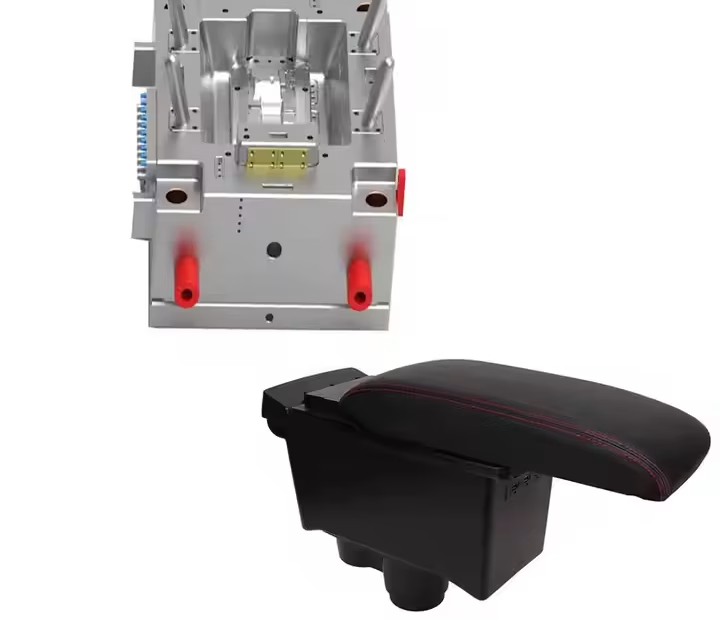
In the ongoing evolution of automotive interior systems, armrests have transitioned from purely functional components to complex engineering systems that serve as critical human-machine interfaces. Driven by the integration of advanced materials and intelligent manufacturing, automotive armrest molds technology is undergoing comprehensive innovation—from precision control to full lifecycle management. This article systematically examines current industry advancements through three dimensions: design philosophy, manufacturing processes, and quality control.
Paradigm Shifts in Design Philosophy
Data-Driven Ergonomics
Modern automotive armrest molds design has established a closed-loop system integrating physiological data, simulation validation, and structural optimization:
- 3D dynamic capture technology: High-precision pressure sensing systems (resolution: 0.1 N/cm²) capture elbow force distribution to construct mathematical models of support surfaces (curvature radius R = 80–100 mm) compatible with 90% of the population.
- Fatigue life prediction: Finite element analysis software simulates 200,000 opening/closing cycles to ensure hinge mechanism displacement ≤0.25 mm (ISO 2376 standard).
Modular Architecture Innovations
To accommodate platform-based vehicle strategies, mold design trends include:
- Reconfigurable mold systems: Standardized mold bases (dimensional tolerance ±0.02 mm) combined with quick-change insert technology enable single molds to produce over six armrest variants, with changeover times reduced to under two hours.
- Multi-material integration: For metal-plastic hybrid structures, partitioned temperature control systems (temperature differential ±15°C) ensure insert molding bond strength ≥12 MPa (ISO 19095 standard).
Lightweighting Breakthroughs
Synergistic material and structural optimization achieves dual objectives of weight reduction and reinforcement:
- Microcellular foaming: Nitrogen-assisted foaming in glass fiber-reinforced engineering plastics (30%–40% fiber content) reduces part density by 15%–20%, requiring precision gas injection systems (pressure control accuracy ±0.3 MPa).
- Topology optimization: AI-generated rib layouts enable wall thickness reduction to 1.8 mm while maintaining flexural strength of 180 MPa (ASTM D790 standard).
Technological Advances in Manufacturing Processes of Automotive Armrest Molds
High-Precision Machining Systems
- Five-axis machining: High-dynamic machining centers with spindle speeds ≥20,000 rpm, coupled with tool radius compensation algorithms, achieve cavity surface roughness Ra ≤0.4 μm.
- Nanoscale surface texturing: Mixed-powder EDM technology etches textures (depth: 0.05–0.15 mm) onto mold steel with ≥97% replication accuracy.
Specialized Molding Processes
Dual-Material Temperature Synchronization
For soft/hard material combinations, molds employ dual-medium temperature control:
- Rigid zones: 100–120°C (oil-circulation heating)
- Soft zones: 20–30°C (semiconductor cooling)
This enhances interfacial bond strength to 15 MPa, a 25% improvement over conventional methods.
Gas-Assisted Injection Precision
Integrated multi-stage gas pressure control in large automotive armrest molds:
- Main channel pressure: 25–35 MPa (±0.5 MPa)
- Auxiliary channel pressure: 8–12 MPa (±0.2 MPa)
Real-time sensor feedback reduces sink marks to ≤0.03 mm/m².
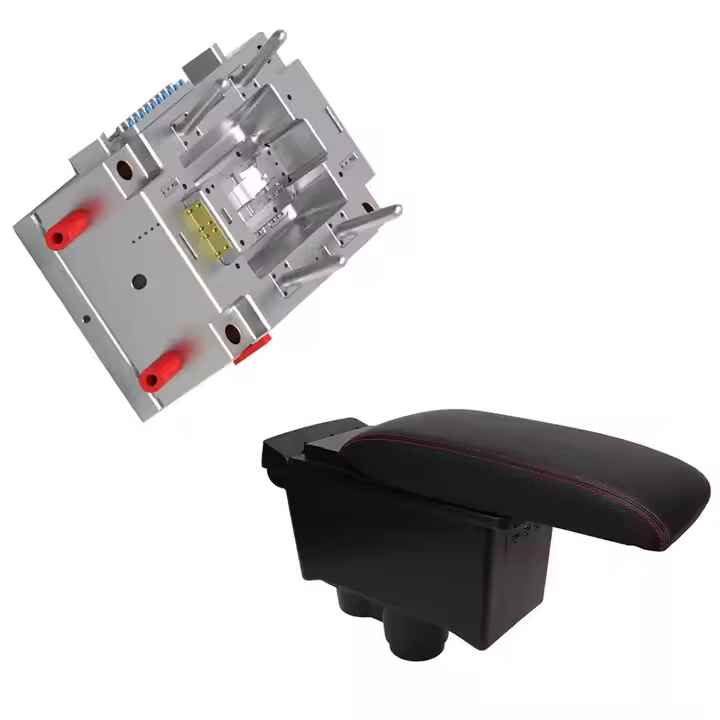
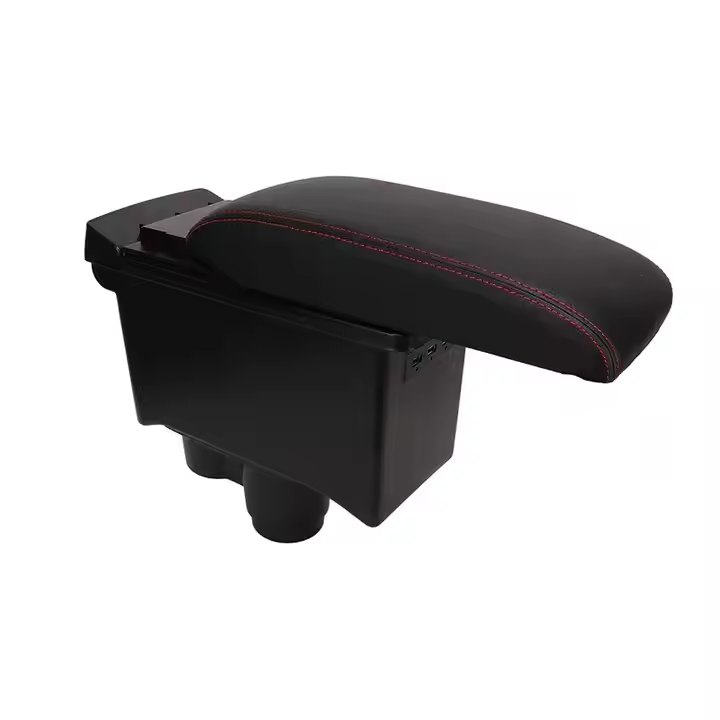
Systemic Reconfiguration for Sustainable Manufacturing of automotive armrest molds
Full-Lifecycle Carbon Management
- Bio-based mold steels: LDC-12 steel derived from lignin reduces lifecycle carbon emissions by 63% versus conventional materials.
- Dynamic energy optimization: Real-time adjustment of clamping force and injection speed based on power curves limits energy fluctuations to ±1.5%.
Closed-Loop Material Flow
- Chemical depolymerization: Catalytic cracking reclaims monomers from recycled armrests, maintaining ≥89% performance in reprocessed material.
- Modular disassembly: Mortise-tenon interfaces enable 18-minute component replacement with 97% material reuse efficiency.
Quality Control Innovations
Digital Inspection Systems
- In-line optical measurement: Blue-light scanning (accuracy ±0.015 mm) performs 100% parting surface inspection, with critical dimension CPK ≥1.67.
- X-ray nondestructive testing: Detects metal insert porosity (≤0.2% per standards) with flaw sensitivity down to 0.05 mm³.
Intelligent Process Control
- IoT monitoring: Embedded pressure, temperature, and displacement sensors (sampling rate ≥1 kHz) enable real-time mold state tracking and automatic process compensation.
- Self-healing coatings: Ultra-hard coatings (microhardness ≥HV1500) maintain stable friction coefficients under high temperatures, extending mold life to >1.2 million cycles.
Conclusion
The transformation of automotive armrest molds technology reflects a convergence of digital innovation, material science breakthroughs, and ecological responsibility. As autonomous vehicles and shared mobility redefine cabin design priorities, automotive armrest molds must evolve to enable mass-customized, multifunctional armrests with near-zero defect rates. Over the next decade, the integration of quantum computing for molecular-scale simulations and 4D-printed adaptive molds will likely establish new benchmarks in precision and sustainability. For manufacturers, investing in these technological frontiers is no longer optional—it is imperative to lead in an era where interior craftsmanship defines brand value.
>>You may also like
Standards & References
The following industry standards are referenced in this article: