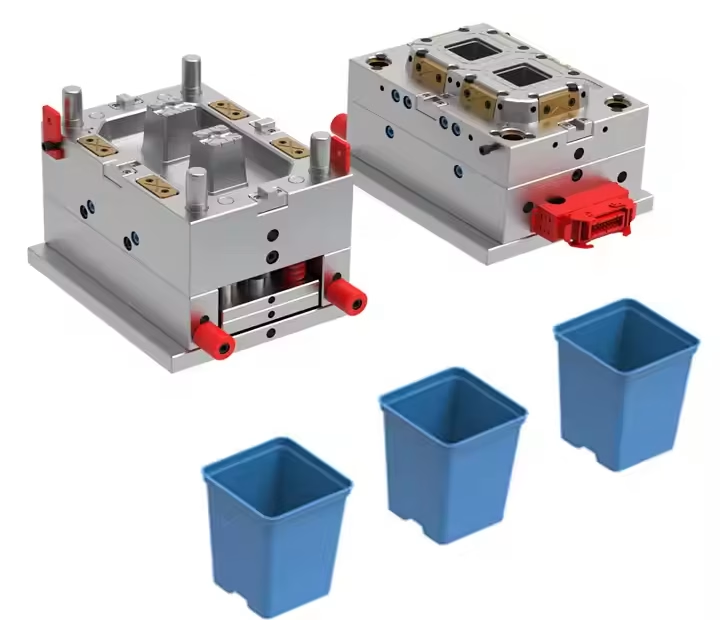
As a core tool in horticultural equipment production, the material selection and manufacturing processes of flower pot molds directly determine product precision, service life, and production efficiency. Steel, with its superior mechanical properties and machining adaptability, has become the primary material for manufacturing high-precision, large-batch flower pot molds. This article systematically analyzes the technical principles and development trends of steel flower pot molds from the perspectives of material characteristics, machining processes, and innovative design.
Material Properties and Selection of Flower Pot Molds
The dominance of steel in flower pot molds manufacturing stems from its comprehensive performance advantages:
- Mechanical Performance Advantages
- High Hardness (HRC 48-55): Ensures resistance to wear during prolonged injection molding or die-casting processes, particularly suitable for molding thermoplastic materials (e.g., PP, ABS) reinforced with glass fibers.
- Thermal Stability (Coefficient of Thermal Expansion: 11.5×10⁻⁶/℃): Maintains dimensional stability at operating temperatures of 150–300°C, minimizing deformation caused by thermal stress.
- Compressive Strength (≥2000 MPa): Meets the ejection force requirements for deep-cavity pot structures, reducing the risk of mold cracking.
- Common Types of Mold Steel
- Pre-Hardened Steel (e.g., P20): Pre-hardened to HRC 30-36, ideal for small-to-medium batch production of structurally simple molds, allowing direct precision machining.
- Heat-Treatable Steel (e.g., H13): Achieves HRC 48-52 through vacuum quenching and secondary tempering, especially suited for molds with relief textures or intricate details.
- Corrosion-Resistant Steel (e.g., 420SS): Contains 13% chromium for rust prevention in humid environments, extending mold lifespan for outdoor pots.
- Material Selection Guidelines
A decision matrix based on pot complexity, production volume, and surface treatment requirements:- Simple geometries (cylindrical/square) & <100k cycles: P20 steel offers optimal cost efficiency.
- Curved parting lines or relief-patterned designs: H13 steel provides balanced performance.
- Electroplating/nitriding requirements: High-purity mirror-polish steel (e.g., S136) is preferred.
Precision Manufacturing Processes for Flower Pot Molds
Modern flower pot molds manufacturing involves five core technical stages:
- CNC Machining Technology
- 5-Axis Machining: Enables high-precision cutting of complex curved parting surfaces, such as 0.1mm-resolution relief patterns (surface roughness Ra ≤0.8μm).
- High-Speed Milling (HSM): Utilizes 20,000 rpm spindles and 0.05mm stepovers to machine ribs >50mm deep in H13 steel, maintaining ±0.01mm dimensional tolerance.
- Electrical Discharge Machining (EDM)
- Copper-tungsten electrodes paired with CNC EDM machines create micro-vent holes (Φ0.3–0.5mm) in steel >HRC 60, achieving ±0.005mm positional accuracy.
- Powder-mixed EDM generates a 10–30μm hardened surface layer (microhardness HV1200), tripling the lifespan of molds with threaded or embossed structures.
- Heat Treatment Processes
- Vacuum High-Pressure Gas Quenching: Austempering H13 steel at 1020°C under 2–5bar nitrogen prevents surface decarburization, ensuring hardness uniformity (deviation ≤HRC 1).
- Cryogenic Treatment: 24-hour exposure to -196°C liquid nitrogen converts residual austenite to martensite, improving dimensional stability by 40%.
- Surface Enhancement Technologies
- Physical Vapor Deposition (PVD): Coating molds with TiAlN (2–4μm thick) reduces friction coefficient to 0.3, lowering ejection force for glass-fiber-reinforced plastics by 25%.
- Laser Cladding: Deposits 1.2mm-thick Stellite alloy layers on wear-prone areas using 3kW fiber lasers, ideal for producing textured-surface pots with relief details.
- Assembly and Debugging
- Blue-light 3D scanners verify core-cavity clearance (<0.02mm), preventing plastic flash.
- Moldflow simulation optimizes cooling channel layouts, reducing temperature gradients to ±3°C and shortening cycle times by 15–20%.
Innovative Design Directions for Flower Pot Molds
- Modular Structure Design
- Insert Systems: Embed H13-carved relief-patterned inserts into P20 steel main molds to produce multiple pot designs, minimizing retooling costs.
- Conformal Cooling Channels: 3D-printed topology-optimized cooling cores improve cooling efficiency for deep-cavity pots by 35%.
- Microstructure Functional Design
- 20–50μm micro-groove arrays on mold surfaces create superhydrophobic pots (contact angle >150°), reducing dirt adhesion.
- Honeycomb reinforcement ribs (0.6–1.2mm wall thickness) reduce pot weight by 30% while maintaining strength.
- Smart Integration
- Pressure/temperature sensors integrated into mold bases monitor cavity pressure (±0.5MPa accuracy), auto-compensating for resin shrinkage.
- Quick-change systems with hydraulic clamping and standardized interfaces enable full mold replacement in <8 minutes.

Quality Control and Maintenance Systems
- Inspection Standards
- Dimensional Verification: CMM scans ensure cavity contour accuracy ≤IT7 grade.
- Fatigue Testing: Simulate 500k mold cycles to measure guide pillar/bushing wear (<0.03mm clearance change).
- Maintenance Strategies
- Ultrasonic cleaning (28kHz) removes carbonized residues from cavities.
- Pulse electrochemical polishing is used to repair micro cracks on the mold surface and restore the mirror effect of Ra≤0.4μm.
Conclusion
The evolution of flower pot molds technology reflects the integration of materials science, precision machining, and intelligent control. With advancements in high-hardness alloys and additive manufacturing, future molds will achieve extended lifespans and higher integration levels. By continually refining manufacturing processes, steel molds will not only meet diverse production demands but also drive the horticultural equipment industry toward greater efficiency, precision, and sustainability.
>>You may also like
Standards & References
The following industry standards are referenced in this article: