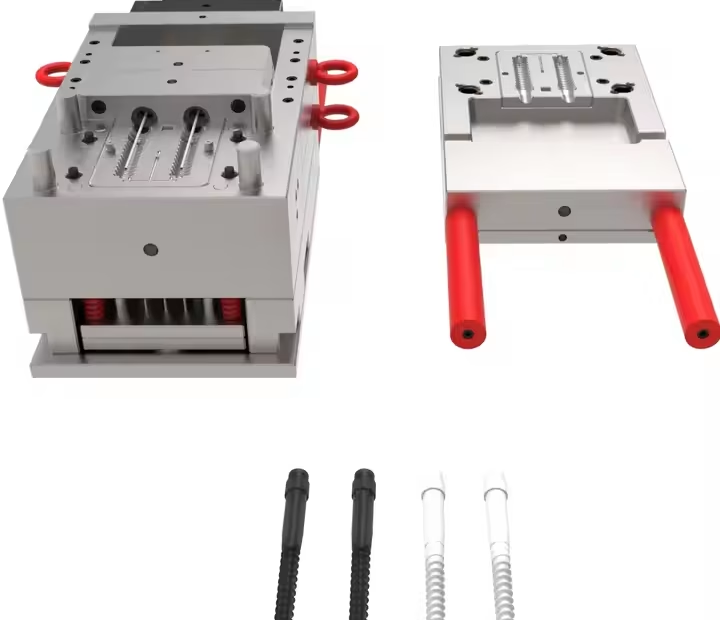
With the rapid development of rail transportation, rail clips – as essential connecting components in track systems – have their operational safety directly influenced by manufacturing precision. Rail clip molds, serving as core equipment for mass production, bear dual missions of technological innovation and quality control. This article provides an in-depth analysis of the technical characteristics, manufacturing processes, and industrial applications of rail clip molds.
Functional Positioning of Rail Clip Molds
Rail clip molds are specialized tools for stamping and forming rail clip components, primarily fulfilling:
- Precision Forming: Controlling geometric dimensions within ±0.02mm tolerance through cavity design
- High-Speed Production: Achieving 200-500 pieces/hour output with single mold set
- Structural Enhancement: Improving mechanical properties via cold working hardening
Typical applications include high-speed rail fastening systems, metro sleeper fixation devices, and heavy-haul railway specialized clamps.
Structural Design of Rail clip molds
- Split-type Mold Architecture
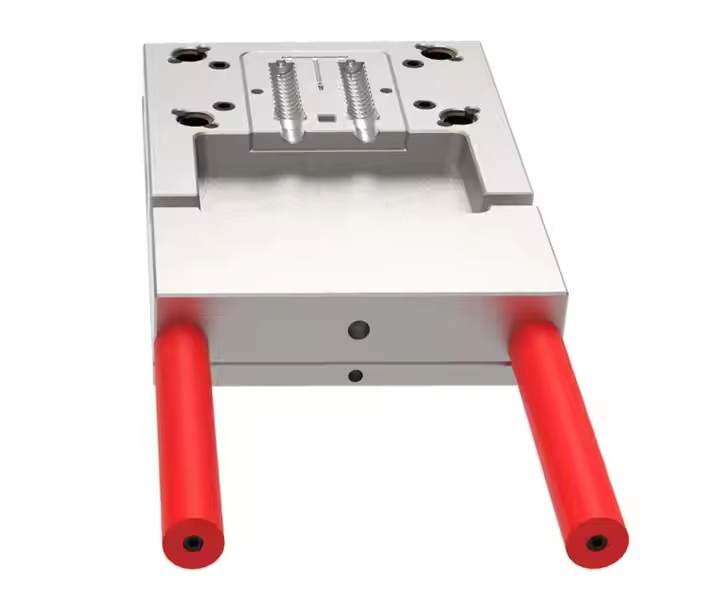
Modern Rail clip molds typically adopt a split structure with upper and lower metal molds, aligned via sliding grooves and positioning holes. For instance, a patented design uses sliding grooves to form casting channels and positioning pins for assembly, achieving molding precision while enabling disassembly for maintenance. This design replaces traditional single-use sand molds, increasing reusability by over 80%. - Multi-directional Slider System
Complex rail clamp geometries require multi-slider systems for demolding. Drawing from earphone clamp mold designs, which use seven sliders and angled ejectors, rail clamp molds integrate lateral sliders to handle irregular rail head and waist profiles. Hydraulic or gear-driven mechanisms ensure synchronized slider movement, as seen in rail fixture designs with roller-claw coordination for smooth rail movement . - Gating and Venting System Optimization
Casting channels must ensure uniform metal flow. Web 1 proposes a gating plug and vent design (with vent holes on the upper mold) to reduce gas entrapment. Intelligent sensors, such as those in Web 5’s smart rail clamp plates, now monitor real-time pressure and temperature during casting.

Material Selection and Performance Enhancement
- Mold Base Materials
Traditional tool steels (e.g., Cr12MoV) face limitations in weight and machining cycles. Current trends favor lightweight composites:
- Metal Matrix Composites: Aluminum-silicon carbide (Al-SiC) offers high thermal conductivity and low expansion, ideal for high-temperature casting.
- Carbon Fiber Reinforced Polymers (CFRP): With 5x the specific strength of steel, CFRP molds reduce weight by 30% through honeycomb core designs .
- Surface Treatment Technologies
Plasma-sprayed WC-Co coatings achieve HRC 65 hardness, tripling wear resistance. Titanium nitride (TiN) coatings, noted in Web 9, reduce friction coefficients below 0.2.
Key Breakthroughs in Manufacturing Processes of Rail clip molds
- Precision Machining
- 5-Axis Machining: Controls rail head curvature errors within ±0.02 mm.
- Electrical Discharge Machining (EDM): Processes deep grooves and complex holes, such as hydraulic cylinder linkage slots.
- Intelligent Assembly
Automated production lines integrate visual alignment systems for positioning pins and sliders, boosting assembly efficiency by 40%.
Technical Challenges and Solutions
Structural Fatigue Under Multi-directional Stresses
Finite Element Analysis (FEA) optimizes stress concentration zones. Web 3 highlights rib reinforcement at slider roots, extending mold life by 50%.
Synchronized Demolding Mechanisms
Gear transmission systems and hydraulic synchronization, as in Web 2’s rail fixtures, ensure precise timing for multi-slider actions2.
Conclusion
The technological evolution of rail clamp molds underscores the relentless pursuit of precision and sustainability in modern manufacturing. From split metal architectures to intelligent smart composite systems, innovation remains anchored in efficiency enhancement, energy consumption reduction, and full lifecycle optimization. As digital twins, additive manufacturing, and smart sensing technologies converge, mold design is transcending physical limitations to shift from “experience-driven” to “data-driven” paradigms. Looking ahead, the integration of modular design principles, self-healing coatings, and bio-based materials will accelerate progress toward zero-defect manufacturing and carbon neutrality goals. These advancements will serve as foundational pillars for sustainable development in global rail transit networks, where cutting-edge mold technology continues to redefine engineering excellence while aligning with planetary ecological imperatives.