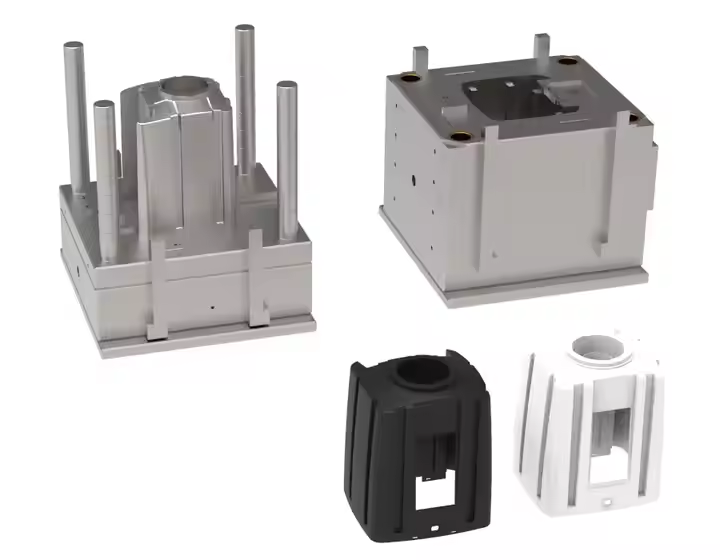
Under the dual drivers of drinking water safety demands and the smart home revolution, water dispenser shell molds have become a focal area for technological innovation in manufacturing. As critical connectors between industrial design and end products, the precision, material performance, and manufacturing processes of molds directly determine the durability, safety, and aesthetic value of water dispensers. The global water dispenser mold market is projected to exceed ¥20 billion by 2025, with high-precision injection molds accounting for 65%
Material Characteristics and Selection Logic
Steel selection determines mold lifespan, product precision, and production costs. Three dominant steel categories define current technical pathways:
1. Pre-Hardened Mold Steels: Balancing Efficiency and Cost
Pre-hardened steels like P20 (HRC 28-35) dominate mass production due to their heat treatment-free properties:
- P20 Steel: With 0.32%-0.40% carbon content and pre-hardened hardness of HB 290-330, it is ideal for household appliances like TV casings and vacuum cleaners. Its mirror polishing capability (Ra ≤0.8 μm) meets food-grade surface requirements.
- 2738 Steel: Nickel-enhanced toughness ensures ΔE color difference <2 after 2,000 hours of QUV aging tests, making it suitable for commercial dispensers in harsh environments. A case study showed a 1.5 million-cycle lifespan in airport water dispenser projects.
2. Corrosion-Resistant Stainless Steels: Solutions for Medical and Specialty Scenarios
S136 (HRC 52-54) and NAK80 (pre-hardened HRC 40-43) excel in extreme conditions:
- S136: Chromium-rich (16%) mirror-grade steel resists PVC corrosion 3× better than standard steels. A hospital ICU mold reduced surface bacterial colonies by 99%.
- NAK80: Precipitation-hardened steel achieves 0.005 mm dimensional stability through nano-level Cu-Ni-Al precipitates, perfect for precision touch modules in smart dispensers.
3. High-Temperature Alloy Steels: Enabling Instant Heating Technology
H13 (HRC 48-52) retains 80% strength at 600°C, overcoming thermal deformation challenges. A 2000W rapid-heating mold using H13 showed <0.03% deformation at 250°C
Intelligent Manufacturing Innovations of Water Dispenser shell Molds
Digital advancements in steel processing are reshaping production paradigms:
1. Precision Injection Molding Systems
- Inverted Hot Runner Design: Internal gates eliminate surface weld lines. A P20 steel mold case reduced weld marks from 1.2 mm to 0.2 mm, boosting appearance pass rates to 98%.
- Multi-Directional Demolding: 2738 steel molds achieved 11 mm demolding within 30 seconds/cycle, improving efficiency by 40%.
2. Digital Twin Technology
PRO/E Wildfire modeling and Moldflow analysis predict stress concentrations:
- A NAK80 mold optimized cooling channels to control temperature variance within ±1.5°C, reducing warpage to 0.08 mm/m.
- AI algorithms generate fiber-reinforced steel layering plans, increasing bending stiffness by 18% while cutting material costs by 12%.
3. Green Manufacturing Breakthroughs
- Chemical depolymerization achieves 85% scrap steel recovery, reducing carbon emissions from 2.1 to 1.3 tons per ton of molds.
- Bio-based coatings lower VOC emissions to ≤0.01 mg/m³ in P20 molds, passing FDA food-contact certifications.

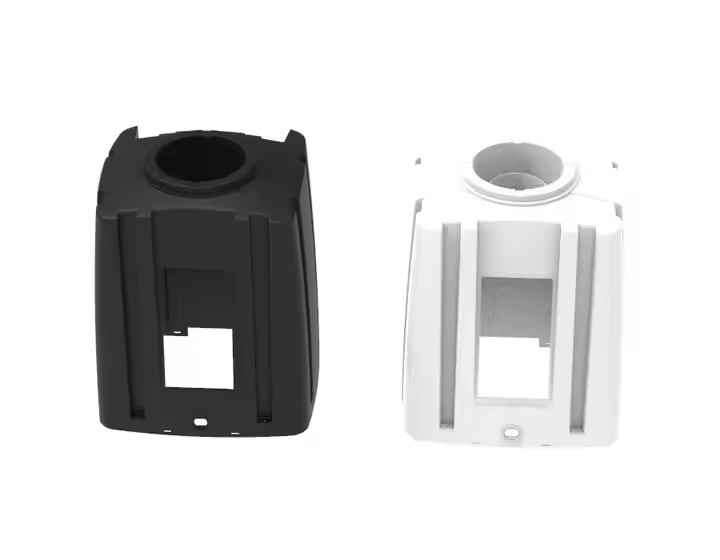
Market Application of Water Dispenser shell Molds
Steel’s performance advantages drive technological transformations across three key sectors:
1. Smart Home Integration
- Ultra-Thin Designs: NAK80-based 3 mm wall molds compress device depth to 18 cm for seamless kitchen integration.
- Touchscreen Integration: S136 steel enables 0.1 mm precision touchscreen embedding with 8 ms response times.
2. Commercial Specialization
- Lightweight Engineering: Topology-optimized 2738 steel molds reduce weight by 35% while maintaining 1.2 MPa compressive strength for high-frequency public dispensers.
- Modular Quick-Change Systems: Filter cartridge replacement time drops to 8 seconds, lowering maintenance costs by 60%.
3. Medical/Industrial Customization
- Explosion-Proof Structures: H13 molds withstand 1.8x pressure tests for oilfield applications.
- Antimicrobial Solutions: S136 modifications achieve <0.01% E. coli survival rates, complying with ISO 13485 medical certification.
Conclusion
From P20’s pre-hardening revolution to S136’s mirror-grade precision, steel is redefining the technological boundaries of water Dispenser shell Molds. Under the dual drivers of intelligent manufacturing and green development, next-gen steel molds transcend functional roles to become guardians of water safety and user experience. As 0.01 μm surface precision meets 800°C thermal resilience, and blockchain traceability converges with self-healing materials, this evolution rooted in steel will propel humanity toward safer, smarter hydration.
>>You may also like
Standards & References
The following industry standards are referenced in this article: